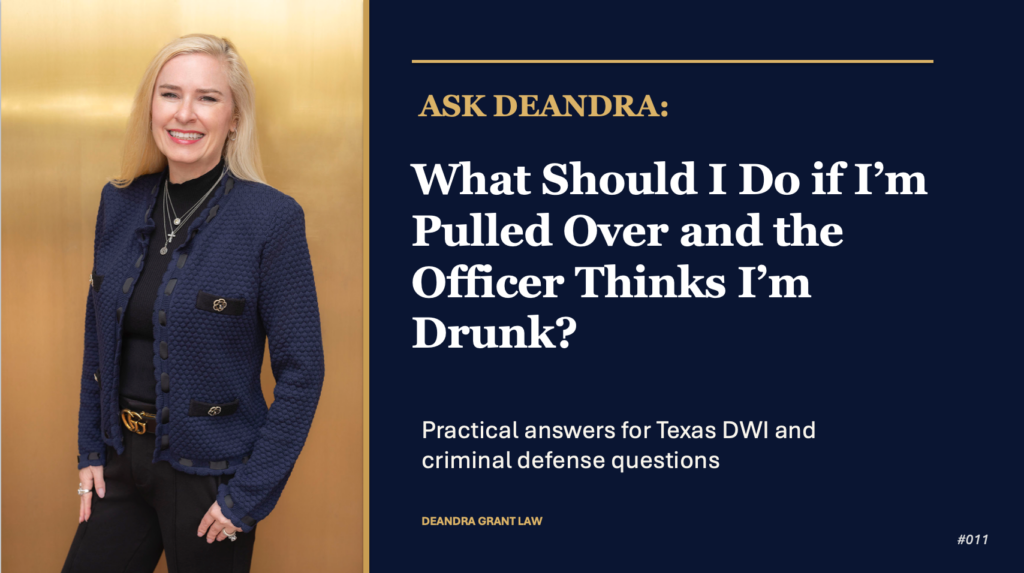
The question: What should I do if I’m pulled over and the officer thinks I’m drunk?
The short answer: Be polite. Pull over safely. Provide your driver’s license, registration, and insurance when asked (required). But understand that you are not required to answer questions about whether you’ve been drinking, where you’ve been, or how much you’ve had. You are not required to perform field sobriety tests. You are not required to consent to a roadside breath test. What you say and do at the side of the road shapes the rest of the case. The single most important thing you can do is stay calm, stay quiet about anything beyond identification, and let your lawyer fight the case from a clean record.
Here is the longer answer: what the officer is doing, what your obligations actually are, and what every Texas driver should know before the stop ever happens.
What the Officer Is Doing
From the moment the lights come on, the officer is building a case. Every observation, every word you say, every movement you make is being noted, and in most stops it is being recorded on a body-worn camera and an in-car camera. The officer is looking for facts to support reasonable suspicion that you committed a traffic offense, probable cause to investigate further, and ultimately probable cause to arrest you for DWI under Penal Code §49.04.
The officer is trained to look for specific signs: bloodshot eyes, slurred speech, the odor of alcohol, fumbling for documents, statements that suggest recent drinking. Some of these signs are real. Many of them have innocent explanations such as fatigue, allergies, contact lenses, illness, anxiety or a recent meal. The officer’s job in the moment is not to evaluate the innocent explanations. The officer’s job is to gather evidence.
Knowing this changes how you handle the stop. You are not in a conversation. You are in an evidence-gathering encounter. Treat it that way.
Pull Over Safely
When you see lights behind you, signal, slow down, and pull over to the right shoulder as soon as it is safe. If you are on a highway and the right shoulder is unsafe, take the next exit or pull into a well-lit lot. Use your turn signal. Do not slam on the brakes, do not swerve, and do not stop in the middle of a lane of traffic.
How you pull over is the first piece of evidence the officer collects. A smooth, controlled stop in a reasonable and safe location helps you. An erratic, delayed, or panicked stop hurts you. Officers note these things in the offense report and they are often visible on dashcam video that the defense will eventually request.
What You Have to Provide
Texas Transportation Code §521.025 requires a driver to display the driver’s license on demand of a peace officer. You also have to provide proof of insurance and, if requested, your vehicle registration. These are obligations. Refusing to identify yourself or refusing to produce these documents is itself a basis for arrest.
So when the officer asks for your license and insurance, hand them over. Do it calmly. Keep your hands visible. If you need to reach into the glove box or center console, tell the officer what you’re doing before you do it: “My registration is in the glove box. May I reach for it?” This is basic safety for both of you, and it eliminates a category of misunderstanding that escalates traffic stops unnecessarily.
What You Don’t Have to Provide
Beyond identification and required documents, you do not have to volunteer information. Specifically, you do not have to:
- Answer questions about whether you’ve been drinking. Polite, accurate refusal: “Officer, I’d prefer not to answer questions without a lawyer.” Or simply, “I’d rather not say.” You are not required to admit to anything, and the officer’s assurance that “honesty will help you” is not a guarantee. It is an interrogation technique.
- Answer questions about where you’ve been or where you’re going. These questions are not casual conversation. They are designed to elicit admissions about timing, location, and consumption that will appear in the offense report and on video.
- Answer questions about how much you’ve had to drink. “I had a couple of beers” and “I had two glasses of wine with dinner” are the two most common admissions in Texas DWI cases. They are also the two admissions that show up most often in trial transcripts.
- Perform field sobriety tests. Standardized Field Sobriety Tests (the walk-and-turn, the one-leg stand, and the horizontal gaze nystagmus test) are voluntary in Texas. The officer is not going to tell you that. Polite refusal: “Officer, I respectfully decline.”
- Submit to a roadside portable breath test (PBT). PBTs are not the same as the Intoxilyzer 9000 used at the station. They are screening devices, not evidentiary instruments, and the test is voluntary at the roadside. You do not have to blow into one.
Knowing your rights is one thing. Exercising them politely and calmly is another. Both matter.
How to Decline Without Escalating
The most common mistake people make at a DWI stop is escalating the encounter when they refuse. You do not have to argue. You do not have to explain. You do not have to convince the officer that they’re wrong. You can decline politely and consistently:
- “Officer, I’d prefer not to answer questions without a lawyer.”
- “I respectfully decline to perform any tests.”
- “Am I free to leave?”
- “Am I being detained?”
If the officer says you are free to leave, leave. Calmly, courteously, without further conversation. If the officer says you are being detained, you do not have to answer questions but you should comply with lawful commands (step out of the vehicle, stand here, place your hands on the car). You can comply without speaking, and you can decline to perform tests without resisting.
Politeness is not weakness. A defendant who handled the stop calmly, declined tests respectfully, and provided only what the law required is a defendant whose video looks good in front of a jury. A defendant who argued, shouted, or tried to talk their way out of the situation is a defendant whose video does not.
If the Officer Asks You to Step Out of the Vehicle
Under Pennsylvania v. Mimms, 434 U.S. 106 (1977), an officer can lawfully order you out of the vehicle during a traffic stop. Comply. Stepping out is not the same as consenting to tests, answering questions, or admitting anything. Step out, follow lawful commands, and continue to decline questions and tests politely.
Once you are out of the car, the officer may ask you to perform field sobriety tests. As discussed above, these are voluntary in Texas. Decline politely and consistently. The officer may then conduct other investigative steps (visual observation, conversation, requests for the PBT) each of which you can decline. At some point the officer will either let you go or arrest you.
If You Are Arrested
If the officer decides to arrest you, you will be placed in handcuffs, transported to the station, and the formal DWI investigation will continue under different rules. At the station:
- You will be read the DIC-24 statutory warning. This is the warning required before a request for breath or blood specimen. It explains the consequences of refusing or consenting to the test. Listen carefully even if you don’t understand every word.
- You will be asked to provide a breath or blood sample. This is a separate decision from anything that happened at the roadside. The decision and its consequences are addressed in detail in our breath-test refusal post.
- You should request to speak with an attorney. Note that Texas does not provide a categorical right to consult counsel before a breath or blood decision.
- You should still decline to answer substantive questions. Anything you say at the station can be used against you. Provide your name and identifying information. Decline questions about drinking, driving, and where you’ve been until you have a lawyer.
After the Stop — Whether or Not You Are Arrested
If you are released without arrest, write down everything you can remember while it is fresh: time, location, officer’s name, what was said, what tests were requested, what you declined. If you are arrested and released later, do the same as soon as possible. Memory fades, and contemporaneous notes are often the foundation of a good defense.
Whether arrested or released, the next step is the same: call a DWI defense lawyer with forensic training. The attorney can request video and reports while they are still being preserved, evaluate any administrative license consequences, and start building the file before the State does.
Things You Should Never Do at a DWI Stop
A short list of mistakes that turn defensible cases into harder ones:
- Do not lie. If you are not going to answer, do not answer. But never give the officer a false statement. False statements come back to harm you in ways that simple silence does not.
- Do not argue. The roadside is not the venue. Save the argument for your lawyer in a courtroom.
- Do not run. Fleeing turns a misdemeanor stop into a felony, and it gives the officer probable cause for everything that follows.
- Do not consent to a vehicle search. If asked, decline politely. “Officer, I do not consent to a search of my vehicle.” The officer may search anyway under an exception to the warrant requirement but your declined consent is on the record.
- Do not post about it on social media. Before, during, or after. Prosecutors and investigators check.
- Do not call the officer back later to apologize or explain. Anything you say in that follow-up call can be used against you.
For a more detailed description of what to do after a DWI arrest read our step-by-step guide to what to do after a DWI arrest in Texas.
The Bottom Line
A DWI stop is a high-stakes, evidence-gathering encounter that the officer has trained for and you have not. The best preparation is to know your rights before the lights ever come on. Pull over safely. Be polite. Provide identification. Decline questions and tests respectfully. If arrested, request a lawyer and stop talking. The roadside is not where DWI cases are won but it is absolutely where they are lost. A handful of careful choices at the side of the road can make the difference between a case your lawyer can fight and a case the State delivers gift-wrapped.
DWI Defense at Deandra Grant Law
Deandra Grant Law defends DWI and intoxication-offense cases across North and Central Texas including Dallas, Fort Worth, Plano, McKinney, Frisco, Allen, Lewisville, Denton, Rockwall, and Waco. We review every traffic stop video, every offense report, and every warrant affidavit for the issues that determine whether the State’s case stands up.
If you have been pulled over for DWI in Texas, call Deandra Grant Law at (214) 225-7117 to schedule a confidential consultation. And remember that the 15-day ALR deadline runs from the date of service of the notice of suspension.
Have a DWI question you want answered in this series? Submit it at texasdwisite.com — you might see it featured in a future Ask Deandra post.