By Deandra Grant, J.D., M.S. (Pharmaceutical Science), ACS-CHAL Forensic Lawyer-Scientist
You take your prescription medication as directed. You drive to the grocery store in the afternoon. You get pulled over. And somehow, by the end of the night, you are in a jail cell facing a DWI charge for taking a drug your doctor prescribed.
This scenario is not hypothetical. Prescription drug DWI arrests, including arrests specifically tied to benzodiazepines like Xanax, are increasing across Texas, and they are among the most scientifically and legally complex DWI cases to defend. They are also among the cases where a defense built on real pharmacological knowledge can make the most difference.

"Deandra Grant Law – Criminal & DWI Defense handled my case with diligence and professionalism. Deandra Grant's reputation is stellar and now I know why. She has a team of individuals who provide quality service."
- N. Coulter
"Deandra Grant Law – Criminal & DWI Defense fights hard for their clients and is always willing to go above and beyond. They are the best firm for DWI cases in DFW and beyond. Definitely hire them to represent you in any pending cases."
- P. Williams
"Deandra Grant made a tough situation so much better. She listened to my concerns and helped me so much with my case. I would recommend her to anyone needing legal services."
- M. Haley
The Legal Framework: No “Legal Limit” for Prescription Drugs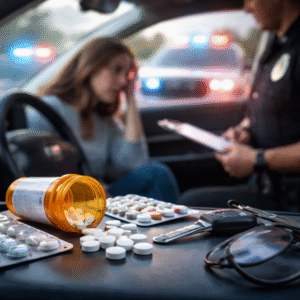
Texas Penal Code §49.01 defines intoxication in two ways. The first is the per se standard: a blood alcohol concentration of 0.08 or above. The second, and the one that applies in prescription drug cases, is the impairment standard: not having the normal use of mental or physical faculties by reason of the introduction of alcohol, a controlled substance, a drug, a dangerous drug, a combination of two or more of those substances, or any other substance into the body.
There is no numerical threshold for Xanax. There is no “legal limit” for alprazolam the way there is for alcohol. The prosecution does not have to prove that a specific blood concentration was exceeded. They only have to prove impairment in that you did not have normal use of your mental or physical faculties.
This sounds simpler than the alcohol standard. In practice, it is far more complex and far more vulnerable to challenge. Because there is no bright-line number, the prosecution’s entire case rests on the quality of the officer’s observations, the validity of any field sobriety testing, the reliability of the Drug Recognition Expert evaluation if one was performed, and the interpretation of the blood test result. Each of those is contestable.
The Pharmacokinetics of Alprazolam: Why Presence Is Not the Same as Impairment
Xanax is the brand name for alprazolam, a benzodiazepine prescribed for anxiety disorders and panic disorder. It acts on GABA receptors in the central nervous system, producing anxiolytic, sedative, and muscle-relaxant effects. Peak plasma concentration typically occurs one to two hours after oral ingestion. The elimination half-life of immediate-release alprazolam is generally eight to fifteen hours meaning the drug persists in the bloodstream long after its therapeutic and impairing effects have diminished.
This pharmacokinetic profile is the foundation of the most important defense argument in any alprazolam DWI case: the presence of alprazolam in a blood sample drawn hours after driving does not tell you whether the person was impaired at the time they were behind the wheel.
A driver who took Xanax at 9:00 PM, slept, and drove to work at 8:00 AM the next morning may have a quantifiable blood level of alprazolam when tested but the impairing peak effect occurred hours before they got in the car. The drug’s presence reflects its pharmacokinetics, not the driver’s functional state at the time of driving.
This is not a technicality. It is basic clinical pharmacology. Any prosecution witness who claims that a therapeutic blood level of alprazolam proves impairment at the time of driving is making a claim that the science does not support and that a defense expert with genuine pharmaceutical science training can systematically dismantle.
Individual tolerance is another critical variable. A patient who has taken alprazolam at a stable therapeutic dose for months or years develops pharmacodynamic tolerance which means the same blood level produces significantly less functional impairment in a chronic user than in a naive subject. The prosecution cannot establish impairment from a blood number without accounting for the defendant’s prescribing history, dosing schedule, and duration of use. Without that context, the number is meaningless.

Managing Partner

Partner & Criminal Division Chief

Criminal Trial Division

Criminal Trial Division

Associate Attorney

Of Counsel
The Field Sobriety Test Problem: These Tests Were Not Designed for Benzodiazepines
The Standardized Field Sobriety Tests (the Horizontal Gaze Nystagmus test, the Walk-and-Turn, and the One-Leg Stand) were developed and validated through research funded by the National Highway Traffic Safety Administration. That research studied alcohol-impaired subjects. The clue thresholds, the scoring criteria, and the correlation with BAC levels were all established using alcohol as the impairing substance.
Benzodiazepine impairment is pharmacologically distinct from alcohol impairment. The two drug classes act on overlapping but different receptor systems and produce overlapping but distinguishable clinical profiles. The SFST battery was not validated for benzodiazepine detection (or any other drug detection). NHTSA has not established that the same clue thresholds correlate with benzodiazepine impairment the way they correlate with alcohol impairment.
As a trained SFST Instructor, I know the validation research behind these tests and I know exactly how they are supposed to be administered. When an officer administers a Walk-and-Turn or One-Leg Stand to a driver suspected of benzodiazepine impairment and then testifies that poor performance indicates drug impairment, that testimony is going beyond what the science supports. The tests were not designed to make that determination.
The problem compounds when the defendant has anxiety which is precisely why many people are prescribed alprazolam in the first place. A person with panic disorder performing field sobriety tests on the side of a highway at night, with emergency lights flashing, is not performing under conditions remotely comparable to the validation studies. Anxiety produces tremor, hesitation, difficulty processing multi-step instructions, and coordination disruption that is indistinguishable from drug impairment on a non-validated instrument. These are exactly the symptoms the officer is looking for and exactly the symptoms the underlying condition produces.
Drug Recognition Experts: What the Protocol Can and Cannot Establish
When an officer suspects drug impairment rather than alcohol impairment, many departments will call in a Drug Recognition Expert who is an officer who has received additional training in a 12-step evaluation protocol designed to identify impairment and classify the drug category involved.
The 12-step DRE protocol includes pulse rate measurement, blood pressure, body temperature, pupil size under different lighting conditions, muscle tone assessment, and injection site examination. For benzodiazepine impairment specifically, the DRE protocol identifies a characteristic profile: normal to slightly elevated vital signs, normal to slightly constricted pupils, decreased muscle tone, and the absence of injection sites. A trained DRE will classify the subject as showing signs consistent with Central Nervous System Depressant impairment.
Several things the DRE evaluation cannot do are worth understanding clearly. It cannot determine which specific drug within a category is present. It cannot determine the blood concentration of that drug. It cannot determine when the drug was taken. It cannot distinguish between impairment and therapeutic effect, between anxiety and drug sedation, or between a chronic tolerant user and someone acutely impaired. The DRE’s opinion is a clinical impression (not a quantitative measurement) and it is subject to the same cross-examination that any expert opinion is subject to.
The DRE program has faced significant scientific criticism. Studies examining the correlation between DRE conclusions and subsequent toxicology results have found meaningful error rates, and the program’s methodology has been challenged in courts across the country. A defense team that understands the protocol can cross-examine a DRE witness in ways that expose the limitations of the evaluation and the gap between the officer’s conclusions and what the science actually establishes.
Case Results
Blood Testing in Prescription Drug DWI Cases
In most prescription drug DWI arrests, law enforcement will seek a blood sample either through consent, implied consent procedures, or a search warrant for a forced draw. The blood test will typically be sent to a forensic toxicology laboratory for analysis using immunoassay screening followed by confirmatory gas chromatography-mass spectrometry (GC-MS) or liquid chromatography-tandem mass spectrometry (LC-MS/MS).
The laboratory report will state the concentration of alprazolam detected in nanograms per milliliter. That number will be presented to the jury as evidence of impairment. The defense challenge is to separate the measurement from the impairment conclusion.
Beyond the pharmacokinetic and tolerance arguments, the blood evidence itself is subject to challenge on procedural and technical grounds. Chain of custody documentation must be complete and consistent. The blood draw must have been performed under proper conditions by qualified personnel. Sample storage and preservation must have been maintained at appropriate temperatures. The laboratory’s analytical methodology, quality control records, and analyst qualifications are all discoverable and subject to examination.
In cases where the blood draw followed a refusal of the breath test, the constitutional validity of any search warrant is also subject to review. Under Texas Code of Criminal Procedure Article 38.23, evidence obtained through a constitutionally defective warrant is suppressible and no good faith exception softens that rule in Texas state court.
The 15-Day ALR Deadline
A DWI arrest based on prescription drug impairment triggers the same Administrative License Revocation process as an alcohol DWI. If you refused testing or submitted to testing that the prosecution claims supports a DWI charge, Texas DPS will move to suspend your driver’s license unless an ALR hearing is requested within 15 days of the date your notice of suspension was received.
The ALR hearing is not just about the license. It is the first opportunity to cross-examine the arresting officer under oath and that transcript becomes available for use in the criminal case. Missing the 15-day deadline eliminates that opportunity entirely.
Penalties
A prescription drug DWI carries the same penalties as an alcohol DWI. A first offense is a Class B misdemeanor carrying three to 180 days in county jail, a fine of up to $2,000, and driver’s license suspension of up to one year. A second offense escalates to a Class A misdemeanor. A third offense is a third-degree felony. If a child passenger was present or an accident occurred, the penalties are enhanced regardless of whether the impairing substance was alcohol or prescription medication.
Speak With Deandra Grant Law
Prescription drug DWI cases are won or lost on science. The pharmacokinetics of alprazolam, the limitations of the SFST battery for benzodiazepine detection, the DRE protocol’s evidentiary weight, and the gap between a blood concentration number and proof of impairment at the time of driving — these are the arguments that matter, and making them effectively requires a defense team with genuine forensic science credentials.
Managing Partner Deandra Grant holds a Master’s Degree in Pharmaceutical Science, an ACS-CHAL Forensic Lawyer-Scientist designation, and SFST Instructor certification. That combination is directly applicable to prescription drug DWI defense in ways that most criminal defense practices cannot match.
Call (214) 225-7117 or visit texasdwisite.com to schedule a confidential consultation. If the 15-day ALR window is still open, call today.
Firm Accolades

Better Business Bureaus

D Magazine