
Home »


Do You Need Legal Help?

"Deandra Grant Law fights hard for their clients and is always willing to go above and beyond. They are the best firm for DWI cases in DFW and beyond. Definitely hire them to represent you in any pending cases."
- P. Williams
"Deandra Grant made a tough situation so much better. She listened to my concerns and helped me so much with my case. I would recommend her to anyone needing legal services."
- M. Haley
"Deandra Grant Law handled my case with diligence and professionalism. Deandra Grant's reputation is stellar and now I know why. She has a team of individuals who provide quality service."
- N. Coulter
As Seen On







Download Our Free Texas Federal Guide
Learn what you should and shouldn't be doing to help your federal defense case.
Federal Wire Fraud Defense Lawyers in Texas
Federal wire fraud under 18 U.S.C. §1343 is one of the most broadly applied criminal statutes in the federal system. Because it covers any scheme to defraud that uses electronic communications (ex. emails, phone calls, text messages, wire transfers, and virtually any internet activity) federal prosecutors use it as a catch-all charge in cases ranging from complex financial fraud to business disputes, regulatory violations, and political corruption. Each count carries a maximum of 20 years. If the fraud affects a financial institution, the maximum increases to 30 years and a fine of up to $1,000,000 per count.
Of Counsel James Lee Bright leads Deandra Grant Law’s federal wire fraud defense. Lee has spent more than 25 years defending clients in the complex, document-intensive federal prosecutions that wire fraud cases produce including white-collar cases, multi-defendant conspiracies, and high-profile federal trials. Partner Douglas Huff’s digital forensics training is directly applicable to the electronic evidence that drives wire fraud prosecutions.
Elements of Federal Wire Fraud
- A scheme or artifice to defraud. The government must prove that the defendant engaged in a plan to deceive for financial gain, involving material misrepresentations or omissions. Following Neder v. United States, 527 U.S. 1 (1999), the misrepresentation must be material which means it must be capable of influencing a reasonable person’s decision. Non-actionable opinions, projections, and puffery are not material misrepresentations.
- Intent to defraud. The defendant must have acted knowingly and with specific intent to deceive. Good-faith business decisions, honest mistakes, reliance on professional advisors, and broken promises are not wire fraud. The government must prove that the defendant knew their representations were false and intended to cause financial harm.
- Use of interstate wire communications. At least one electronic communication must cross state lines. This element is met in virtually every modern business transaction involving email or electronic funds transfer. The wire transmission itself does not need to carry the fraudulent content directly. It only needs to be made in furtherance of the scheme.
Deandra Grant Law – Criminal & DWI Defense Helps Residents across Texas with Criminal Defense Matters – Including: Allen , Arlington, Belton, Cleburne, Collin County, Dallas, Denton, Fairview, Fort Worth, Frisco, Gainesville, Granbury, Hood County, Johnson County, Lewisville, Little Elm, McKinney, Park Cities, Parker County, Plano, Princeton, Richardson, Rockwall, Rowlett, Royse City, Southlake, Sunnyvale, The Colony, Waco, and Weatherford.
Recent Blogs

Bite Marks, Hair Analysis, and the Science Courts Are Still Admitting
In 2016, the President’s Council of Advisors on Science and Technology (PCAST) published a detailed [...]
Cold Cases and the Fourth Amendment: What Genetic Genealogy Means for Defendants
Florida Attorney General James Uthmeier announced this week a $600,000 partnership with Othram (a Texas-based [...]
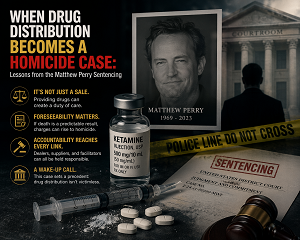
When Drug Distribution Becomes a Homicide Case: Lessons from the Matthew Perry Sentencing
On April 8, 2026, U.S. District Judge Sherilyn Peace Garnett sentenced Jasveen Sangha (the Los [...]
Criminal Justice Reform in 2026: What It Means for Texas Defendants
National headlines about criminal justice reform in 2026 tell a story of accelerating bipartisan progress [...]
How Do Police Track Your Online Activity And Can That Evidence Be Challenged?
Law enforcement agencies have increasingly sophisticated tools for monitoring and documenting internet activity. They can [...]

What to Do if You’re Falsely Accused of Sexual Assault in Texas
Few things are more terrifying than being accused of something you did not do and [...]

How Killing a Cop Went from Murder to Manslaughter
A New York jury recently acquitted Guy Rivera of first-degree murder in the 2024 shooting [...]

When Restraining a Student Becomes a Criminal Charge: What Texas Teachers Need to Know About Injury to a Child
A veteran teacher with twenty-something years in the classroom, no disciplinary history, no prior criminal [...]
Common Federal Wire Fraud Cases in Texas
- Business and investment fraud — Ponzi schemes, securities fraud, fraudulent solicitations
- Real estate and mortgage fraud — fraudulent applications, inflated appraisals, straw buyer schemes
- Insurance fraud — fraudulent claims, staged accidents
- Government contract fraud — false billing, misrepresentation of qualifications
- Business email compromise (BEC) — compromised or spoofed emails redirecting wire transfers
- Cryptocurrency and digital asset fraud — fraudulent ICOs, rug pulls, fake exchanges
- COVID-era relief fraud — PPP and EIDL applications charged under both wire fraud and 18 U.S.C. §1014
How We Challenge the Government’s Evidence
Intent to defraud. The intent element is the most contested issue in most wire fraud cases. Not every business failure is fraud. Lee examines whether the government is criminalizing bad business outcomes, recharacterizing contractual disputes, relying on hindsight, or conflating aggressive business practices with criminal conduct. His decades of federal trial experience give him the ability to present these distinctions persuasively to federal judges and juries.
Digital evidence and electronic communications. The defense must evaluate whether email accounts and devices have been properly attributed to the defendant, whether communications are presented in full context or selectively excerpted, whether metadata and timestamps are accurate, and whether the government’s timeline is consistent with the underlying data.
Financial evidence and loss calculations. Lee works with forensic accountants to independently analyze financial evidence, challenge inflated loss calculations, identify legitimate transactions included in the government’s loss figure, and present alternative calculations. Reducing the calculated loss amount can significantly reduce the Guidelines sentencing range.
Materiality and reliance. Following Neder, wire fraud requires proof that misrepresentations were material. Lee examines whether alleged misrepresentations were actually capable of influencing a reasonable person, whether victims relied on them, and whether statements were facts or non-actionable opinions, projections, or puffery.
Federal Sentencing in Wire Fraud Cases
Sentences are heavily driven by the loss amount under U.S.S.G. §2B1.1. The loss table adds levels to the base offense level based on the calculated financial harm:
- Loss over $6,500: +2 levels
- Loss over $15,000: +4 levels
- Loss over $40,000: +6 levels
- Loss over $95,000: +8 levels
- Loss over $250,000: +12 levels
- Loss over $550,000: +14 levels
- Loss over $1,500,000: +16 levels
- Loss over $3,500,000: +18 levels
- Loss over $9,500,000: +20 levels
Additional enhancements apply for large victim counts, sophisticated means, leadership role, and abuse of trust. The loss calculation is frequently the most important variable in federal financial crime sentencing and it is subject to independent challenge at the sentencing hearing.
James Lee Bright — Federal Wire Fraud Defense
- 25+ years of federal trial experience across all four Texas federal districts
- Admitted: Northern, Eastern, Southern, and Western Districts of Texas; District of Columbia; Fifth Circuit; U.S. Supreme Court
- J.D., University of Tennessee College of Law (1996)
- LL.M. in International Law, SMU Dedman School of Law (2003) — Phi Delta Phi honor fraternity
- Three-month federal trial in the District of Columbia — national prominence, covered by legal and news organizations worldwide
- President, Dallas Criminal Defense Lawyers Association (2010–2011)
- Texas Super Lawyers® 2021–2024 | D Magazine Best Lawyers
If you are facing federal wire fraud charges in Texas, call (214) 225-7117 for a free, confidential consultation with James Lee Bright. Or schedule online at texasdwisite.com.
Frequently Asked Questions About Wire Fraud Charges in Dallas, TX
If you’ve recently been arrested for wire fraud in Dallas, TX, you likely have many questions about the legal process and what to expect. Below are some of the most common questions people ask when facing wire fraud charges. Our Texas Wire Fraud Lawyers at Deandra Grant Law are here to provide clear and reliable answers to guide you through this challenging time.
What is wire fraud?
Wire fraud is a federal crime that involves using electronic communication—such as phone calls, emails, or the internet—to deceive someone for financial gain. This can include fraudulent schemes like scamming investors, sending fake emails to steal money or personal information, or using interstate communications to conduct a fraudulent business.
What are the penalties for wire fraud in Dallas, TX?
Wire fraud is considered a serious federal crime. If convicted, you could face:
- Up to 20 years in federal prison
- Fines of up to $250,000 (or $500,000 for organizations)
- Restitution to victims
The exact penalties depend on the details of the case, such as the amount of money involved and any prior criminal history.
Do I need a lawyer if I'm charged with wire fraud?
Yes, hiring a lawyer is crucial when facing wire fraud charges. Federal charges are complex, and the consequences of a conviction can be severe. A skilled lawyer can review your case and evidence, build a defense strategy tailored to your situation, negotiate on your behalf to reduce penalties or charges, and represent you in court. At Deandra Grant Law, we specialize in defending clients against wire fraud charges and will fight to protect your rights.
Can I be convicted of wire fraud even if I didn't directly take money from someone?
Yes, you don’t have to directly take money to be convicted of wire fraud. The law focuses on whether there was an intent to defraud or deceive someone using interstate communication or electronic means. Even if you didn’t personally steal the money, if you were part of a scheme or facilitated it, you could still face charges.
How long will my case take to go to trial?
The length of time for a wire fraud case to go to trial depends on several factors, such as the complexity of the case and the court’s schedule. Some cases can take months or even years to resolve, especially if the prosecution is pursuing serious charges. Having an experienced lawyer can help speed up the process and ensure you’re fully prepared for trial.
Can wire fraud charges be reduced or dismissed?
Yes, in some cases, wire fraud charges can be reduced or dismissed. Your attorney may find weaknesses in the prosecution’s case, negotiate a plea agreement, or argue that you were not involved in the fraudulent scheme. At Deandra Grant Law, we work diligently to explore all defense options and seek the best possible outcome for our clients.
What should I do if I've been arrested for wire fraud?
If you’ve been arrested for wire fraud, here are the immediate steps you should take:
- Exercise your right to remain silent and do not speak to law enforcement without a lawyer present.
- Contact a criminal defense lawyer as soon as possible to start building your defense.
- Avoid posting about your case on social media, as anything you say could be used against you in court.
At Deandra Grant Law, we are available to guide you through every step of the legal process and protect your rights.
Will my case go to federal court?
Yes, wire fraud is a federal offense, so your case will likely be prosecuted in federal court. Federal court cases are different from state court cases and can involve different rules and procedures. Having a lawyer with experience in federal cases is crucial for navigating these complexities.
What are my options if I'm facing wire fraud charges?
There are several options you may have if you’re facing wire fraud charges:
- Plea Bargaining: You might be able to negotiate a plea agreement for a lesser sentence or reduced charges.
- Defense: If there is insufficient evidence against you or if you did not intend to defraud anyone, your lawyer can build a defense case to have the charges reduced or dismissed.
- Trial: If your case goes to trial, your lawyer will represent you in front of a judge or jury to fight the charges.
How can Deandra Grant Law help with my wire fraud charge?
At Deandra Grant Law, our experienced Texas Wire Fraud Lawyers have a deep understanding of federal criminal law. We provide aggressive defense strategies and are committed to protecting your rights. We’ll work closely with you to evaluate your case, guide you through the legal process, and seek the best possible outcome. Contact us for a free consultation to discuss your case and get the legal help you need.
Client Reviews

“Deandra Grant Law – Criminal & DWI Defense handled my case with diligence and professionalism. Deandra Grant’s reputation is stellar and now I know why. She has a team of individuals who provide quality service.”
N. Coulter


(214) 225-7117
Experienced DWI Defense