By Deandra Grant, J.D., M.S. (Pharmaceutical Science), ACS-CHAL Forensic Lawyer-Scientist
A story out of Illinois should be required reading for anyone charged with a drug-related DWI anywhere in the country, including Texas.
Illinois’s state forensic science commission has sharply criticized the University of Illinois Chicago for inadequately investigating a now-shuttered toxicology lab whose work contributed to nearly two dozen known wrongful DUI convictions. Between 2016 and 2024, the lab’s analysts tested people’s body fluid samples for cannabinoids in more than 2,200 cases using scientifically discredited methods and faulty machinery, and the lab’s lead toxicologist testified about test results in misleading ways.
This is not a story about one bad actor in one state. It is a story about what happens when forensic science goes unquestioned by prosecutors, by courts, and by defense attorneys who assumed the lab report was the final word. And it is a story that has played out in Texas before.

"Deandra Grant Law – Criminal & DWI Defense handled my case with diligence and professionalism. Deandra Grant's reputation is stellar and now I know why. She has a team of individuals who provide quality service."
- N. Coulter
"Deandra Grant Law – Criminal & DWI Defense fights hard for their clients and is always willing to go above and beyond. They are the best firm for DWI cases in DFW and beyond. Definitely hire them to represent you in any pending cases."
- P. Williams
"Deandra Grant made a tough situation so much better. She listened to my concerns and helped me so much with my case. I would recommend her to anyone needing legal services."
- M. Haley
What Actually Went Wrong in Illinois
The technical failures at UIC’s Analytical Forensic Testing Laboratory were specific and consequential.
At issue are results that were unable to distinguish Delta-9 THC from other commonly encountered THC isomers such as Delta-8, and the testing of urine for THC levels. That distinction matters enormously. Delta-9 THC is the psychoactive compound associated with cannabis impairment. Delta-8 THC is a legal hemp-derived isomer with no impairment significance. A test that cannot tell them apart isn’t measuring impairment. It’s measuring the presence of a molecule, then letting a prosecutor argue the rest.
Lab management knew its machines were not producing reliable results for THC blood tests, yet for years failed to notify law enforcement or fix their testing methods. The lab didn’t just make errors. It concealed them.
When UIC eventually commissioned a law firm to review the situation, the resulting report claimed the lab’s methods were appropriate. The Illinois Forensic Science Commission responded by saying the UIC report suggests a fundamental lack of understanding of forensic toxicology, and that it does not consider the UIC report to be an authoritative document for criminal justice stakeholders to evaluate the competency or accuracy of forensic testing. The university hired lawyers to review science. The lawyers got it wrong. The state’s own scientific oversight body called them out for it.
In January 2025, DuPage County State’s Attorney Robert Berlin exonerated 18 people and dropped one person’s pending DUI charges, stating that with the validity of the test results called into question, he could not legally, ethically, and in good conscience continue prosecution of those cases.
Defense attorneys estimate hundreds of other people are still dogged by criminal convictions based on the lab’s work, with some still awaiting trial and at least two serving prison sentences. And as of this writing, neither the university nor prosecutors’ offices that relied on the lab’s evidence have notified potentially impacted individuals that questions have been raised about the validity of the lab’s testing results.
This Is Not an Isolated Incident — Including in Texas
The temptation when a scandal like this surfaces is to treat it as a rare exception. The record says otherwise. Forensic lab misconduct is a documented, recurring problem that has produced wrongful convictions across the country — including right here in Texas.
Houston Crime Lab (Texas). Texas’s most significant forensic scandal involved the Houston Police Department Crime Lab, which suffered years of severe mismanagement, compromised evidence storage, and a 2004 scandal in which analysts fabricated evidence. The fallout required a massive independent audit, resulted in multiple wrongful convictions being revisited, and ultimately led to the lab’s closure. The cases it touched stretched across thousands of prosecutions.
Jonathan Salvador (Texas). In 2012, Houston-area lab technician Jonathan Salvador was found to have mishandled drug tests, failed to follow established protocols, and engaged in “dry-labbing” — reporting results for tests that were never actually performed. Hundreds of cases were affected.
Fred Zain (West Virginia/Texas). Zain served as Chief of Serology in West Virginia before moving to Texas, where he continued forensic work. An investigation found he had systematically falsified serology evidence across hundreds of cases spanning more than a decade — fabricating results, overstating certainty, and providing false testimony. His misconduct resulted in wrongful convictions in both states and millions of dollars in civil settlements.
Annie Dookhan (Massachusetts). In 2012, state drug lab chemist Annie Dookhan admitted to falsifying results, mixing up samples, and fabricating tests across more than 10,000 cases. The fallout ultimately triggered over 20,000 convictions being dismissed — one of the largest forensic scandals in American legal history.
Sonja Farak (Massachusetts). Following the Dookhan scandal, a second Massachusetts lab chemist, Sonja Farak, was found to have been using drug evidence from cases she was actively testing to feed her own addiction — including smoking crack cocaine in the lab itself. Her misconduct tainted thousands of additional drug cases and exposed systemic failures in how the state supervised its forensic facilities.
Ivonne “Missy” Woods (Colorado). In 2023, DNA analyst Ivonne Woods, whose work at the Colorado Bureau of Investigation spanned nearly three decades, was found to have altered evidence across more than 1,000 cases. She was charged with over 100 felonies. The breadth of her tenure meant the cases affected ranged across generations of prosecutions.
FBI Hair Analysis. A 2015 review revealed that FBI hair examiners had provided scientifically flawed testimony in over 95% of the 268 trials reviewed — testimony that had been used to obtain convictions, sustain appeals, and in some cases, carry out executions. The problem wasn’t a single analyst. It was an entire forensic discipline, practiced and vouched for by the federal government’s own laboratory, that failed to meet basic scientific standards.
According to the National Registry of Exonerations, false or misleading forensic evidence helped convict a quarter of the more than 4,000 people wrongfully convicted in the United States since tracking began. These scandals are not outliers. They are the documented record of a system that places enormous evidentiary weight on forensic science while providing inconsistent oversight of the people and institutions producing it.
The Out-of-State Lab Problem Texas Defendants Don’t Know About
There is an additional layer that matters specifically in Texas: not all forensic testing in Texas DWI and drug cases happens at a Texas lab.
Due to backlogs at state and local facilities, biological samples in Texas criminal cases are routinely sent to out-of-state private laboratories for analysis including NMS Labs (National Medical Services) in Willow Grove, Pennsylvania, one of the largest forensic toxicology contractors in the country. The results come back on official letterhead, get introduced as evidence, and are treated by courts as authoritative.
What defendants and many attorneys don’t realize is that the oversight framework governing that out-of-state analysis may be entirely different from what a Texas state lab is subject to. Accreditation standards, chain of custody protocols, analyst qualification requirements, and quality control documentation practices vary across jurisdictions and private contractors. When something goes wrong at an out-of-state lab (as it has, repeatedly, at labs across the country) the defendant whose sample was processed there may have no idea their results could be implicated.
In any Texas DWI case involving a forensic toxicology result, your attorney needs to know where that sample was actually tested, under what accreditation, by whom, and with what methodology. The answer is not always what the lab report header suggests.
Case Results
The Questions That Should Always Be Asked
In any DWI case involving forensic toxicology (blood, urine, or otherwise) a prepared defense attorney examines the evidence, not just the conclusion. That means asking:
Is the lab accredited and was the specific test within the scope of that accreditation? Accreditation by an independent body such as ANAB or A2LA requires labs to demonstrate compliance with established scientific standards. But accreditation is scope-specific. A lab accredited for blood alcohol testing is not automatically accredited for THC isomer analysis. The UIC lab’s failures occurred in part because it was operating outside appropriate scientific standards for the specific tests it was running.
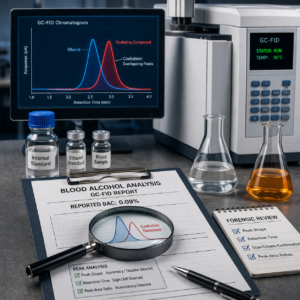
What methodology was used, and is it validated for forensic purposes? In cannabis cases, gas chromatography with mass spectrometry confirmation (GC/MS) is an accepted standard for identifying specific THC isomers. Methods that can’t distinguish Delta-9 from Delta-8, or that rely on urine reconversion techniques not validated for forensic use, should be challenged. These aren’t exotic objections. They are basic quality standards the lab should be able to document.
Was the right biological matrix tested? The UIC lab’s urine testing was a core part of the problem. Urine testing for cannabis measures metabolites (compounds the body produces after processing THC) not active Delta-9 THC itself. Those metabolites can remain detectable for days or weeks after any psychoactive effect has worn off. A positive urine result does not establish that a person was impaired while driving. Using it as primary evidence of DWI impairment is scientifically unsupportable, and this exact issue has now been specifically flagged by a state forensic science commission.
Are the instrument maintenance and calibration records complete and clean? Every forensic instrument requires regular calibration against known reference standards. Gaps, anomalies, or instruments running outside validated parameters are exactly the kind of issue that went unaddressed at UIC for years and exactly what a defense attorney should be requesting and reviewing in discovery.
Who actually performed and reviewed this analysis? UIC’s attorneys consulted with a forensic toxicologist who, when asked about the lab’s protocols for testing urine, said he had “no knowledge” about that, explaining that he only ever talked to the lawyers. A credential on a report doesn’t mean the reviewer understood what was actually done. The same question applies to the original analyst.
What This Means If You Are Facing Drug DWI Charges in Texas
If you are facing a DWI charge in Texas that involves a blood toxicology result (whether that testing was done in Texas or at an out-of-state contractor like NMS Labs) you have the right to challenge that evidence. And in many cases, compelling reasons to do so.
That challenge requires more than a general objection. It requires someone who understands the underlying science: what the test actually measures, how the instrument works, what the validated methodology requires, and where the margin for error lies.
My background is somewhat unusual for a criminal defense attorney. I hold a Master’s Degree in Pharmaceutical Science, an ACS-CHAL Forensic Lawyer-Scientist designation (which requires demonstrated competency in the forensic chemistry underlying DWI testing) and I teach this material to other attorneys and scientists at institutions including Axion Analytical Labs and the Robert F. Borkenstein Drug Course at Indiana University. I approach forensic toxicology evidence in DWI cases the way a scientist would: by examining the methodology, the instrument, the analyst, and the chain of custody and not just the number at the bottom of the report.
The Illinois case is a useful reminder of why that matters. Dozens of people were convicted of crimes based on lab results that a state scientific commission ultimately found unreliable. Their cases went through prosecution, plea, and sentencing without the science ever being seriously examined. Texas has produced its own version of that story more than once.
A lab report is not a verdict. It is a document produced by a human being operating a machine according to a methodology — all of which can be wrong, incomplete, or misleading. That document deserves to be treated as evidence, not as fact.
Call (214) 225-7117 or visit texasdwisite.com.
Firm Accolades

Better Business Bureaus

D Magazine