On April 30, 2026 (the 40th anniversary of Batson v. Kentucky) the State of Texas executed James Broadnax, a black man whose Batson claim alleged that prosecutors had used peremptory strikes to remove every black juror at his capital trial. The same week, a UPI commentary by Amherst law professor Austin Sarat surveyed 40 years of empirical work on jury selection and concluded what most working trial lawyers already know: Batson, as currently applied, does not stop racial discrimination in voir dire. UC Berkeley law professor Elisabeth Semel, co-director of the school’s Death Penalty Clinic, told the Death Penalty Information Center she would give Batson a grade of “F.”
Justice Thurgood Marshall, in his Batson concurrence, predicted exactly this. He wrote that “any prosecutor can easily assert facially neutral reasons for striking a juror, and trial courts are ill-equipped to second-guess those reasons.” Forty years of trial transcripts have proved him right.
This post is for clients, families, and lawyers trying to understand what the Batson framework actually does, why the empirical results have been so disappointing, and (most importantly for criminal defendants in Texas) what defense counsel can and should be doing in voir dire to build a record that gives the claim a real chance on appeal.
Note: We’ve covered Batson in a previous blog about the recent SCOTUS decision in Pitchford v. Cain.
What Batson Actually Held and Where the Three-Step Framework Came From
Before 1986, racial discrimination in jury selection was governed by Swain v. Alabama, which required a defendant to prove a prosecutor’s systematic pattern of striking black jurors over many cases. That standard was, as the Supreme Court later acknowledged, almost impossible to meet. In Batson v. Kentucky, 476 U.S. 79 (1986), the Court replaced Swain with a framework focused on the individual case in front of the trial court. Refined and clarified in Purkett v. Elem, Snyder v. Louisiana, and Foster v. Chatman, 578 U.S. 488 (2016), the framework now has three steps:
- Step 1 — Prima facie case. The defendant points to evidence that the prosecutor’s use of peremptory strikes raises an inference of racial discrimination. Statistical disparities in strike rates are typical (ex. the State strikes a high percentage of qualified black venire members compared to similarly situated white venire members).
- Step 2 — Race-neutral explanation. The burden of production shifts to the prosecutor to articulate a race-neutral reason for each challenged strike. Under Purkett, this reason need not be persuasive or even plausible, only facially race-neutral. “He didn’t make eye contact.” “She lives in a high-crime neighborhood.” “His body language was off-putting.” All have been accepted at Step 2.
- Step 3 — Purposeful discrimination. The trial court must decide whether the defendant has carried the burden of proving that the strike was, in fact, racially motivated. The burden of persuasion remains on the defendant. The court considers the totality of the circumstances including the proffered reason, the comparative treatment of similarly situated non-black jurors, the pattern of questioning, and any other relevant evidence.
Step 3 is where the doctrine collapses in practice. Trial courts overwhelmingly accept the prosecutor’s proffered reason. Appellate courts then review under a clear-error standard. “Clear error” in this context is hard to satisfy when the trial judge has watched live voir dire, and almost every Step 3 ruling in favor of the State is treated as a credibility determination entitled to deference.
Why the Empirical Record Has Been So Bad
The 2026 UPI piece, drawing on work compiled by the Death Penalty Information Center, the Equal Justice Initiative, and academic studies, lays out what the data show:
- Disparate strike rates. A March 2026 study of criminal trial data in Mississippi’s Fifth Circuit Court (1992–2017) found that black prospective jurors faced nearly seven times the odds of being struck compared to similarly situated white jurors.
- All-white or near-all-white capital juries. A 2025 Equal Justice Initiative analysis of 122 Alabama capital cases found that more than one-third were decided by juries with no black jurors or only one, in cases involving black and white defendants in roughly equal numbers.
- Trial-court “race-neutral” rulings rarely reversed. Once a trial judge accepts a prosecutor’s Step 2 explanation, appellate reversals are rare. There have been notable exceptions where evidence emerges (like in Foster) of explicit racial coding in prosecutor work product.
- Curtis Flowers — six trials, one defendant. Mississippi prosecutor Doug Evans tried Curtis Flowers six times for the same offense, in front of all-white or nearly all-white juries, before the Supreme Court reversed in Flowers v. Mississippi in 2019. Flowers was eventually exonerated.
The structural problem is the one Marshall identified in 1986: a system that requires a defendant to prove the subjective state of mind of an experienced prosecutor, in front of a trial judge who works with that prosecutor every day, on the basis of a record the defense has only minutes to build.
The Texas Story: Miller-El, Dallas County, and the Jury Shuffle
Some of the most consequential Batson cases in American history are Texas cases. The doctrine that defines modern Batson practice was largely written in Dallas County.
Miller-El v. Dretke, 545 U.S. 231 (2005)
Thomas Joe Miller-El was tried in Dallas County for capital murder in 1986. During jury selection, prosecutors used peremptory strikes against 10 of the 11 qualified black venire members which is aa strike rate of 91%. Miller-El’s appeal eventually reached the U.S. Supreme Court twice. In Miller-El v. Cockrell, 537 U.S. 322 (2003), the Court (8–1) reversed the Fifth Circuit’s denial of a certificate of appealability, criticizing what it called the lower court’s “dismissive and strained interpretation” of the record. In Miller-El v. Dretke, 545 U.S. 231 (2005), the Court (6–3) granted habeas relief, holding that Miller-El had carried his burden under Batson.
The Miller-El opinion is the modern playbook for proving a Batson claim because Justice Souter walked through, in detail, what made the evidence powerful:
- Statistical disparity. 91% of qualified black venire members were struck. The Court called this disparity “unlikely to have been produced by happenstance.”
- Side-by-side comparative juror analysis. The reasons given for striking black panelists applied equally to white panelists who were not This is now the centerpiece of any serious Batson appeal.
- Disparate questioning. Prosecutors used a “graphic script” about the death penalty when questioning black panelists at far higher rates than when questioning white panelists (53% of Black venire members heard it, versus 6% of white venire members).
- The Texas “jury shuffle.” Under former CCP Art. 35.11, either side may request that the order of the venire be reshuffled. In Miller-El, the prosecution shuffled the cards when black members were seated near the front and not when white members were similarly placed. The Court found the pattern probative of intent.
- Office-wide history. Evidence of a culture and policy in the Dallas County District Attorney’s Office of removing black jurors (documented going back at least to the mid-1980s) reinforced the inference of discriminatory intent in Miller-El’s individual case.
Together, the Miller-El factors created the modern framework: statistical disparity + comparative juror analysis + disparate questioning + procedural manipulation + institutional history. Any Texas defense lawyer building a Batson record today is, knowingly or not, working in the structure Miller-El laid down.
Texas’s Codification: CCP Article 35.261
In 1987, the year after Batson, the Texas Legislature enacted Code of Criminal Procedure Article 35.261 to codify Batson into Texas law. The statute provides:
- A defendant who is a member of an identifiable racial group may move to dismiss the array if the State exercised peremptory challenges to exclude jurors on the basis of race;
- Once a prima facie case is shown, the burden shifts to the State to give a racially neutral explanation;
- The burden of persuasion remains with the defendant; and
- If the court finds purposeful racial discrimination, the statutory remedy is to dismiss the array and call a new array – not (per State ex rel. Curry v. Bowman, 885 S.W.2d 421 (Tex. Crim. App. 1993) to merely reinstate the stricken jurors.
Texas case law has extended Batson principles to gender-based strikes (per J.E.B. v. Alabama) and the analysis applies equally to defense peremptory challenges under Georgia v. McCollum. Article 35.261, by its text, addresses State strikes against defendants of an identifiable racial group, but the constitutional doctrine is broader.
Building a Batson Record That Survives Appellate Review
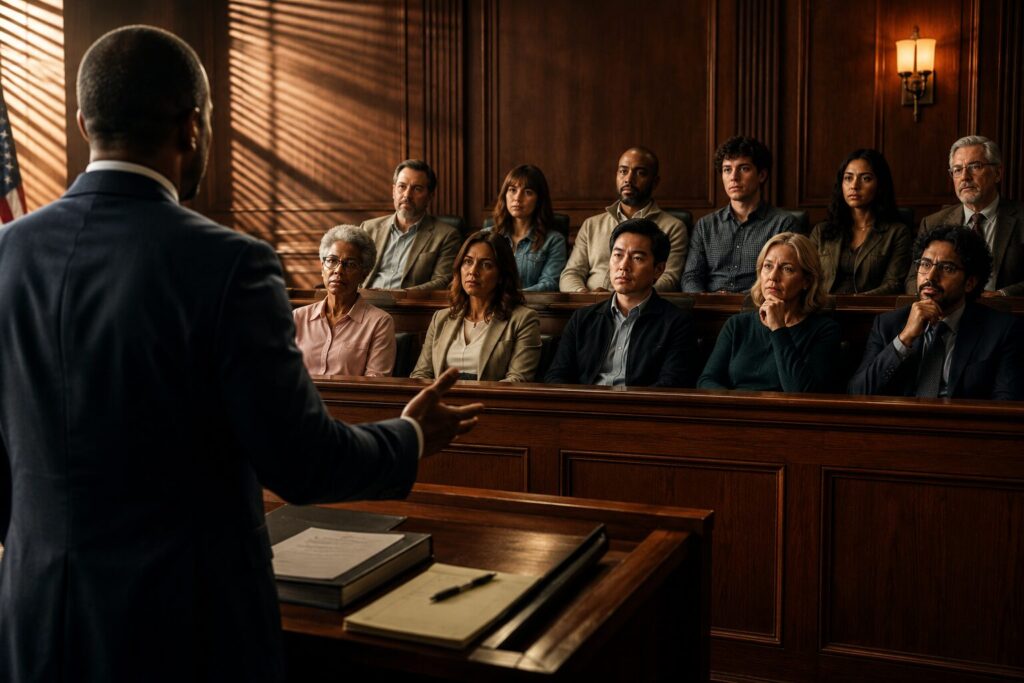
Most Batson claims fail not because the strikes were race-neutral, but because the trial record was thin. The clear-error standard on appeal is unforgiving when the only evidence in the record is the prosecutor’s articulation and the trial judge’s ruling. The work begins long before the prosecutor uses a single strike.
Before voir dire
- Demand the venire panel data. Request, before voir dire begins, the demographic information available about the panel (race, ethnicity, gender, age). Panel demographics are the denominator for any later statistical argument.
- Set up the spreadsheet. During panel questioning, build a contemporaneous spreadsheet identifying each panel member by number, race (as observed and verified), responses to key questions, and any answers that would justify a for-cause or peremptory strike. This is the source document for comparative juror analysis.
- Be ready to put race on the record. Texas appellate courts cannot review what is not in the record. If the prosecutor strikes a juror and there is no demographic information about that juror in the record then the appellate claim is dead at the threshold. Counsel may need to make a record through panel-member questionnaires, the panel’s own self-identifications or the court’s own observations on the record.
During voir dire
- Ask the same questions of every panelist. If the State asks a longer or more loaded version of a question to black panelists than to similarly situated white panelists, document it on your spreadsheet contemporaneously. Miller-El treats disparate questioning as evidence of pretextual intent.
- Watch the jury shuffle. If the State requests a shuffle that disadvantages minority panelists (or repeatedly does) note the pattern and timing on the record. Texas’ shuffle procedure is unique, and Miller-El specifically held that shuffle patterns can be probative of discriminatory intent.
- Identify your comparative jurors as you go. As each State strike is exercised, identify the most similarly situated non-minority panelist who was not The comparison is the heart of Miller-El. You need to know it before the Batson hearing begins, not after.
At the Batson hearing
- Make a specific objection. Invoke Batson and Article 35.261 by name. Identify the struck juror by panel number and race. State the prima facie basis on the record (statistical disparity, disparate questioning, and any pattern of strikes).
- Force a complete State proffer. The State should articulate a race-neutral reason for each strike challenged, on the record. Group answers (“all of these jurors had similar issues”) blur Step 2 and Step 3. Insist on individual articulation.
- Rebut on the record. This is where most Batson claims are won or lost. Walk the court through:
- the comparative juror who was not struck;
- any factual mischaracterization of the struck juror’s answers (and read the record back if necessary);
- any disparate questioning;
- the statistical pattern across all strikes;
- any office-wide history relevant to the prosecutor or office; and
- if the proffered reason is unverified subjective impression (“demeanor,” “body language,” “eye contact”), point out that under Snyder v. Louisiana, a court cannot defer to a demeanor-based explanation that the trial judge did not personally observe and confirm.
Preserving the issue for appeal
- Get specific findings. Ask the trial court to make explicit findings on the record about each challenged strike. Vague rulings (“Motion denied”) make appellate review almost impossible.
- Ensure the voir dire transcript captures everything. Have the court reporter on the record during sidebars. If a sidebar conference relates to a Batson issue, request that it be transcribed or that the substance be placed on the record after the conference.
- Move for the statutory remedy. Under Art. 35.261(b), the remedy is to dismiss the array and call a new array. State that motion specifically. Curry v. Bowman makes clear that a partial reinstatement is not the statutory remedy.
- Renew the objection if the panel proceeds. If the trial court denies the Batson motion and proceeds with the original panel, renew the objection at the time the jury is impaneled and again at any meaningful stage where the issue is preserved.
What Appellate Counsel Does with the Record
On direct appeal in Texas, a Batson denial is reviewed under the clearly erroneous standard. The reviewing court will defer heavily to the trial court’s credibility determination unless the record makes clear that no reasonable factfinder could have credited the State’s explanation. Foster v. Chase (where prosecution notes were eventually obtained showing black jurors had been highlighted, marked with a “B,” and ranked against one another) is the rare modern case where the Court reversed under Batson on direct evidence of intent.
Appellate work in a Texas Batson case typically involves:
- Comparative juror analysis on a fully developed record — matching strike rationales against panelists who escaped strike.
- Statistical analysis of strike rates against the demographic composition of the venire.
- Office and prosecutor history — prior Batson reversals, training materials, internal memoranda, and (in extreme cases) work product.
- Federal habeas review under 28 U.S.C. § 2254. Even if direct appeal fails, federal habeas review is available. Miller-El is the model for what successful federal habeas review of a Batson denial looks like and how long it can take.
The Bigger Picture: Reform Conversations
Outside the courtroom, the Batson framework is the subject of an active national reform conversation:
- Eliminating peremptory challenges. Justice Marshall’s original concurrence in Batson called for abolition of peremptory challenges altogether. Some scholars and a small number of state-court decisions have begun to take that proposal seriously.
- Washington and California reforms. Washington’s General Rule 37 (effective 2018) replaced the Batson framework in Washington state courts with an objective standard: a peremptory strike is invalid if an objective observer could view race or ethnicity as a factor in the strike. California adopted a similar reform via AB 3070 / Code of Civil Procedure § 231.7 effective in 2022.
- Texas legislative proposals. Bills addressing peremptory-strike reform have been introduced in recent Texas legislative sessions but have not yet passed. As of 2026, Article 35.261 remains the controlling Texas statute and the Batson three-step framework remains the operative federal doctrine.
What This Means for Clients and Families
If you are facing a felony or serious misdemeanor trial in Texas where the racial composition of the jury matters, several things are worth knowing:
- Voir dire is part of the trial. Defense counsel’s work in jury selection (the questions asked, the spreadsheet built, the objections preserved) directly affects whether you have a viable Batson claim later. Choose counsel who treats voir dire as substantive trial work, not throat-clearing.
- The record matters more than the ruling. A trial judge denying a Batson motion is not the end of the issue. A complete record (including comparative-juror analysis, race identification, statistical pattern, and disparate-questioning evidence) preserves the question for appeal. An incomplete record forecloses it.
- Appellate sophistication is a trial-level skill. The lawyers most effective at making Batson objections at trial are the ones who routinely litigate Batson claims on appeal. Those two skills are not separable.
Forty years after Batson, the doctrine has not delivered what the Supreme Court promised. But the doctrine is still the law, and in the hands of a careful trial team it can still be made to work — case by case, panel by panel, strike by strike.
Sources
- UPI — Why a landmark Supreme Court ruling has failed to keep racial bias out of jury selection (May 8, 2026)
- Death Penalty Information Center — The Miscarriage of Batson v. Kentucky: 40 Years Later (Apr. 30, 2026)
- Batson v. Kentucky, 476 U.S. 79 (1986)
- Miller-El v. Cockrell, 537 U.S. 322 (2003)
- Miller-El v. Dretke, 545 U.S. 231 (2005)
- Snyder v. Louisiana, 552 U.S. 472 (2008)
- Foster v. Chatman, 578 U.S. 488 (2016)
- Flowers v. Mississippi, 588 U.S. ___ (2019)
- Texas Code of Criminal Procedure Art. 35.261 — Peremptory Challenges Based on Race Prohibited
- Texas Code of Criminal Procedure Art. 35.11 — Jury Shuffle
If you or a family member is facing a felony or serious misdemeanor trial in Texas, call (214) 225-7117 for a free, confidential consultation. Voir dire is the trial. The record built in jury selection shapes everything that comes after. Or schedule online at texasdwisite.com.