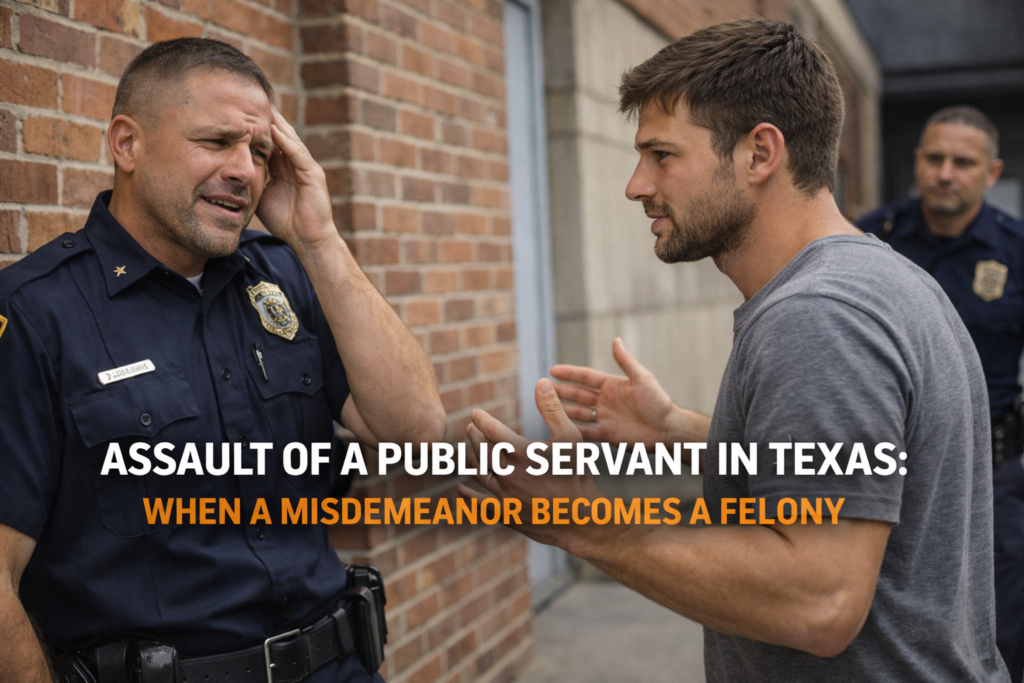
A bodily injury assault in Texas is normally a Class A misdemeanor which carries up to one year in county jail, a $4,000 fine, and the collateral consequences of a misdemeanor conviction. But if the person assaulted is a public servant lawfully discharging an official duty, that same conduct becomes a third-degree felony carrying 2 to 10 years in prison. The distinction is the identity and status of the victim at the moment of the offense and Texas courts have been consistent in applying this enhancement broadly.
Assault of a public servant is one of the most commonly charged felony assault offenses in North Texas, arising most often from DWI stops, domestic call responses, and custody situations where law enforcement contact escalates.
The Statute: §22.01(b)(1)
Texas Penal Code §22.01(b) provides that a bodily injury assault (normally a Class A misdemeanor) is enhanced to a third-degree felony when the offense is committed against a person the actor knows is a public servant while the public servant is lawfully discharging an official duty, or in retaliation or on account of the public servant’s exercise of official power or performance of an official duty.
Third-degree felony: 2 to 10 years in the Texas Department of Criminal Justice, fine up to $10,000.
This is not aggravated assault. No serious bodily injury is required. No deadly weapon is required. The element that elevates the offense is entirely the victim’s status and the circumstances of the contact.
Who Qualifies as a “Public Servant”
The Texas Penal Code defines “public servant” broadly to include: peace officers (city police, county sheriff’s deputies, DPS troopers, constables); emergency services personnel (firefighters, EMS personnel, emergency room personnel, and others who provide services during emergency situations); hospital personnel (nurses, physicians, physician assistants, maintenance and janitorial staff, receptionists, and other persons employed by or working in a hospital — added by the Legislature in 2023); and security officers.
Effective September 1, 2025, the statute was expanded to cover employees or agents of a utility (including electric, telecommunications, cable, gas, and pipeline utilities) performing duties within the scope of their employment. A utility worker in a distinctive uniform performing a service call who is assaulted now triggers the third-degree felony enhancement.
The Knowledge Requirement and the Uniform Presumption
The statute requires that the actor knew the person was a public servant at the time of the offense. However, §22.01(d) creates a significant presumption: the actor is presumed to have known the person assaulted was a public servant, a security officer, a utility employee, or emergency services personnel if the person was wearing a distinctive uniform or badge indicating their employment or status.
In practice, this presumption eliminates the knowledge defense in the vast majority of cases. A uniformed police officer is presumed to be known. An EMT in a distinctive uniform is presumed to be known. A utility worker in a company uniform is presumed known. The knowledge question remains genuinely contested only in cases where the contact occurred in low-light conditions, in a crowd, before the officer identified themselves, or in other circumstances where the victim’s status was not reasonably apparent.
“Lawfully Discharging an Official Duty” — The Second Element
The enhancement requires not just that the victim was a public servant, but that the assault occurred while the public servant was lawfully discharging an official duty. Courts have interpreted this broadly: an officer who is on duty and responding to a scene is generally found to be discharging an official duty even if the specific act at the moment of the assault was not itself an official act.
The defense argument is stronger when the officer or public servant was acting outside the scope of their authority. For instance, when an off-duty officer without official authorization inserts themselves into a situation, or when the arrest or detention being resisted was itself unlawful, then the defense may be applicable.
Common Factual Scenarios
DWI stops. The most frequent context for assault of a public servant charges in North Texas. A suspect who resists arrest, pulls away during field sobriety testing, strikes an officer during handcuffing, or kicks while being placed in a patrol vehicle faces a third-degree felony assault charge on top of the DWI charge.
Domestic call responses. Law enforcement responding to family violence calls frequently encounter volatile situations. When a defendant assaults an officer attempting to intervene, effect an arrest, or separate the parties, the assault of a public servant charge arises alongside the underlying family violence charge.
Medical transport and hospital situations. A patient in acute mental health crisis, medical distress, or under the influence who strikes, kicks, or bites emergency personnel during transport or treatment faces the third-degree felony charge.
Retaliation cases. The statute also covers assaults committed in retaliation for a public servant’s prior exercise of official power, including situations where a defendant assaults an officer hours or days after an arrest, in response to a citation, or because of a prior law enforcement encounter.
Defenses
Unlawful arrest or detention. The stronger argument in most cases is not that resistance to an unlawful arrest is justified, but that the arrest itself was unlawful and the underlying probable cause for the arrest should be challenged, potentially leading to suppression of all evidence.
Lack of knowledge. Where the victim’s status as a public servant was not reasonably apparent (no uniform, no badge, no prior identification) the knowledge element is genuinely contested.
Self-defense in excessive force situations. A defendant who used force in response to excessive or unlawful force by a peace officer may have a self-defense claim under §9.31, though the standard is demanding and requires careful factual development.
Lack of bodily injury. The enhancement applies to bodily injury assault. If the contact did not cause physical pain, illness, or impairment of physical condition, the offense does not reach §22.01(a)(1). Cases involving minimal contact may be argued as offensive contact (a Class C misdemeanor) rather than bodily injury assault.
Speak With Deandra Grant Law
An assault of a public servant charge turns what would otherwise be a misdemeanor into a felony that can affect your freedom, your record, and your future for decades. Deandra Grant Law brings 30+ years of criminal defense experience and more than 500 trials to every case across North and Central Texas.
Call (214) 225-7117 or visit texasdwisite.com for a confidential consultation.