
Prosecutors have discovered that social media accounts are gold mines of potential evidence. Your Facebook posts, Instagram stories, Snapchat messages, tweets, TikTok videos, and even your Venmo transactions can be used to establish motive, intent, location, relationships, state of mind, and even admissions. In sex crime cases, social media evidence is often used to establish communication between the defendant and the accuser, to demonstrate relationship dynamics, and to corroborate or contradict testimony.
But social media evidence is not as straightforward as prosecutors make it appear and it can be challenged on multiple grounds.

"Deandra Grant Law – Criminal & DWI Defense handled my case with diligence and professionalism. Deandra Grant's reputation is stellar and now I know why. She has a team of individuals who provide quality service."
- N. Coulter
"Deandra Grant Law – Criminal & DWI Defense fights hard for their clients and is always willing to go above and beyond. They are the best firm for DWI cases in DFW and beyond. Definitely hire them to represent you in any pending cases."
- P. Williams
"Deandra Grant made a tough situation so much better. She listened to my concerns and helped me so much with my case. I would recommend her to anyone needing legal services."
- M. Haley
How Prosecutors Obtain Social Media Evidence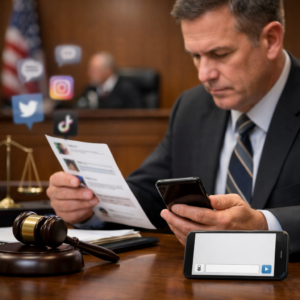
- Public posts. Anything you post publicly on social media can be viewed, screenshotted, and preserved by law enforcement without a warrant. If your profile is public, your posts, photos, check-ins, friend lists, and comments are all accessible.
- Subpoenas and warrants. For private messages, account data, IP logs, and other non-public information, law enforcement must obtain legal process from the platform. Platforms like Facebook, Instagram, Snapchat, and others maintain subscriber information, login records, IP addresses, and stored communications that can be obtained through subpoenas, court orders, or search warrants.
- Forensic collection from devices. When law enforcement seizes a phone or computer, forensic analysis can extract social media data including messages, cached content, login tokens, and app data even from apps the user thought were ephemeral.
- Complainant or witness screenshots. Prosecutors sometimes rely on screenshots of social media conversations provided by the alleged victim or witnesses. These screenshots are among the most problematic forms of evidence.

Managing Partner

Partner & Criminal Division Chief

Criminal Trial Division

Criminal Trial Division

Associate Attorney

Of Counsel
Authentication and Reliability Challenges
Screenshots Are Not Forensic Evidence
A screenshot of a social media post or conversation is a photograph of a screen. It can be fabricated, edited, or taken out of context. Screenshots do not carry metadata, cannot be verified against the platform’s records, and do not establish that the account’s owner was the person who created the post or sent the message.
Account Ownership vs. Account Use
The fact that an account is registered to the defendant does not prove the defendant made a specific post or sent a specific message. Accounts can be hacked, shared, left logged in on other devices, or accessed by others who know the password. A forensic analysis of login records, IP addresses, and device identifiers is necessary to attribute specific activity to a specific person.
Context and Completeness
Prosecutors select the posts and messages that support their narrative and ignore the rest. A single message taken out of a months-long conversation can be made to look incriminating when the full context tells a completely different story. Doug demands complete social media records and presents the full context to the jury.
Ephemeral Content
Platforms like Snapchat are designed to delete content after viewing. When prosecutors present Snapchat evidence, the defense must examine how that content was preserved — was it forensically collected, or is it a screenshot that may have been altered?
How Doug Challenges Social Media Evidence
- Demanding forensic collection from the platform rather than accepting screenshots
- Examining IP logs and device identifiers to determine who actually accessed the account
- Presenting complete conversation threads rather than the prosecution’s selected excerpts
- Investigating whether the account was compromised, shared, or spoofed
- Challenging the authentication of social media evidence through pretrial motions
- Retaining independent forensic experts to analyze social media data and present their findings
Case Results
Talk to a Defense Team That Understands Digital Evidence
At Deandra Grant Law, Attorney Douglas Huff is our Partner and Criminal Division Chief — a senior trial attorney who has completed advanced training in digital forensics with Garrett Discovery, one of the nation’s leading digital forensics firms. Doug doesn’t just read the prosecution’s forensic reports. He has the training to understand the tools, challenge the methods, and expose the weaknesses in digital evidence.
If you are facing criminal charges involving digital evidence of any kind, contact Deandra Grant Law for a free, confidential consultation.
Call (214) 225-7117 or schedule an appointment online at texasdwisite.com.
Firm Accolades

Better Business Bureaus

D Magazine