
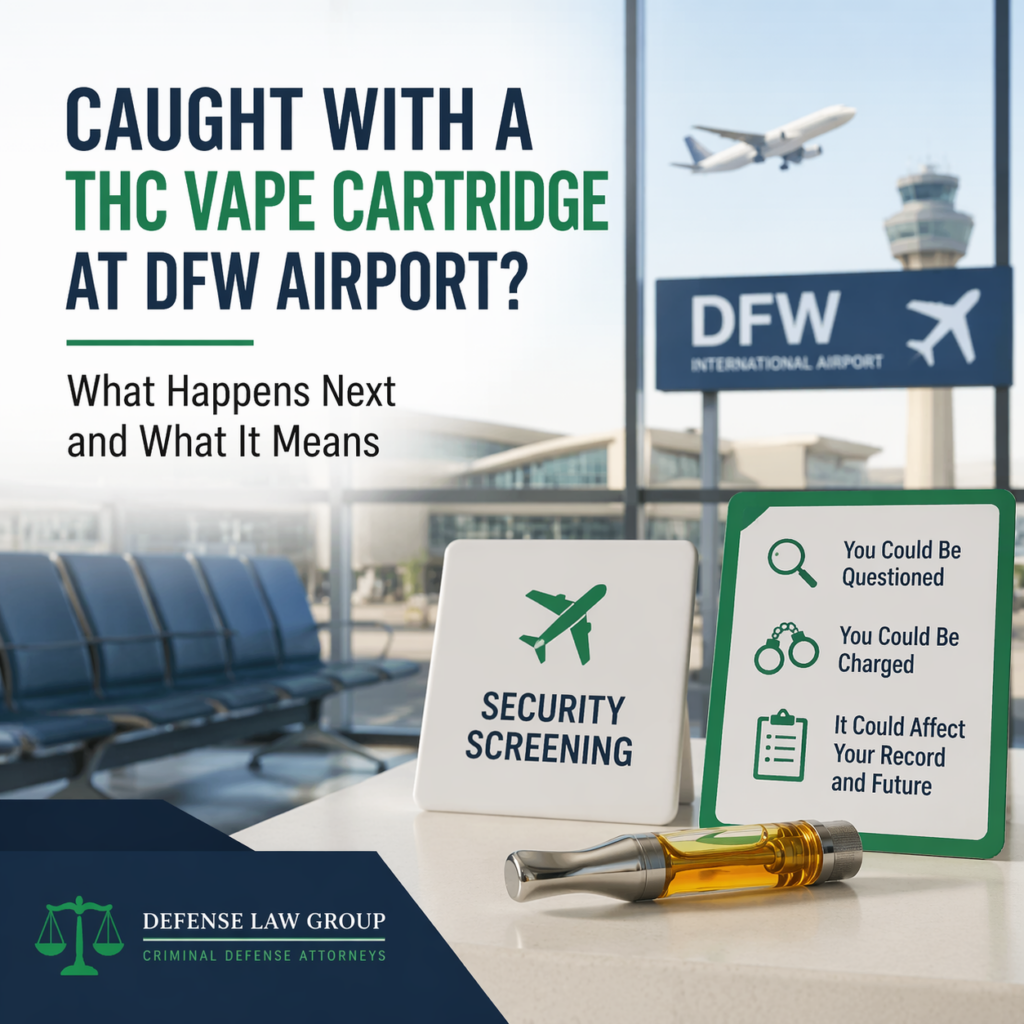
The THC vape cartridge in your carry-on bag just cost you a felony charge. That sentence captures what tens of thousands of travelers who pass through Dallas-Fort Worth International Airport every year do not know until it is too late. A THC vape cartridge that is entirely legal where you purchased it, that you have been carrying for months without incident, that you have flown with before without anyone looking twice, is a felony-level controlled substance in Texas from the moment you enter the state.
This is not a recent change in the law. It is not a technicality likely to be dismissed. It is the direct consequence of how Texas classifies THC concentrate (as a Penalty Group 2 controlled substance, subject to felony prosecution at any detectable quantity) and it generates a steady stream of arrests at DFW among travelers who had no idea they were carrying a felony.
Why a Vape Cartridge Is Treated as a Felony in Texas
Texas law distinguishes sharply between marijuana flower and THC concentrate. The distinction matters more than most people realize.
Marijuana flower (the plant itself) is prosecuted under Texas Health and Safety Code §481.121. Possession of two ounces or less is a Class B misdemeanor. It is a serious charge, but it is a misdemeanor.
THC concentrate (the oil in a vape cartridge, wax, shatter, edibles, or any other extracted form of tetrahydrocannabinol) is classified under Texas Health and Safety Code §481.103 as a Penalty Group 2 controlled substance. Penalty Group 2 puts THC concentrate in the same statutory category as MDMA and PCP. Possession of any amount is a felony. There is no misdemeanor threshold. There is no de minimis quantity that avoids felony prosecution.
The penalty structure for THC concentrate under §481.116:
Less than 1 gram: State jail felony — 180 days to 2 years in state jail, fine up to $10,000. This is a no-parole sentence; state jail felony defendants serve every day of their sentence.
1 to less than 4 grams: Third-degree felony — 2 to 10 years in TDCJ, fine up to $10,000.
4 to less than 400 grams: Second-degree felony — 2 to 20 years in TDCJ, fine up to $10,000.
400 grams or more: First-degree felony — 10 to 99 years in TDCJ, fine up to $50,000.
A standard prefilled vape cartridge contains 0.5 to 1 gram of oil. A single cartridge can produce a state jail felony or a third-degree felony depending on its weight. Multiple cartridges, or a cartridge on the larger end of the standard size range, can push the total weight above 1 gram. The weight used for charging purposes is the total weight of the liquid mixture and not just the THC content within it.
How DFW Airport Arrests Actually Happen
TSA Finds It
TSA security screening at DFW is not looking for drugs. TSA’s mission is aviation security (explosives, weapons, prohibited items). But CT scanners and X-ray machines that flag unusual items in carry-on bags also reveal vape cartridges, and when a screener identifies what appears to be a vape pen or cartridge containing liquid, the protocol is to investigate.
If a TSA officer believes the item may be a THC cartridge rather than a nicotine vape (based on packaging, labeling, odor, or the traveler’s response when questioned) they are required to notify law enforcement. TSA does not make arrests. They call the DFW Airport Police Department.
DFW Airport DPS Takes Over
The DFW Airport Department of Public Safety (DFW DPS) is an independent law enforcement agency with jurisdiction over the airport. When TSA calls them to the checkpoint, DFW DPS officers take custody of the item and the traveler and conduct a field investigation. They may test the item with a field test kit. If the item tests positive for THC, or if it is otherwise apparent that the cartridge contains a THC product, an arrest typically follows.
At this point, the traveler has missed their flight. They are under arrest at an international airport, potentially far from home, with a felony charge pending in a jurisdiction they have never had reason to think about.
Which County Prosecutes: The Jurisdiction Question
DFW Airport straddles the Tarrant County and Dallas County line. Criminal charges can be filed in either county but typically the cases are filed with the Tarrant County District Attorney’s Office and heard in the Tarrant County courts in Fort Worth.
This is an important practical point for travelers arrested at DFW: the case is not handled in Dallas County even though the airport carries the Dallas name. If you are arrested at DFW and charged with THC possession, you will be dealing with Tarrant County courts, Tarrant County pretrial services, and Tarrant County resolution options. Defense attorneys familiar with Tarrant County court practices and the Tarrant County DA’s approach to these cases are the appropriate counsel.
The Out-of-State Legal Defense: Why It Does Not Work
The single most common thing travelers say when stopped at DFW with a THC vape cartridge is some version of: “I bought this legally in Colorado” (or California, or Michigan, or any of the 24-plus states where recreational cannabis is legal). It is an understandable response. It is not a legal defense in Texas.
Texas law does not recognize out-of-state purchases, out-of-state medical marijuana cards, or out-of-state legal status as a defense to Texas drug charges. When you are in Texas, Texas law applies. A product that is entirely lawful to possess in the state where you purchased it is a felony-level controlled substance in Texas the moment you bring it into the state or, in the case of a DFW arrest, the moment TSA finds it in your bag on Texas soil.
This is the specific gap in awareness that produces so many DFW airport arrests. Travelers who have been compliant with the laws of their home state, who purchased the product legally, who have never been arrested for anything, find themselves facing a felony charge because they did not know that the legal landscape changes completely when they enter Texas airspace.
The Checked Luggage vs. Carry-On Question
TSA screens all carry-on bags. TSA also screens checked luggage, though the screening is different and less thorough for non-security items. A THC vape cartridge in a checked bag has a lower probability of detection than one in a carry-on that passes through an X-ray machine in front of a screener.
Lower probability is not zero probability. DFW handles tens of millions of passengers annually. Checked luggage screening does identify THC products, and the same arrest sequence follows. The legal analysis and the charge level are identical regardless of whether the item was in a carry-on or a checked bag. The prosecution does not depend on which bag it was found in.
Delta-8 and the Hemp-Derived Product Problem
A growing category of DFW airport arrests involves products marketed as hemp-derived Delta-8 THC cartridges, Delta-9 edibles sold in states where hemp products are regulated, or products labeled with a QR code linking to a Certificate of Analysis showing delta-9 THC below 0.3 percent. These products occupy a contested legal space in Texas that requires careful analysis.
Texas law defines hemp as cannabis with a delta-9 THC concentration at or below 0.3 percent by dry weight. Products that genuinely meet this standard are not classified as marijuana or as Penalty Group 2 THC under current Texas law. Whether a specific product meets that standard (whether the Certificate of Analysis is from an accredited laboratory, whether the testing methodology was valid, and whether the product in the traveler’s possession matches the tested batch) is a forensic question that can be challenged.
A product labeled as hemp-derived or legal CBD that the crime lab tests and identifies as containing THC above the legal threshold is a Penalty Group 2 controlled substance regardless of the label. The defense challenge in those cases focuses on the laboratory methodology, the testing accuracy, and the chain of custody from the traveler’s bag to the crime lab.
The Tarrant County First Offender Drug Program
Tarrant County operates a First Offender Drug Program (FODP) through the DA’s office that may be available to qualifying first-time defendants charged with THC possession. A defendant who successfully completes the FODP has their charge dismissed and becomes eligible for expunction after a waiting period. The FODP is not available to every defendant and not available for every charge level. Eligibility depends on the specific charge, the defendant’s criminal history, and the prosecutor’s assessment of the case.
Whether the FODP is the best resolution in a specific case depends on factors that require evaluation by defense counsel familiar with how Tarrant County handles these cases. It is one tool, not the automatic answer.
Defense Challenges in DFW Airport THC Cases
Weight determination. The charge level is driven entirely by the weight of the oil. At the threshold between state jail felony (under 1 gram) and third-degree felony (1 gram or more), the margin of measurement error is potentially dispositive. Whether the crime lab correctly weighed the liquid content, whether the weight includes any non-THC material in the mixture, and whether the instrument was properly calibrated are all subject to independent examination. Deandra Grant and Douglas Huff hold the ACS-CHAL Forensic Lawyer-Scientist designation, which allows evaluation of the laboratory analysis at the analytical chemistry level.
Identity of the substance. A field test positive for THC is not a confirmed result. Field tests are immunoassay screening tests subject to cross-reactivity and false positives. The confirmatory laboratory analysis (its methodology, the instrument used, the analyst’s qualifications, and the chain of custody from arrest to result) is the evidence that actually establishes what the substance was.
Hemp-derived product analysis. If the product is legitimately hemp-derived with delta-9 THC below the 0.3 percent threshold, the laboratory methodology used to test it must be examined. Delta-9 THC concentration in hemp products requires testing by accredited laboratories using validated methods. Results that fail to distinguish between hemp and marijuana-derived products, or that do not test for the specific compound at issue, are subject to challenge.
The search and seizure question. TSA security screening is a Fourth Amendment consent search. Travelers consent to screening as a condition of air travel.
What to Do If You Are Stopped at DFW
Do not try to explain your way out of it. Telling the DFW DPS officer that you bought the cartridge legally in Colorado, that you have a medical card, or that you did not know Texas law was different does not help your legal situation and may produce additional statements that complicate the defense. Exercise your right to remain silent beyond what is legally required.
Do not consent to additional searches. If the officer asks to search your other bags, your phone, or any other belongings beyond what was initially identified by TSA, you can decline. A consent search of your phone looking for evidence of distribution or trafficking activity is not the same as the initial TSA screening.
Call a Texas criminal defense attorney as soon as possible. An out-of-state arrest for a Texas felony has consequences in both Texas and your home state. Your Texas attorney handles the criminal case; you may also need to consider whether and how to disclose the charge to a professional licensing board, employer, or other regulatory body in your home state. The earlier counsel is involved, the more options are available.
Deandra Grant Law handles THC possession charges and drug cases in Tarrant County and throughout North Texas. Managing Partner Deandra Grant and Partner Douglas Huff both hold the ACS-CHAL Forensic Lawyer-Scientist designation, allowing independent evaluation of the laboratory evidence at the chemistry level. Call (214) 225-7117 for a free, confidential consultation.