By Deandra Grant, J.D., M.S. (Pharmaceutical Science), ACS-CHAL Forensic Lawyer-Scientist
When law enforcement seizes your phone in connection with a criminal investigation, the clock used to work in your favor at least a little. Processing a device, extracting the data, and having a forensic analyst make sense of thousands of messages, location pings, and call records took time. Sometimes weeks. That time created space for defense counsel to request preservation orders, challenge the scope of the search warrant, and examine the methodology before evidence went to a prosecutor.
That window is closing.

"Deandra Grant Law – Criminal & DWI Defense handled my case with diligence and professionalism. Deandra Grant's reputation is stellar and now I know why. She has a team of individuals who provide quality service."
- N. Coulter
"Deandra Grant Law – Criminal & DWI Defense fights hard for their clients and is always willing to go above and beyond. They are the best firm for DWI cases in DFW and beyond. Definitely hire them to represent you in any pending cases."
- P. Williams
"Deandra Grant made a tough situation so much better. She listened to my concerns and helped me so much with my case. I would recommend her to anyone needing legal services."
- M. Haley
What Cellebrite Just Announced
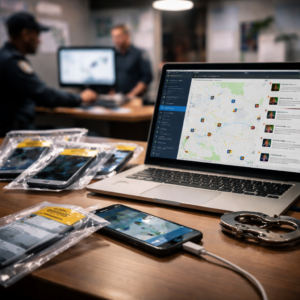
Cellebrite, the Israeli digital forensics company whose tools are used by law enforcement agencies in more than 150 countries, including departments throughout Texas, has released new AI-powered capabilities that can analyze data extracted from seized phones and computers in near real time. As soon as data is retrieved from a mobile phone and uploaded into Cellebrite’s Guardian cloud platform, the system can begin decoding and analyzing it without waiting for forensic experts to submit reports on each device.
What that analysis looks like in practice is not subtle. The platform can take cell site data which records the phone masts a mobile device has connected to, along with data from Google Maps, to track an individual’s movements over time. It acts as a replacement for the whiteboards investigators use to map locations, timelines, and communications, with AI tools able to find relationships between social media posts, messages, images, and video.
The system can identify anomalous behavior (ex. flagging when two people who are in regular contact suddenly stop communicating or when someone puts their phone into airplane mode). In an investigation context, that kind of pattern recognition is exactly what detectives are looking for. It is also exactly the kind of inference-layering that defense counsel needs to be prepared to challenge.
Cellebrite has been building toward this for years. Since 2015, the company has been incorporating AI into its platform, starting with image classification and expanding into language classification (analyzing communication patterns to flag behaviors of interest). Its Pathfinder product, launched in 2018, allows investigators to sift through vast amounts of data to identify patterns that would be invisible or time-consuming for human analysts. The new Guardian Investigate capabilities represent the next step: not just analyzing a single device, but linking data across devices, locations, and communications in real time as the extraction happens.
The Defense Problem This Creates
Speed is not neutral. When law enforcement can generate an AI-produced evidence map within hours of seizing a device (one that links your location data, your contacts, your messages, and your behavior patterns into a visual narrative) that narrative arrives in the prosecutor’s hands before the defense attorney has had a chance to examine the underlying data, challenge the extraction methodology, or identify what the AI got wrong.
And AI in forensic contexts does get things wrong. Peter Sommer, a forensic expert familiar with Cellebrite’s technology, has been direct about this: AI is useful for sorting through large quantities of data, but its results must be manually checked against the original data before they can hold up in court. “There are just too many things that can go wrong with AI if people just take the immediate results,” he said.
That expert caution is important. But the practical concern is that law enforcement agencies, particularly in high-volume investigations, may not always have the resources or the inclination to run every AI-generated finding back to the source data before acting on it. Arrests get made. Charges get filed. And by the time defense counsel has received the digital evidence through discovery and begun examining it, the AI-generated narrative has already shaped how the prosecutor sees the case.
There is also a compounding problem: Cellebrite’s new tools can link call records, messages, images, and location data as evidence is uploaded generating connections between data points that a human analyst might not have drawn. Some of those connections will be accurate. Some will be artifacts of the algorithm which are correlations that look meaningful and aren’t, or behavioral flags that reflect innocent conduct the system has no context to evaluate correctly.
The defense challenge is not just to challenge what the AI found. It is to challenge the methodology by which the AI was directed to look, what it was told to flag, and whether the human analyst who reviewed its output actually verified the underlying data or accepted the machine’s narrative at face value.
What This Means for Your Case
If law enforcement has seized your phone, tablet, or computer in connection with a criminal investigation in Texas, here is what you need to understand about how this evidence will be built and how it can be challenged.
The warrant scope matters more than ever. A search warrant for digital evidence authorizes a search of specific data for specific purposes. If Cellebrite’s AI platform is ingesting your entire device (location history, all communications, deleted data recovered through forensic extraction) and running pattern analysis across all of it, the scope of that analysis must be consistent with what the warrant actually authorized. Searches that exceed warrant scope are suppressible under Texas Code of Criminal Procedure Article 38.23, with no good faith exception under Texas law.
The extraction methodology is discoverable. Defense counsel is entitled to know which Cellebrite tools were used, what version of the software, what extraction method was applied (logical, file system, physical, or full file system), and what the analyst did with the AI-generated output. Hash values that verify data integrity, chain of custody documentation through the cloud upload process, and the specific queries or parameters used to generate the AI’s analysis are all part of the evidentiary record that a prepared defense team will demand.
AI-generated outputs are not self-authenticating. Courts across the country are actively grappling with the standards for admitting AI-generated forensic evidence, and no clear national standard has emerged. What Cellebrite’s Guardian platform produces (a visual map of relationships, a flagged behavior pattern, a reconstructed timeline) must be authenticated through the analyst who used it, who must be able to testify about how the tool works, what its known error rates are, and how they verified the AI’s findings against the source data. Cross-examination of a Cellebrite-trained analyst by defense counsel who understands the platform and its limitations can expose the gap between what the machine produced and what the evidence actually shows.
Your location data is especially vulnerable. Cell site location information, GPS data from Google Maps integration, and device-generated location history are among the most powerful inputs Cellebrite’s AI can work with and among the most frequently misunderstood by juries. Cell tower data covers a geographic range, not a pinpoint location. GPS data can be wrong. And an AI system that uses this data to track movements over time is making inferences that the raw data may not support. Challenging location-based evidence requires understanding both the technical limitations of the data source and the legal framework established by Carpenter v. United States (2018), which requires a warrant for historical cell site location information.
Why Digital Forensics Expertise in Your Defense Team Is No Longer Optional
The gap between what law enforcement can do with AI forensic tools and what most defense attorneys know how to challenge is widening. Cellebrite’s platform is used by tens of thousands of agencies worldwide. The company reports that its AI-powered capabilities enable investigators to reduce the time required for large-scale investigations from months to just weeks. That efficiency comes at a cost to defendants whose counsel is not equipped to examine AI-generated evidence at the technical level it requires.
At Deandra Grant Law, Douglas Huff’s digital forensics training is not incidental to our practice. It is the foundation of how we approach any case where a phone, a computer, or any digital device has been seized and analyzed.
If your phone has been seized, if you are under investigation, or if you are facing charges in which digital evidence will play a role, the time to have a defense attorney examine that evidence is before the prosecution’s narrative is fully formed and not after.
Call (214) 225-7117 or visit texasdwisite.com for a confidential consultation.
Firm Accolades

Better Business Bureaus

D Magazine