
Home »


Do You Need Legal Help?

"Deandra Grant Law fights hard for their clients and is always willing to go above and beyond. They are the best firm for DWI cases in DFW and beyond. Definitely hire them to represent you in any pending cases."
- P. Williams
"Deandra Grant made a tough situation so much better. She listened to my concerns and helped me so much with my case. I would recommend her to anyone needing legal services."
- M. Haley
"Deandra Grant Law handled my case with diligence and professionalism. Deandra Grant's reputation is stellar and now I know why. She has a team of individuals who provide quality service."
- N. Coulter
As Seen On






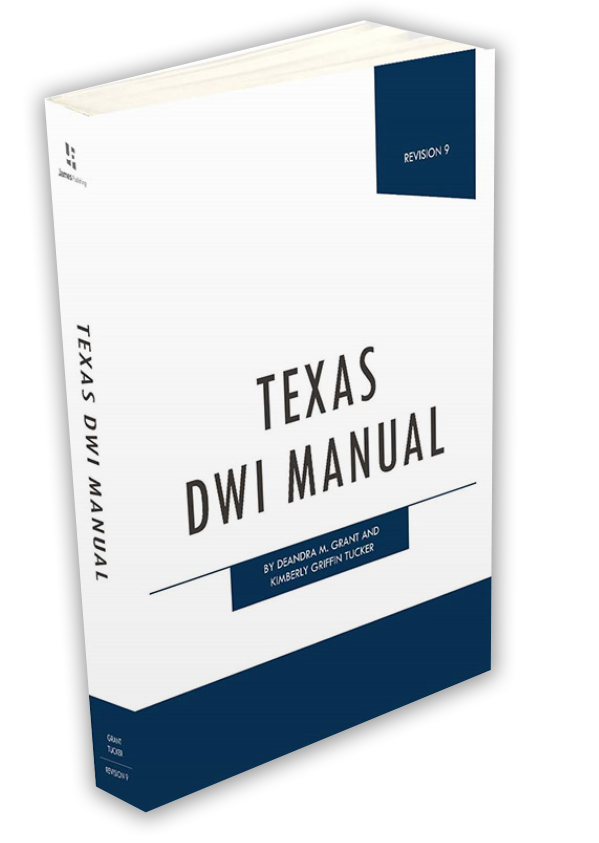
Texas DWI Manual
By Attorney Deandra Grant
Fighting DWI charges can present many challenges, not only for the defense, but prosecutors as well. This is why it is important to be armed with the necessary knowledge so you understand the DWI process.
Attorney Deandra M. Grant is the co-author of the Texas DWI Manual, offering legal advice to both clients and fellow attorneys.
Learn MoreDallas DWI Injury Attorneys
Intoxication assault in Texas is not simply a “DWI with an injury.” It is a felony with its own statute (Penal Code § 49.07), its own elements, and its own forensic and causation issues. The state must prove that the defendant operated a motor vehicle while intoxicated and that, by reason of that intoxication, serious bodily injury was caused to another. Each element (operation, intoxication, causation, and the “serious” quality of the injury) is separately provable and separately contestable.
Deandra Grant Law defends intoxication assault cases in Dallas County with the forensic training that these cases require. Call (214) 225-7117 to discuss your case.
How Texas Defines Intoxication Assault
Intoxication assault is defined in Texas Penal Code § 49.07. A person commits the offense by operating a motor vehicle in a public place, an aircraft, a watercraft, or an amusement ride while intoxicated and, by reason of that intoxication, causing serious bodily injury to another.
The Four Elements
- Operation of a motor vehicle, aircraft, watercraft, or amusement ride. Motor vehicle is the most common. The state must prove the defendant was operating, not merely present in or near, the vehicle.
- In a public place (for motor vehicles). Public place is broadly defined in § 1.07(a)(40) but is not unlimited.
- While intoxicated. Intoxication under § 49.01(2) means not having the normal use of mental or physical faculties by reason of alcohol, a controlled substance, a drug, a dangerous drug, or any combination, or having an alcohol concentration of 0.08 or more.
- That caused, by reason of the intoxication, serious bodily injury to another. The causal link between the intoxication and the injury is a separate element. Intoxication plus an accident is not sufficient; the state must prove the intoxication caused the injury.
“Serious Bodily Injury” — Penal Code § 1.07(a)(46)
Serious bodily injury means bodily injury that creates a substantial risk of death, causes death, serious permanent disfigurement, or protracted loss or impairment of the function of any bodily member or organ. Bodily injury that heals without lasting impairment is not, by itself, serious bodily injury. The distinction is fact-intensive and often determinative. If the state cannot prove serious bodily injury, the case is not an intoxication assault at all, and the appropriate charge is DWI under § 49.04 with any applicable enhancements.
Punishment for Intoxication Assault
Intoxication assault is a third-degree felony. Under Texas Penal Code § 12.34 and § 49.09(h):
- Imprisonment: 2 to 10 years in the Texas Department of Criminal Justice.
- Fine: up to $10,000.
- Community service: 160 to 600 hours, required by § 49.09(h). This is in addition to any prison or supervision term.
- Driver’s license suspension under Transportation Code §§ 521.344 and 521.372.
- Mandatory ignition interlock as a bond condition under Code of Criminal Procedure Article 17.441, and as a condition of any occupational license under Transportation Code § 521.246.
- Restitution to the victim under Code of Criminal Procedure Article 42.037.
Enhancement: Peace Officer, Firefighter, or EMS Personnel — § 49.09(b-1)(1)
Intoxication assault against a peace officer, firefighter, or emergency medical services personnel who is on duty is enhanced to a second-degree felony. Punishment range: 2 to 20 years, fine up to $10,000, plus the 160 to 600 hours of community service.
Enhancement: Traumatic Brain Injury — § 49.09(b-4)
Intoxication assault that causes a traumatic brain injury resulting in a persistent vegetative state is enhanced to a second-degree felony.
Escalation to Intoxication Manslaughter
If an injured victim later dies from the injuries, the charge can be upgraded to intoxication manslaughter under § 49.08, a second-degree felony (2 to 20 years), enhanced to a first-degree felony (5 to 99 years or life) when the victim is a peace officer, firefighter, or EMS personnel on duty. The community service range for intoxication manslaughter is 240 to 800 hours.
Deferred Adjudication Is Not Available
HB 3582 (2019) made deferred adjudication available for certain first-offense misdemeanor DWIs with a BAC below 0.15%. That statute does not apply to intoxication assault, or to any other felony DWI offense. A plea of guilty or no contest to intoxication assault produces a final felony conviction, with all of the collateral consequences that follow a felony record.
Mandatory Blood Draw? Only in an Exigent Circumstance
Texas Transportation Code § 724.012(b) creates a “mandatory blood draw” rule. When an officer has probable cause to believe a person committed an intoxication offense and the person was involved in an accident that the officer reasonably believes caused serious bodily injury or death, the officer must require the taking of a blood or breath specimen even over the person’s refusal. The U.S. Supreme Court has held, however, that the natural dissipation of alcohol does not automatically justify a warrantless blood draw. A warrant is generally required absent a true exigency.
- Missouri v. McNeely, 569 U.S. 141 (2013). Natural dissipation of alcohol is not a per se exigency; whether a warrant is required is a totality-of-the-circumstances inquiry.
- Birchfield v. North Dakota, 579 U.S. 438 (2016). A state may not criminalize refusal of a blood test absent a warrant.
- Probable cause affidavits. Most Dallas County intoxication assault cases proceed on a warrant-supported blood draw. The probable cause affidavit, the reliability of the information, and the scope of the warrant are all contestable under Texas’s exclusionary rule (Code of Criminal Procedure Article 38.23).
Related Videos
The Administrative License Revocation (ALR) Track
Parallel to the criminal case, an Administrative License Revocation proceeding runs on the DWI side. The ALR deadline to request a hearing is 15 days from the date of the notice of suspension (not necessarily the date of arrest). Missing the deadline results in an automatic suspension. The ALR hearing is an opportunity not only to contest the license suspension but to cross-examine the arresting officer under oath before the criminal trial.
How Intoxication Assault Cases Are Defended
Causation
The statutory phrase “by reason of that intoxication” requires the state to prove the intoxication caused the serious bodily injury. An intoxicated driver who is struck by another vehicle, whose brakes failed, whose blood draw was performed hours later, or whose BAC rose after the accident due to absorption may have caused nothing. Causation is a frequent ground for defeating, or reducing, an intoxication assault charge.
Accident Reconstruction
Event data recorder (EDR) downloads, scene analysis, skid mark measurement, vehicle inspection, and independent biomechanical review frequently show alternative causes for the injury ranging from the other driver’s fault to mechanical failure to the passenger’s failure to wear a seat belt. Accident reconstruction is often the single most effective area of defense investment in an intoxication assault case.
Blood Alcohol Analysis
Ethanol analysis in Texas is performed by headspace gas chromatography with flame ionization detection (GC-FID). Attack points include the sample collection, the preservative and anticoagulant balance, the chain of custody, the instrument calibration, the internal standard, the column chemistry, the measurement uncertainty, and the possibility of microbial fermentation during storage.
Drug Toxicology
Drug-related intoxication assault cases typically rely on LC-MS/MS confirmation. The pharmacology of the drug, whether the concentration correlates with impairment, active versus inactive metabolites, polypharmacy effects, and the timing between the alleged driving and the blood draw are all contestable.
“Serious Bodily Injury” Challenges
If the state cannot prove serious bodily injury as defined in § 1.07(a)(46), the charge is not intoxication assault. Medical records review, independent expert evaluation, and cross-examination of treating providers on whether the injury created a substantial risk of death or caused protracted loss or impairment can reduce or defeat the charge.
Constitutional Challenges
Traffic stops, field investigations, arrests, and blood warrants are constrained by the Fourth and Fifth Amendments, the Texas Constitution, and the Code of Criminal Procedure. Suppression motions attacking the stop, the probable cause affidavit, the warrant, and any custodial statements are routine.
Where Dallas County Intoxication Assault Cases Are Heard
Intoxication assault is a felony and is filed in the Dallas County Criminal District Courts at the Frank Crowley Courts Building, 133 N. Riverfront Boulevard. The Dallas County District Attorney’s Office prosecutes. A parallel ALR proceeding runs before a Texas Department of Public Safety administrative law judge.
Frequently Asked Questions
My BAC was over 0.08 and there was an accident. Isn’t that intoxication assault?
Not automatically. The state has to prove that the intoxication caused the serious bodily injury. An intoxicated driver who was not at fault for the accident, or whose intoxication did not cause the injury, is not guilty of intoxication assault under the statute.
The injury was minor. Can it still be intoxication assault?
Only if the injury qualifies as serious bodily injury under § 1.07(a)(46) (substantial risk of death, serious permanent disfigurement, or protracted loss or impairment of function). Ordinary bodily injury is not sufficient, and the appropriate charge in that case is DWI under § 49.04.
Can I get deferred adjudication on an intoxication assault charge?
No. Deferred adjudication is not available for any felony DWI offense, including intoxication assault. A plea produces a final felony conviction.
They drew blood without asking me. Is that legal?
Under Missouri v. McNeely and Birchfield v. North Dakota, a warrantless blood draw requires a true exigency beyond natural alcohol dissipation. In the great majority of Dallas County intoxication assault cases, the state obtains a blood warrant. The validity of that warrant is regularly contested.
Will I lose my license?
Possibly. Two separate tracks can trigger license action: the ALR track (on the DWI side, running from the notice of suspension) and the criminal conviction itself (under Transportation Code §§ 521.344 and 521.372).
Related Blogs
About Deandra Grant Law
Deandra Grant Law is a Texas criminal defense firm with offices in Dallas, Fort Worth, Allen, Denton, Waco, and Rockwall. Our intoxication assault defense practice is built on the forensic training that these cases actually require.
Deandra M. Grant, Managing Partner
- More than 30 years in practice, focused on criminal defense and DWI
- Former prosecutor
- J.D.; M.S. in Pharmaceutical Sciences
- Graduate Certificate in Forensic Toxicology
- ACS-CHAL Forensic Lawyer-Scientist from the American Chemical Society
- Standardized Field Sobriety Test (SFST) Instructor
- Texas Super Lawyer since 2011
- Author of 17 law books including The Texas DWI Manual
- Executive Director, DUI Defense Lawyers Association (DUIDLA)
Douglas E. Huff, Partner
- ACS-CHAL Forensic Lawyer-Scientist
- Digital forensics and electronic evidence training
- Extensive North Texas DWI trial experience
James Lee Bright, Of Counsel
- National federal criminal defense practice, including serious-felony cases
- Admitted to all four Texas federal districts, the District of Columbia, the Fifth Circuit Court of Appeals, and the Supreme Court of the United States
Contact Our Dallas Intoxication Assault Defense Attorneys
Intoxication assault cases turn on forensic and causation questions that need early attention. Blood samples can be retested. Warrants can be challenged. Accident reconstruction opportunities are best preserved soon after the event. The earlier counsel is involved, the more of those opportunities remain available.
Call Deandra Grant Law at (214) 225-7117 to schedule a consultation. We serve Dallas County and surrounding North Texas counties from our Dallas office.
Frequently Asked Questions About DWI Causing an Injury in Dallas, TX
If you have been recently arrested for a DWI causing an injury in Dallas, TX, you likely have many questions and concerns about your situation. At Deandra Grant Law – Criminal & DWI Defense, we understand the stress you may be experiencing, and we are here to provide you with answers to some of the common questions you may have:
What are the potential consequences of a DWI causing an injury conviction in Dallas, TX?
A DWI causing an injury conviction can result in serious penalties, including fines, probation, mandatory alcohol education programs, community service, and possible jail time. Additionally, you may face a driver’s license suspension and the installation of an ignition interlock device on your vehicle.
Can I fight the DWI injury charges against me?
Yes, you have the right to defend yourself against the DWI injury charges. Our experienced DWI injury attorneys at Deandra Grant Law – Criminal & DWI Defense can help build a strong defense on your behalf. We will examine the evidence, challenge the prosecution’s case, and explore any possible defenses to pursue the best outcome for your case.
What if the injury was unintentional? Will I still be charged with a DWI causing an injury?
Even if the injury was unintentional, you may still be charged with a DWI causing an injury if it is alleged that your impaired driving contributed to the accident. However, intent is not a necessary element in proving this charge. Our attorneys will assess the specific circumstances of your case and work to build a defense that best represents your situation.
Can I lose my driver's license after a DWI injury arrest?
Yes, a DWI injury arrest can lead to a driver’s license suspension. You may have the opportunity to contest the suspension through an administrative hearing. Our attorneys can guide you through this process and work to protect your driving privileges.
How can Deandra Grant Law – Criminal & DWI Defense help me with my DWI injury case?
Our team of experienced DWI injury attorneys at Deandra Grant Law – Criminal & DWI Defense will provide you with expert legal representation and personalized attention. We will explain your rights, guide you through the legal process, and craft a robust defense strategy tailored to your case. We will advocate for a positive outcome, considering your unique circumstances.
Should I speak to the police or prosecutors without an attorney present?
It is essential to exercise your right to remain silent and avoid speaking to the police or prosecutors without an attorney present. Anything you say can be used against you in court. Our attorneys will represent you during any interactions with law enforcement and protect your rights.
Client Reviews

“Deandra Grant Law – Criminal & DWI Defense handled my case with diligence and professionalism. Deandra Grant’s reputation is stellar and now I know why. She has a team of individuals who provide quality service.”
N. Coulter


(214) 225-7117
Experienced DWI Defense