
Home »


Do You Need Legal Help?

"Deandra Grant Law fights hard for their clients and is always willing to go above and beyond. They are the best firm for DWI cases in DFW and beyond. Definitely hire them to represent you in any pending cases."
- P. Williams
"Deandra Grant made a tough situation so much better. She listened to my concerns and helped me so much with my case. I would recommend her to anyone needing legal services."
- M. Haley
"Deandra Grant Law handled my case with diligence and professionalism. Deandra Grant's reputation is stellar and now I know why. She has a team of individuals who provide quality service."
- N. Coulter
As Seen On






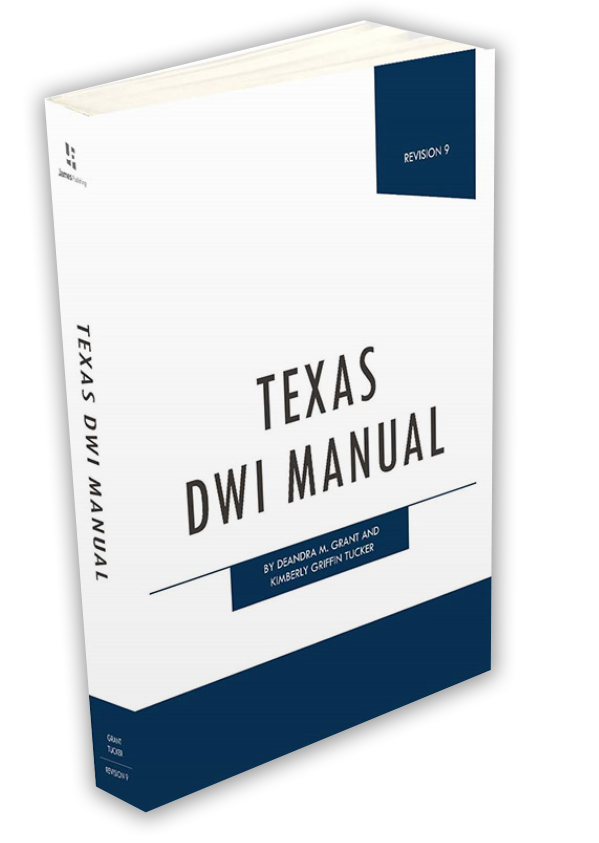
Texas DWI Manual
By Attorney Deandra Grant
Fighting DWI charges can present many challenges, not only for the defense, but prosecutors as well. This is why it is important to be armed with the necessary knowledge so you understand the DWI process.
Attorney Deandra M. Grant is the co-author of the Texas DWI Manual, offering legal advice to both clients and fellow attorneys.
Learn MoreDallas Felony DWI Attorneys
A felony DWI charge in Dallas County is a case that can take years of your liberty, end a career, and follow you for the rest of your life. The Texas Penal Code treats intoxication offenses that result in serious injury, death, repeat convictions, or the presence of a child in the vehicle as felonies, and the Dallas County Criminal District Courts impose real prison time on people convicted of them.
Deandra Grant Law defends people charged with felony DWI in Dallas County. Our defense is built on the forensic science that drives these cases including blood alcohol analysis, gas chromatography, drug toxicology, and accident reconstruction. Call (214) 225-7117 to discuss your case.
What Makes a DWI a Felony in Texas
A DWI is ordinarily a misdemeanor. Texas law elevates a DWI to a felony in four circumstances, each governed by Chapter 49 of the Texas Penal Code.
DWI Third or Subsequent — Texas Penal Code § 49.09(b)
A DWI becomes a third-degree felony when the person has two or more prior DWI convictions, regardless of how old those priors are. Texas has no “washout” period for DWI enhancement. A conviction from 25 years ago counts the same as one from last year.
Punishment range: 2 to 10 years in the Texas Department of Criminal Justice and a fine of up to $10,000.
Intoxication Assault — Texas Penal Code § 49.07
A person commits intoxication assault when, while operating a motor vehicle in a public place while intoxicated, by reason of that intoxication the person causes serious bodily injury to another. “Serious bodily injury” means injury that creates a substantial risk of death or causes serious permanent disfigurement or protracted loss or impairment of the function of any bodily member or organ.
Punishment range: Third-degree felony; 2 to 10 years in prison and a fine of up to $10,000, plus 160 to 600 hours of community service. Enhanced to a second-degree felony (2 to 20 years) if the victim is a peace officer, firefighter, or emergency medical services personnel on duty, or if the victim suffers a traumatic brain injury resulting in a persistent vegetative state.
Intoxication Manslaughter — Texas Penal Code § 49.08
A person commits intoxication manslaughter when, while operating a motor vehicle in a public place while intoxicated, by reason of that intoxication the person causes the death of another.
Punishment range: Second-degree felony; 2 to 20 years in prison and a fine of up to $10,000, plus 240 to 800 hours of community service. Enhanced to a first-degree felony (5 to 99 years or life) if the victim is a peace officer, firefighter, or emergency medical services personnel on duty.
DWI with Child Passenger — Texas Penal Code § 49.045
A person commits this offense by operating a motor vehicle in a public place while intoxicated, when the vehicle is occupied by a passenger younger than 15. The state does not have to prove any prior DWI conviction; a first offense is a felony.
Punishment range: State jail felony; 180 days to 2 years in a state jail facility and a fine of up to $10,000.
Consequences Beyond Prison Time
The prison range is only the headline. A felony DWI conviction carries consequences that begin the moment of arrest and continue long after any sentence is served.
- Driver’s license suspension. A felony DWI conviction triggers a license suspension under the Texas Transportation Code. A separate Administrative License Revocation (ALR) suspension is also triggered at arrest for anyone who refuses or fails a breath or blood test. The deadline to request an ALR hearing is 15 days from the date of the notice of suspension.
- Mandatory ignition interlock. Under Code of Criminal Procedure Article 17.441, a court must require an ignition interlock device as a condition of bond in most felony DWI cases. Interlock is also required as a condition of any occupational license.
- No deferred adjudication. House Bill 3582 (2019) made deferred adjudication available for some first-offense misdemeanor DWI cases with a BAC below 0.15%. It remains unavailable for any felony DWI offense. A plea of guilty or nolo contendere to a felony DWI produces a final conviction.
- Firearm rights. A felony conviction results in the loss of the right to possess a firearm under federal law (18 U.S.C. § 922(g)(1)) and restricts state carry rights under Texas Penal Code § 46.04(a). Texas’ constitutional carry law (House Bill 1927, effective September 1, 2021) does not restore rights lost through felony conviction.
- Professional licensing. Nurses, pharmacists, CDL holders, teachers, real estate agents, and many other licensed professionals face separate administrative proceedings before their licensing boards after a felony DWI.
- Immigration consequences. Felony DWI, and particularly DWI with child passenger or intoxication assault/manslaughter, can trigger removal, inadmissibility, or denial of naturalization for non-citizens.
- Civil liability. An intoxication assault or manslaughter case is almost always accompanied by a parallel civil lawsuit by the injured party or the decedent’s family.
Related Videos
How We Defend Felony DWI Cases
Felony DWI cases are won on the science. Nearly every felony DWI prosecution in Texas today turns on a blood test result, a toxicology report, or an accident reconstruction, and each of those areas has specific failure points a trained defense lawyer can identify.
Blood Alcohol Analysis
Blood alcohol in Texas is measured by headspace gas chromatography with flame ionization detection (GC-FID). Attacking a blood result requires understanding the instrument, the validation studies, the internal standard calibration, the column chemistry, and the chain of custody from the hospital or DPS laboratory.
Drug Toxicology
Drug-related DWI cases typically rely on liquid chromatography–tandem mass spectrometry (LC-MS/MS) confirmation. The pharmacology of the drug, whether the concentration correlates with impairment, active versus inactive metabolites, and the timing between the alleged driving and the draw are all contestable. We work with board-certified forensic toxicologists to challenge what the state claims the numbers mean.
Accident Reconstruction
In intoxication assault and intoxication manslaughter cases, the state must prove that the defendant’s intoxication caused the injury or death. That is a causation question separate from impairment. Independent accident reconstruction, event data recorder (EDR) downloads, and scene analysis frequently show that intoxication was not the cause.
Field Sobriety and Drug Recognition Evaluations
Deandra Grant is a Standardized Field Sobriety Test (SFST) instructor. She teaches the same curriculum the officers in your case were trained on, which means she can identify administration errors that invalidate the results the state wants to rely on.
Constitutional and Procedural Challenges
Traffic stops, DWI investigations, and warrant applications are constrained by the Fourth and Fifth Amendments, the Texas Constitution, and the Texas Code of Criminal Procedure. Suppression motions attacking the stop, the arrest, the warrant, and the statements are a routine and often decisive part of a felony DWI defense.
Challenging Priors on a DWI 3rd
A DWI 3rd prosecution requires the state to prove two prior DWI convictions. Judgment documents with incomplete records, out-of-state convictions that do not qualify under § 49.09(c), and convictions obtained without counsel are all areas where a supposedly rock-solid prior can be knocked out and which, in turn, reclassifies the case downward to a Class A misdemeanor.
Dallas County Courts
Felony DWI cases in Dallas County are filed in the Dallas County Criminal District Courts at the Frank Crowley Courts Building, 133 N. Riverfront Boulevard. The Dallas County District Attorney’s Office prosecutes. Our Dallas office is positioned to appear in the courthouse and to work with local investigators, toxicologists, and accident reconstructionists.
Frequently Asked Questions
I have two prior DWI convictions from years ago. Is this really a felony?
Yes. Texas has no lookback or washout period for DWI enhancement under § 49.09. Any two prior DWI convictions, at any age, can support a felony DWI 3rd charge.
My child was in the car but nothing happened. Is this really a felony?
Yes. DWI with child passenger under § 49.045 is a state jail felony on a first offense. No injury, no accident, and no prior DWI is required.
Can I get deferred adjudication on a felony DWI?
No. House Bill 3582 made deferred adjudication available for certain first-offense misdemeanor DWIs with a BAC below 0.15%. It is not available for any felony DWI.
Will I have to use an ignition interlock while my case is pending?
Almost certainly. Article 17.441 of the Code of Criminal Procedure makes interlock a required bond condition for most felony DWI cases in Texas. A judge must have a specific reason to deviate from it.
I refused the blood test. Can they still take my blood?
Yes. A refusal triggers an ALR suspension, and Texas officers routinely obtain search warrants to draw blood after a refusal. The validity of the warrant, the probable cause affidavit, and the draw itself are all contestable in the resulting criminal case.
How long will my case take?
Felony DWI cases in Dallas County typically take six months to eighteen months to resolve, longer when forensic evidence has to be independently retested or when the case is set for trial.
About Deandra Grant Law
Deandra Grant Law is a Texas criminal defense and DWI firm with offices in Dallas, Fort Worth, Waco, Denton, Allen, and Rockwall. Our Dallas felony DWI defense is led by attorneys whose qualifications are built specifically for the forensic science that drives these cases.
Deandra M. Grant, Managing Partner
- More than 30 years in practice, focused on criminal defense and DWI
- Former prosecutor
- J.D.; M.S. in Pharmaceutical Sciences
- Graduate Certificate in Forensic Toxicology
- ACS-CHAL Forensic Lawyer-Scientist from the American Chemical Society
- Standardized Field Sobriety Test (SFST) Instructor
- Texas Super Lawyer since 2011
- Author of 17 law books including The Texas DWI Manual
- Executive Director, DUI Defense Lawyers Association (DUIDLA)
Douglas E. Huff, Partner
- ACS-CHAL Forensic Lawyer-Scientist
- Digital forensics and electronic evidence training
- Extensive North Texas DWI trial experience
James Lee Bright, Of Counsel
- National federal criminal defense practice
- Admitted to all four Texas federal districts, the District of Columbia, the Fifth Circuit Court of Appeals, and the Supreme Court of the United States
- Serious-felony and complex-case experience
Related Blogs
Contact Our Dallas Felony DWI Attorneys
If you or someone you love has been charged with felony DWI in Dallas County, the time to build a defense is now. Blood samples can be re-tested. Warrants can be challenged. Witnesses’ memories are fresher than they ever will be again. The decisions made in the first weeks after arrest often determine the result of the case.
Call Deandra Grant Law at (214) 225-7117 to schedule a consultation. We serve Dallas County and surrounding North Texas counties from our Dallas office.
Frequently Asked Questions About Felony DWI in Dallas, TX
If you have been recently arrested for a Felony DWI in Dallas, TX, you likely have many questions and concerns about your situation. At Deandra Grant Law – Criminal & DWI Defense, we understand the complexities of Felony DWI cases and are here to provide you with answers to some of the most commonly asked questions.
What is considered a Felony DWI in Dallas, TX?
A Felony DWI in Dallas, TX is a Driving While Intoxicated charge that is elevated to a felony level due to certain aggravating factors. These factors may include prior DWI convictions, accidents causing serious bodily injury, or other specific circumstances. Felony DWI charges carry more severe penalties than misdemeanor DWI charges.
What are the potential consequences of a Felony DWI conviction?
A Felony DWI conviction in Dallas, TX can lead to significant consequences, such as substantial fines, extended jail or prison time, a suspended driver’s license, mandatory installation of an ignition interlock device, probation, and a permanent criminal record. The impact of a Felony DWI conviction on your personal and professional life can be long-lasting.
Can I challenge the evidence against me in a Felony DWI case?
Yes, you have the right to challenge the evidence presented against you in a Felony DWI case. Experienced Felony DWI attorneys at Deandra Grant Law – Criminal & DWI Defense will carefully review the evidence, including police reports, field sobriety test results, breathalyzer or blood test data, and any other relevant information to identify potential weaknesses in the prosecution’s case.
Can I still drive with a suspended license after a Felony DWI arrest?
If your driver’s license is suspended following a Felony DWI arrest in Dallas, TX, it is illegal to operate a motor vehicle until your driving privileges are reinstated. Driving with a suspended license can result in additional charges and penalties.
How can an attorney at Deandra Grant Law – Criminal & DWI Defense help me with my Felony DWI case?
Our experienced Dallas Felony DWI attorneys at Deandra Grant Law – Criminal & DWI Defense will provide personalized and aggressive representation for your case. We will carefully evaluate the circumstances surrounding your arrest, explore potential defense strategies, and advocate on your behalf in court and administrative proceedings. Our goal is to protect your rights, pursue a positive outcome for your case, and minimize the impact of the charges on your life.
Can I get my Felony DWI charge reduced to a misdemeanor?
In some cases, it may be possible to negotiate with the prosecution to have a Felony DWI charge reduced to a misdemeanor. This can result in less severe penalties and a less detrimental impact on your criminal record. However, securing a reduction requires skillful negotiation and a thorough understanding of Texas DWI laws, which our experienced attorneys possess.
How can I schedule a free consultation with an attorney at Deandra Grant Law – Criminal & DWI Defense?
Scheduling a free consultation with one of our experienced Felony DWI attorneys is simple. You can reach us by phone or through our website’s contact form. During the consultation, we will discuss the details of your case, answer your questions, and provide initial guidance on the best steps to take.
Client Reviews

“Deandra Grant Law – Criminal & DWI Defense handled my case with diligence and professionalism. Deandra Grant’s reputation is stellar and now I know why. She has a team of individuals who provide quality service.”
N. Coulter


(214) 225-7117
Experienced DWI Defense