In a Massachusetts courtroom this month, a jury is being asked one of the hardest questions the criminal law poses. Lindsay Clancy, a Duxbury mother of three, does not dispute that she caused her three children’s deaths in January 2023. What her lawyers dispute is whether she is criminally responsible for it. Her defense is legal insanity, rooted in severe postpartum psychosis, and it has revived a debate that most people only half understand: how a person can admit to doing a terrible thing and still, in the eyes of the law, be found not guilty.
For a Texas audience, the case is also a window into how differently this one defense works from one state line to the next. What would happen to a defense like Clancy’s here is not what may happen in Massachusetts, and the reasons go to the core of one of the most misunderstood ideas in American criminal law. Here is what the insanity defense actually is, why conceding the act is not the same as conceding guilt, and how Texas’ insanity standard compares with the one being applied in the Clancy trial.
Admitting the Act Is Not Admitting Guilt
Start with the piece that confuses almost everyone. A crime is not just a bad act; it is a bad act committed with a certain state of mind. The law calls these two ingredients the actus reus (the wrongful act) and the mens rea (the guilty mind), and to convict, the State generally must prove both. The insanity defense operates on the second ingredient. It says, in effect: yes, I did the act, but because of a severe mental illness I lacked the criminal responsibility that turns an act into a crime. That is why a defendant can stand up, concede that she caused a death, and still ask a jury to find her not guilty. She is not denying what happened; she is denying that the law should hold her blameworthy for it.
This is also why the popular image of the insanity defense as an easy escape hatch is so far from reality. It is raised in only a small share of felony cases and succeeds in a fraction of those. And a successful insanity verdict is not a release. In every state, a defendant found not guilty by reason of insanity is committed to a secure psychiatric facility, often for years, sometimes for longer than a prison term would have lasted, subject to periodic hearings on whether she is still dangerous. It is a different outcome, not a free one.
What Postpartum Psychosis Is, and Why It Matters Here
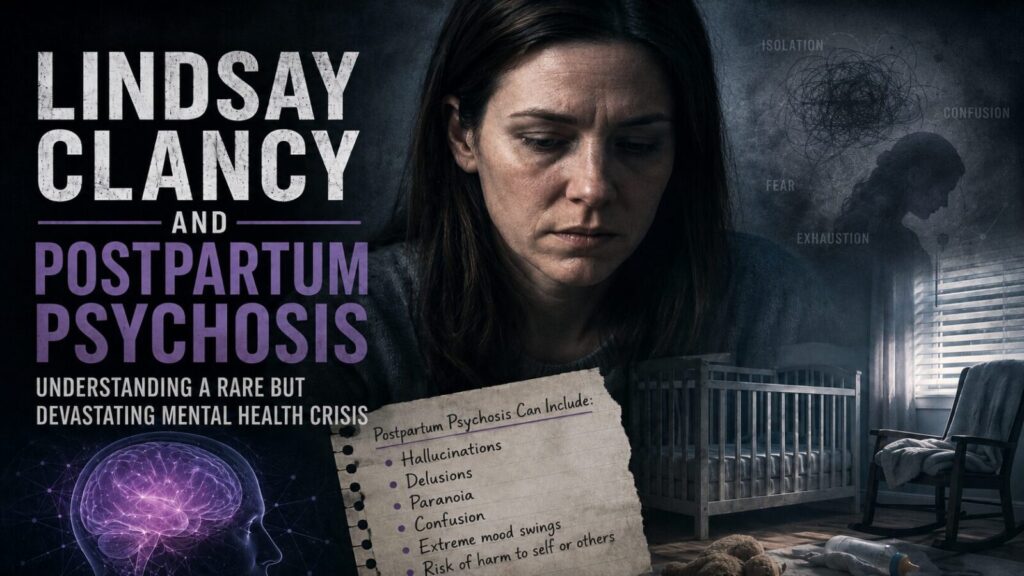
Postpartum psychosis is the rare and severe end of the spectrum of maternal mental illness, distinct from the common “baby blues” and even from postpartum depression. It affects roughly one to two mothers per thousand births, usually comes on quickly in the weeks after delivery, and can involve delusions, hallucinations, profound confusion, and a frightening loss of contact with reality. In its worst form it can produce command hallucinations, voices that direct the sufferer to act, along with delusional beliefs that reframe a horrific act as somehow protective. It is a genuine psychiatric emergency, not a character flaw.
That clinical picture is what makes these cases so legally fraught. According to the defense in the Clancy case, she was in the grip of exactly this kind of psychosis, and reporting on the case has described a command hallucination, a voice directing her to harm the children. The prosecution has taken the opposite view, arguing that she acted deliberately and was in control. Which account the jury credits will decide the case. The deeper point, for our purposes, is what legal test the jury has to run that evidence through, because that test is not the same everywhere.
The Massachusetts Standard: Two Ways to Be Insane, and the State Must Disprove Both
Massachusetts uses the broader of the two dominant insanity standards, drawn from the American Law Institute’s Model Penal Code and adopted in the state’s landmark decision Commonwealth v. McHoul. Under it, a person is not criminally responsible if, because of a mental disease or defect, she lacked substantial capacity to do either of two things: to appreciate the wrongfulness of her conduct or to conform her conduct to the requirements of the law. That second branch is crucial. It recognizes a volitional failure: the person who may know an act is wrong but, because of illness, cannot stop herself from doing it.
Massachusetts also places the burden of proof in an unusual, defendant-friendly spot. Once the defense raises credible evidence of mental illness, the Commonwealth must prove beyond a reasonable doubt that the defendant was sane, and it must do so even though she has admitted the act. The prosecution, in other words, has to disprove insanity to the same demanding standard it uses to prove everything else. For a defendant like Clancy, that combination of a volitional prong and the state’s heavy burden is about as favorable as the insanity defense gets in this country.
The Texas Standard: Narrower, and the Burden Flips
Texas takes a markedly different and much narrower path. Under Section 8.01 of the Penal Code, insanity is an affirmative defense that succeeds only if, at the time of the offense, the defendant, as a result of a severe mental disease or defect, “did not know that his conduct was wrong.” There is no volitional branch. It does not matter, under the statute, whether the illness made it impossible for the person to control her behavior. The only question is whether she knew the conduct was wrong.
And Texas courts have defined “wrong” in the way hardest for a defendant. In Bigby v. State, the Court of Criminal Appeals held that “wrong” means illegal. So, a defendant who knew her act was against the law is legally sane in Texas even if her illness convinced her the act was morally right (or even commanded). A psychotic mother who believed a voice was telling her to save her children by killing them could still fail the Texas test as long as she also knew that killing them was against the law.
The burden flips here, too. Texas presumes every defendant sane and makes insanity an affirmative defense, which means the defendant must prove it by a preponderance of the evidence. Where Massachusetts makes the state disprove insanity beyond a reasonable doubt, Texas makes the accused establish it herself, on a more-likely-than-not basis. By design, Texas has one of the most stringent insanity standards in the United States.
Texas Has Already Seen This Case: Andrea Yates
Texans do not have to imagine how a Clancy-type defense plays out here, because the state lived through it. In 2001, Andrea Yates, a Houston mother suffering from severe postpartum psychosis, drowned her five children while in the grip of a delusion, fed by command hallucinations, that she was saving them from damnation. By any clinical measure she was profoundly ill. And in 2002 a Texas jury convicted her of capital murder anyway, because under the narrow Texas test the prosecution argued she knew the killings were wrong, pointing to the fact that she called the police right afterward. Her illness was not in serious doubt. The problem was that Texas law asked only whether she knew the act was wrong, not whether she could resist it.
Yates was eventually found not guilty by reason of insanity, but only on retrial in 2006, and only after her first conviction was overturned because a prosecution expert had given false testimony. Even then she was committed to a state hospital, not freed. The Yates saga is the clearest illustration of the gap between the two standards: the same kind of facts that give a defense real traction under the Massachusetts test produced a capital-murder conviction the first time through in Texas. The law, not just the illness, shaped the result.
Why the Standard Matters More Than the Diagnosis
That is the lesson worth taking from the Clancy trial, wherever it ends. Whether an act like this is treated as a crime or as the product of an illness does not turn on the diagnosis alone. It turns on the legal test the jurisdiction has chosen: whether that test recognizes a person who cannot control her conduct, and who carries the burden of proof. A defendant can be unambiguously, severely mentally ill and still be convicted under a narrow standard or acquitted under a broad one. Same illness, different state, different result.
For anyone facing a Texas case in which mental illness is central, that makes two things essential: an early and serious psychiatric evaluation, and a defense team that understands both the science of the illness and the specific, demanding contours of Section 8.01. The insanity defense is not the cartoon that popular culture makes of it. It is narrow, it is hard, and in Texas it is harder than almost anywhere, which is exactly why it has to be built with care.
The Bottom Line
“Not guilty by reason of insanity” does not mean a person did not do the act and it does not mean she goes free. It means the law has decided that a severe mental illness stripped her of the responsibility that turns an act into a crime, and it commits her to psychiatric custody instead of prison. Massachusetts, where Lindsay Clancy is being tried, asks whether illness robbed her of the capacity to know the act was wrong or to control it, and it makes the state disprove insanity beyond a reasonable doubt. Texas asks only whether she knew the act was wrong, treats “wrong” as “illegal,” and puts the burden on her to prove it. The difference between those two frameworks is, quite literally, the difference between a hospital and a prison. It is why the most misunderstood defense in American law deserves to be understood clearly.
Deandra Grant is the managing partner of Deandra Grant Law, a Texas DWI and criminal defense firm. A forensic lawyer-scientist, she has spent three decades working at the intersection of the science, the mental-health evidence, and the law that decide the State’s cases.
If you or someone you know is struggling with postpartum mental illness, the National Maternal Mental Health Hotline offers free, confidential support around the clock at 1-833-TLC-MAMA (1-833-852-6262).
Further Reading
- The Boston Globe’s ongoing coverage of the Lindsay Clancy trial. bostonglobe.com
- Texas Penal Code Section 8.01 (Insanity). law.justia.com
- Commonwealth v. McHoul, 352 Mass. 544 (1967), which adopted the Model Penal Code insanity standard in Massachusetts. law.justia.com
- Texas District & County Attorneys Association, “Understanding the Insanity Defense,” on the Section 8.01 test, the “wrong means illegal” rule, and the defendant’s burden. tdcaa.com
- On the Andrea Yates case and the stringency of the Texas standard: FindLaw legal commentary, “The Andrea Yates Verdict and Sentence.” findlaw.com
- Bigby v. State, 892 S.W.2d 864 (Tex. Crim. App. 1994) (defining “wrong” as “illegal”); and Tex. Code Crim. Proc. Chapter 46C (procedures and commitment following an insanity acquittal).
This post is an informational synthesis for educational purposes and is not legal advice. The Lindsay Clancy trial was ongoing as of publication, and nothing here is a prediction of its outcome. Case citations should be independently verified against the official record before use in any filing.