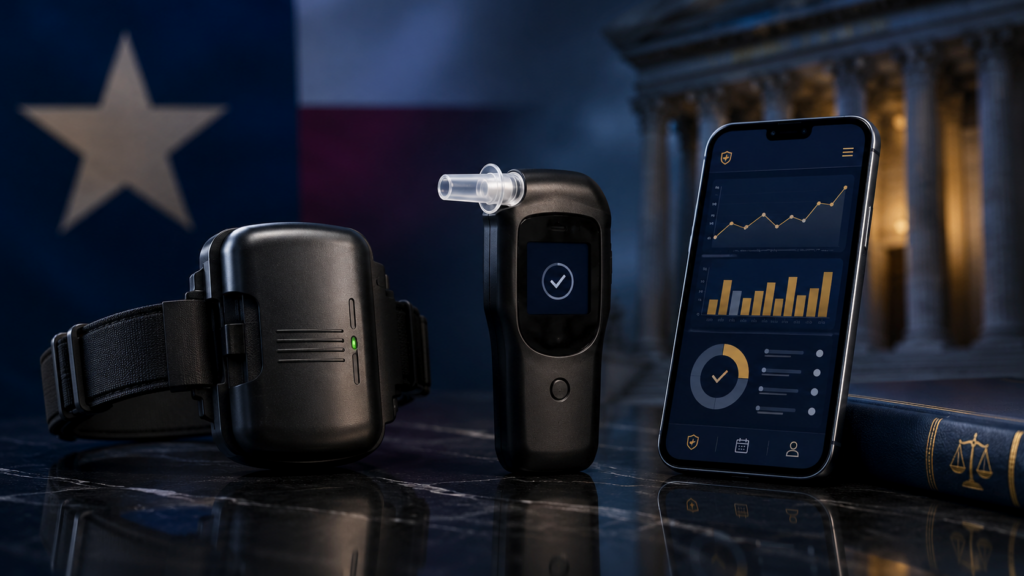
SCRAM, Ignition Interlock, Soberlink, and the New Wave of Wearables — What They Are, Who Makes Them, and Where the Science Breaks Down
By Deandra Grant, J.D., M.S. (Pharmaceutical Science), ACS-CHAL Forensic Lawyer-Scientist
If you have a DWI case in Texas, there is a good chance a monitoring device will become part of it as a condition of bond, a condition of probation, or part of a plea. These devices go by a lot of names: SCRAM, CAM, interlock, Soberlink, “the ankle bracelet,” “the car breathalyzer.” They are not interchangeable. They use different technology, answer different questions, and fail in different ways.
I wrote a short Ask Deandra post explaining what a single SCRAM device is. This is the longer companion piece: a working map of the entire alcohol-monitoring landscape a Texas defendant, family, or lawyer is likely to encounter, including the major manufacturers, the products actually on the market in 2026, the wearable wrist technology people keep asking about, and the places where a confident-looking number deserves a hard second look.
| The one idea to carry through this whole guide: these devices measure a chemical signal. They do not measure behavior, and they do not establish intent. A reading is the beginning of an inquiry, not the end of one. |
First, the Big Picture: Two Families of Devices
Almost every alcohol-monitoring device a Texas court uses falls into one of two families, and almost all of them share the same sensor at their core: an electrochemical fuel cell that reacts with ethanol and produces a small electrical current. The difference is where the device looks for alcohol and how often.
- Breath-based devices read alcohol in a breath sample. This family includes the ignition interlock wired into a car and handheld remote breathalyzers like Soberlink and SCRAM Remote Breath. They produce a Breath Alcohol Concentration (BrAC) at the moment you blow.
- Transdermal devices read the tiny amount of alcohol that leaves the body through the skin. The ankle-worn SCRAM CAM bracelet is the dominant product here. It produces a Transdermal Alcohol Concentration (TAC), sampled automatically around the clock.
That single distinction (breath versus skin, on-demand versus continuous) drives everything else: when a court picks one over the other, what the data can prove, and how it can be challenged.
Transdermal Monitoring: The SCRAM Family
SCRAM stands for Secure Continuous Remote Alcohol Monitor. It is made by SCRAM Systems (formerly Alcohol Monitoring Systems, Inc.), and it is by far the most widely used transdermal alcohol monitor in the American justice system. The company reports having monitored more than one million clients. In North and Central Texas, courts in Dallas, Tarrant, Collin, Denton, McLennan, and Rockwall Counties order it routinely.
How transdermal monitoring works
When you drink, your body eliminates most of the alcohol through metabolism, but a very small fraction (roughly 1%) leaves unchanged through the skin in what is called insensible perspiration. The SCRAM CAM bracelet sits against the ankle and, about every 30 minutes, samples the air and perspiration just above the skin, measures the ethanol with a fuel cell, and logs the reading along with skin temperature and infrared data meant to confirm the device is actually being worn on a human leg. The data uploads wirelessly (usually overnight through a base station in the home) to the monitoring agency and the court.
Because transdermal alcohol lags behind blood alcohol by roughly 30 minutes to two hours and peaks at much lower levels, SCRAM is not a roadside or impairment tool. It is an abstinence tool. The court is not asking “How drunk were you?” It is asking “Did you drink at all?”
The SCRAM Systems product line
“SCRAM” is a brand, not a single gadget. The company sells an integrated suite, and a Texas defendant may encounter several pieces of it:
| Product | Type | What it does |
| SCRAM CAM | Transdermal (ankle) | The classic 24/7 ankle bracelet. Continuous abstinence monitoring for higher-risk clients; can be bundled with house-arrest/RF curfew. |
| SCRAM Remote Breath / Remote Breath Pro | Breath (handheld) | Portable wireless breathalyzer with facial recognition and GPS on each test. Scheduled, random, on-demand, or client-initiated testing for lower-risk clients. |
| SCRAM GPS | Location | Ankle GPS tracking with geofencing and tamper alerts — not alcohol monitoring, but often bundled. |
| SCRAM House Arrest | Curfew/RF | Home-confinement compliance monitoring. |
| SCRAM Nexus / Insight | Software | Case-management and analytics platforms agencies use to review and flag the data. |
Why this matters for a case: the software layer is where raw sensor readings get turned into a “confirmed drinking event.” That classification is an interpretation made by an analyst applying proprietary criteria and not a direct measurement. SCRAM Systems also continues to expand its product line, so the exact mix of devices and software in your case may differ from a case filed a year earlier.
What SCRAM reports to the court
- Confirmed drinking events — readings the agency flags as consistent with the absorption-and-elimination curve of consumed alcohol.
- Tamper events — attempts to remove the bracelet, obstruct the sensor, or place a barrier between sensor and skin.
- Missed readings and disconnections — failed uploads, dead batteries, or loss of skin contact.
Any of these can trigger a bond-revocation hearing or a motion to revoke probation which is exactly why the reliability of the underlying data is worth fighting over.
Breath Monitoring in the Car: Ignition Interlock Devices (IIDs)
An ignition interlock device is a breath tester wired into a vehicle’s ignition. The driver blows into it; if the device detects alcohol above a set threshold, the car will not start. Many units also require rolling retests while driving and store a log of every result, photo, and engine event for the supervising agency.
When Texas requires an interlock
Interlock requirements in Texas come from the Code of Criminal Procedure and the Transportation Code. In broad strokes:
- As a bond condition under 17.441: mandatory for a second or subsequent DWI, and on a first offense for DWI with a child passenger (§49.045), intoxication assault (§49.07), or intoxication manslaughter (§49.08). Judges also use the general bond-condition power of Art. 17.40 to order interlock on a first DWI with a high BAC.
- As a condition of community supervision under 42A.408: mandatory where the trial showed an alcohol concentration of 0.15 or more, on §49.09 enhancements, where the defendant has a qualifying prior or if the defendant is placed on deferred adjudication for a Class B DWI.
- Carried into an occupational license: if you obtain an ODL while an interlock requirement exists, the restriction follows you into that license ( Code §521.246), subject to a limited employer-vehicle exception.
Who makes the interlocks: the Texas-approved vendors
Unlike SCRAM, interlocks are not a single-manufacturer market. The Texas Department of Public Safety certifies the device models that may be used in the state under Transportation Code §521.2476, and several manufacturers compete for that business. Models that have appeared on the Texas DPS approved list include:
- Smart Start (SSI-1000, SSI 20/20, SSI 20/30, SSI-2035, Flex 3030) — a Texas-based company and one of the most common providers in the state.
- Intoxalock (1001A).
- LifeSafer (FC100, L250).
- Low Cost Interlock (LCI-750, TAB-720, LCI-777).
- Monitech (QT-1L), Simple Interlock (Co-Pilot), Skyfine (AT588), and Smart Alco Solutions / Alcobrake (A-200).
| Practical note: because the approved-vendor list changes as DPS certifies and de-certifies models, confirm the current list and the specific model installed in your case rather than relying on any single article. The device model matters for calibration intervals and for what records exist. |
Breath Monitoring Without a Car: Soberlink and Remote Breathalyzers
Not every breath-monitoring order involves a vehicle. A growing category of handheld, cellular-connected breathalyzers lets a person prove sobriety on a schedule from anywhere. The dominant product is Soberlink, and SCRAM Systems competes here with Remote Breath.
Soberlink
Soberlink is a portable, professional-grade fuel-cell breathalyzer with cellular connectivity. Its signature features are real-time facial recognition to verify who is testing, tamper-detection sensors, and instant reporting of each result by text or email to designated parties. The company markets FDA 510(k) clearance and reports long use in family-law matters. In Texas, you often see Soberlink in family court (custody and visitation disputes where one parent’s drinking is at issue) in addition to criminal court.
One claim worth flagging for cross-examination: Soberlink’s materials state that its fuel-cell sensor is specific to alcohol and “does not respond to acetone.” Fuel cells are indeed more specific than older sensor types, but specificity is not the same as immunity. Mouth alcohol from products and substances, the absence of a built-in observation period, and the device’s inability to distinguish the source of ethanol all remain live issues (the same interpretation problems that affect every fuel-cell device).
SCRAM Remote Breath
SCRAM’s Remote Breath and Remote Breath Pro occupy the same niche on the criminal-justice side: a portable breathalyzer with facial recognition and GPS tagging on each test, marketed for lower-risk clients or as a “step-down” for someone who has demonstrated long-term compliance on the CAM ankle unit. Buddi’s AlcoTag (distributed alongside SCRAM products by some providers) combines alcohol testing with GPS in one unit.
The Question Everyone Asks: What About the Wrist Device?
A lot of people remember hearing about a wrist-worn alcohol monitor (which is something that looks like a fitness tracker instead of a clunky ankle bracelet) and want to know whether they can wear that instead. Here is the honest, current picture.
Wrist-worn transdermal sensors are real and the technology has advanced quickly, but as of 2026 they live almost entirely in the research and consumer-wellness world and not in the court-ordered compliance world. The history is instructive:
- WrisTAS was an early wrist-worn transdermal research device, used in studies for years.
- Quantac Tally was a consumer wrist sensor but the company ceased operations in 2017.
- BACtrack Skyn won the NIAAA’s Wearable Alcohol Biosensor Challenge and is the best-known wrist device today. It continuously estimates TAC and pairs with a smartphone app. Crucially, BACtrack’s own materials state that Skyn is “available for research use only” and is not cleared or approved by the FDA and it is not (yet) a court-ordered compliance product.
| Bottom line on wearables: you generally cannot substitute a consumer wrist device for a court-ordered SCRAM CAM bracelet. Wrist sensors are promising for treatment, research, and personal awareness, but they have not been validated and accepted as single-source, court-admissible compliance evidence the way SCRAM CAM has. If a court is going to rely on transdermal data to affect someone’s liberty, it is still going to use the ankle device. |
It is worth watching this space. Research repeatedly finds that subjects prefer the wrist form factor, and the field is moving fast. But “preferred in a study” and “accepted by a Texas court as proof of a probation violation” are very different standards.
Side by Side: How the Devices Compare
| Feature | SCRAM CAM (ankle) | Ignition interlock | Soberlink / Remote Breath |
| Measures | Transdermal (TAC) | Breath (BrAC) | Breath (BrAC) |
| Where worn/used | Ankle, continuous | In the vehicle | Handheld, anywhere |
| Sampling | Automatic, ~every 30 min | At start-up + rolling retests | Scheduled / random / on-demand |
| Identity check | Skin temp + IR | Some models: camera | Facial recognition |
| Typical Texas use | Bond / probation abstinence | Bond / probation; ODL | Family court; some probation |
| Stops the car? | No | Yes | No |
Where the Science Breaks Down (The Part Prosecutors Skip)
Every one of these devices is built on the same fuel-cell chemistry, and that chemistry has the same well-documented blind spots. A device can be working perfectly and still generate a reading that does not mean what the report says it means. The recurring problem areas:
- It detects ethanol, not the source of ethanol. A fuel cell cannot tell whether alcohol came from a drink or from hand sanitizer, lotion, perfume, hairspray, cleaning products, or an industrial environment. Transdermal and breath devices alike can be fooled by environmental ethanol.
- Cross-reactivity and the body’s own chemistry. Volatile organic compounds (solvents, fuels, some cleaning agents) can influence fuel-cell readings. Physiological states (diabetes, ketogenic diets, fasting) can raise acetone and isopropanol, and conditions like GERD can push vapor into a breath sample.
- “Consistent with consumption” is a judgment, not a measurement. Whether a curve reflects drinking is an analyst’s interpretation, applying proprietary criteria, for a company whose product exists to detect drinking. That is the textbook setting for confirmation bias.
- The data is interpreted before you ever see it. Proprietary algorithms smooth the raw signal, internal thresholds decide what becomes a reportable event, and the raw dataset is frequently withheld. The report is the conclusion, not the evidence.
- Calibration drift. Fuel cells drift and require periodic recalibration. Without the calibration and maintenance history for the specific unit, there is no way to confirm the device was reading true on the dates that matter.
- Delayed reporting destroys context. Transdermal violations are sometimes reported weeks or months later. By then the glucose logs, work schedules, product receipts, and witness memories that would explain a reading may be gone. That is a failure of timing, not of innocence.
None of this means the devices never work. It means a positive reading is a starting point for inquiry, and that the conclusion drawn from it has to be justified and not assumed.
Challenging Monitoring Evidence in a Texas Court
In Texas, scientific evidence is not automatically admissible. Under Kelly v. State, 824 S.W.2d 568 (Tex. Crim. App. 1992), and Rule of Evidence 702, the party offering the evidence must show, by clear and convincing proof, that (a) the underlying science is valid, (b) the technique applying it is valid, and (c) the technique was properly applied on this occasion. That third prong (was the technique properly applied on this occasion?) is where monitoring cases are usually won or lost. The three real cases below show what that looks like in practice.
Two practical points. First, Kelly applies not just at trial but at bond hearings and motions to revoke. Second, the State’s witness is often a monitoring-provider employee who can authenticate a report but cannot speak to the science; a timely objection paired with voir dire under Rule 705(b) tests whether anyone present can actually prove up prong (c).
What prong (c) looks like in real cases
The best way to understand why a monitoring number is not self-proving is to look at cases where the data convicts itself. My colleague Jan Semenoff, a forensic criminalist, has reviewed monitoring logs where simple arithmetic (not a clever defense theory) shows the reading could not be true. Three examples make the point.
The toothpaste positive (breath monitor). A father on a zero-tolerance order had logged more than 100 clean tests. One morning, right after brushing his teeth, his device reported a 0.114 and then a clean 0.000 about an hour and a half later. The problem: the human body eliminates alcohol at roughly 0.015 per hour, and the fastest rate ever reported is about 0.045. To erase a 0.114 that quickly, this man would have had to clear alcohol several times faster than any human on record. He could not have, which means the reading was never blood alcohol at all. The real source was mouth alcohol from the toothpaste, which contained ethanol and that is a contamination problem the device had no way to catch. The judge agreed, restored his visitation, and ordered the unit replaced.
The Static Guard reading (SCRAM transdermal). A SCRAM unit flagged a positive overnight while the wearer slept under a brand-new blanket that had just been sprayed with Static Guard which is a product that is mostly ethanol. The reported curve told the story: it spiked almost instantly to a level that would have required more than a dozen drinks consumed and fully absorbed in minutes, then fell in a way that looks nothing like human metabolism. The body clears alcohol at a steady, roughly straight-line rate; this curve dropped fast and then flattened, which is the signature of a liquid evaporating off the skin and the blanket — not a person processing a drink. The data matched contamination, not consumption.
Two devices, one truth (SCRAM versus interlock). A second SCRAM wearer showed erratic overnight readings that peaked around 8:00 a.m. At nearly that exact moment, he blew a clean 0.00 into his ignition interlock and started his car. Both devices cannot be right. The contradiction itself was the evidence but it was only visible because someone requested and compared both data sets. Standing alone, the SCRAM report would have looked like an open-and-shut violation.
In each case the device was not necessarily broken. What failed was the interpretation of the reading. And in each, the answer came from the records behind the number, which is why discovery matters so much.
What your defense team should demand in discovery
- The raw data files — every reading, skin-temperature and IR data point, and the testing curves (not just the summary report).
- Calibration and maintenance records for the specific unit assigned to the client, not a generic certificate.
- Chain-of-custody documentation for the device: installation, removal, and any service events.
- The analyst’s training records and the internal protocols used to classify a reading as a confirmed drinking event.
- Threshold and algorithm settings — any smoothing or filtering applied to the raw signal before reporting.
If You Are Ordered to Wear or Use One
Compliance matters — but so does protecting yourself against a false reading. Practical steps:
- Read every label. Avoid products listing alcohol, ethanol, ethyl alcohol, or denatured alcohol (sanitizers, body sprays, lotions, cleaners, mouthwash, some cosmetics) and keep them away from the device.
- Keep a daily log. Note your activities, the products you used, the environments you were in, and any unusual exposures (a paint project, a new cleaning job, a shift in a bar as a non-drinker). If a reading is challenged, that log becomes evidence.
- Do not tamper. Even well-meant attempts to adjust a strap or clean a sensor can generate tamper events that are harder to defend than a drinking allegation.
- Report problems immediately to the monitoring company and your attorney. A contemporaneous report beats an after-the-fact explanation every time.
- Call your lawyer the moment you get a violation notice. The sooner the team can request raw data, device logs, and calibration records, the stronger your position.
- Consider structured monitoring education. Programs such as the myCAMprogram teach clients how monitoring devices work and how to avoid preventable violations.
The Bottom Line
Alcohol-monitoring devices are useful tools, and they keep many people out of jail. But they are instruments, not oracles. SCRAM watches the skin; interlocks and Soberlink watch the breath; the wrist devices people ask about are still mostly confined to research. Every one of them produces a number that requires interpretation. In a Texas courtroom, the difference between a violation and a defensible outcome is often whether someone understood what that number could, and could not, say.
Alcohol Monitoring Defense at Deandra Grant Law
Deandra Grant Law defends DWI and intoxication-offense cases across North and Central Texas including Dallas, Fort Worth, Plano, McKinney, Frisco, Allen, Lewisville, Denton, Rockwall, and Waco. Our team includes an ACS-CHAL Forensic Lawyer-Scientist with a Master of Science in Pharmaceutical Science and a Graduate Certificate in Forensic Toxicology.
Call Deandra Grant Law at (214) 225-7117 or visit texasdwisite.com to schedule a confidential consultation.
This article is for general educational purposes and is not legal advice. Device models, manufacturers, and Texas approved-vendor lists change over time; confirm current information for any specific case. Statutory citations should be verified against the current code.