By Deandra Grant, J.D., M.S. (Pharmaceutical Science), ACS-CHAL Forensic Lawyer-Scientist
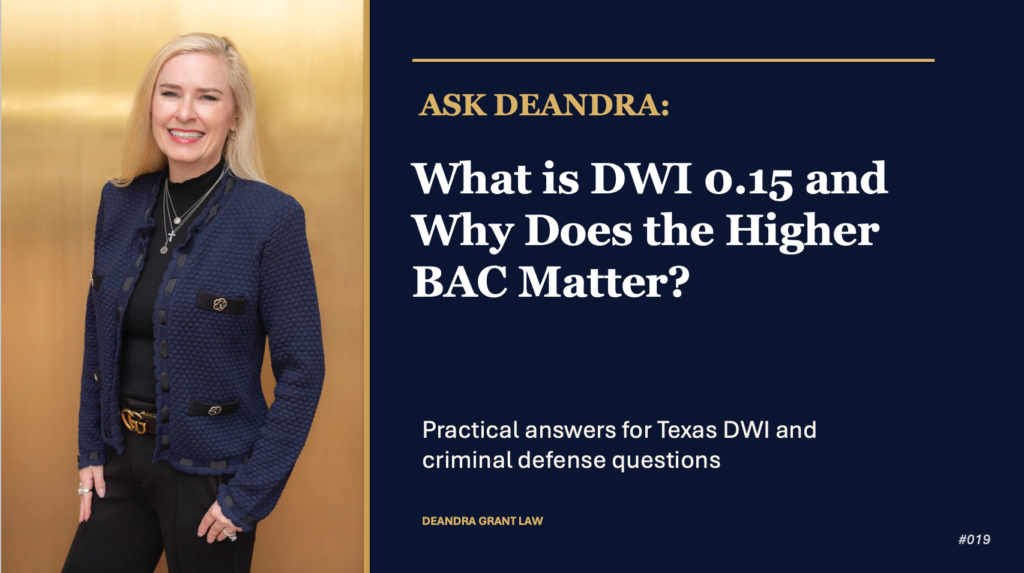
The question: What is “DWI 0.15” and why does the higher BAC matter?
The short answer: “DWI 0.15” is shorthand for a first-offense DWI charged as a Class A misdemeanor under Penal Code §49.04(d) because the defendant’s reported alcohol concentration was 0.15 or higher at the time the analysis was performed. The 0.15 threshold doubles the maximum jail exposure from 180 days to one year, doubles the maximum fine from $2,000 to $4,000, triggers mandatory ignition interlock under Article 17.441 of the Code of Criminal Procedure, and (critically) closes off HB 3582 deferred adjudication entirely. The 0.15 number is presented to juries as objective scientific evidence. It is not. It is the output of an instrument with documented variability, applied to a body with individual physiology, under conditions that may or may not have been controlled. The higher BAC matters legally, but the BAC reading itself is forensically contestable and, in a Class A enhancement case, contesting it is among the most consequential things the defense can do.
Here is the longer answer: what §49.04(d) actually says, why the 0.15 threshold has cascading consequences, and how the science of breath and blood testing intersects with the legal threshold.
The Statute: Penal Code §49.04(d)
Texas Penal Code §49.04 makes it an offense to operate a motor vehicle in a public place while intoxicated. Subsection (d), added by the Texas Legislature in 2011, provides:
“If it is shown on the trial of an offense under this section that an analysis of a specimen of the person’s blood, breath, or urine showed an alcohol concentration level of 0.15 or more at the time the analysis was performed, the offense is a Class A misdemeanor.”
This single subsection converts a first-offense DWI from a Class B misdemeanor (up to 180 days in jail, up to $2,000 fine) to a Class A misdemeanor (up to one year in jail, up to $4,000 fine). The mechanism is straightforward: the 0.15 reading enhances the offense classification for that specific case.
Note the precise statutory language: the analysis must show a concentration of 0.15 or more “at the time the analysis was performed.” The reading is the trigger: not the concentration at the time of driving, not the concentration at the time of arrest, but the concentration at the time the laboratory or breath instrument actually performed the analysis. This timing language matters, and it is forensically important.
Why 0.15 — The Policy Background
The Texas Legislature chose 0.15 as the enhancement threshold because of public-safety concerns about high-BAC drivers. Research on alcohol-related crash risk consistently shows that crash risk increases steeply with BAC, with substantially elevated risk at concentrations above 0.15. The legislature’s policy judgment was that drivers who reach this concentration represent a meaningfully more dangerous category than those just over 0.08 and that the law’s response should reflect that difference.
Whether one agrees with the policy or not, it is the law. And it is enforced. §49.04(d) is one of the most commonly applied DWI enhancements in Texas. Any DWI prosecution where the State has a reading at or above 0.15 will be charged as a Class A first offense, with all the consequences that follow.
The Cascading Consequences of §49.04(d)
The Class A enhancement is more consequential than it looks at first. The headline change (doubling the jail cap from 180 days to one year) is only the beginning. The 0.15 threshold also triggers:
- Mandatory ignition interlock as a condition of bond. Under Code of Criminal Procedure Article 17.441, the court must require an ignition interlock as a condition of bond for any defendant charged under §49.04(d). Bond conditions in DWI 0.15 cases routinely include interlock from the moment of arraignment.
- Mandatory ignition interlock as a condition of probation. In most DWI 0.15 cases that result in a probated disposition, the court orders interlock for a substantial portion of the probation term and often the entire term.
- Closure of HB 3582 deferred adjudication. This is the most consequential closure. HB 3582 deferred adjudication is available only for first-offense DWI cases where the BAC was below 0.15. A DWI 0.15 case is categorically excluded. The disposition that would have avoided a final conviction on a sub-0.15 case is not available on a 0.15 case.
- Higher fines and longer probation terms. Class A maximum fines are double Class B fines. Probation terms in Class A cases can run longer than in Class B cases.
- Greater sentencing exposure on revocation. If probation is granted and later revoked, the defendant can be sentenced up to the Class A maximum of one year instead of the Class B maximum of 180 days.
The 0.15 threshold is not a small enhancement. It is a categorical shift in how the case is treated, what dispositions are available, and what the long-term consequences look like. The defense to a DWI 0.15 case has to be calibrated to those stakes and not approached as a routine first-offense matter.
The Most Important Thing Most Defendants Do Not Understand
Most defendants assume the BAC reading is a fixed, scientific number that cannot be challenged. That assumption is wrong, and it is the single most expensive mistake people make in DWI 0.15 cases.
A reported BAC of 0.15 is not the defendant’s actual blood alcohol concentration. It is the output of an instrument applying assumptions, calibration, and analytical methodology to a sample taken at a specific time under specific conditions. Every part of that process is subject to forensic challenge. And in a 0.15 case, even small adjustments to the reported number can have dramatic legal consequences.
Consider the math. A reading of 0.150 triggers Class A enhancement under §49.04(d). A reading of 0.149 does not. The legal difference between Class A and Class B treatment hinges on a 0.001 change in the reported concentration. Forensic measurement uncertainty alone (the inherent variability in any chemical measurement) routinely runs at or above this magnitude. And measurement uncertainty is only one of many factors that can affect the reported number.
Forensic Challenges to the 0.15 Reading
The detailed forensic challenges to breath and blood evidence are addressed in our breathalyzer accuracy and blood test posts. In the specific context of a 0.15 enhancement case, several issues take on particular importance:
- Measurement uncertainty. Every forensic measurement has an uncertainty range. Manufacturer specifications, laboratory method validations, and quality control data should all be developed. A reading of 0.15 reported without its uncertainty is an incomplete measurement and once uncertainty is introduced, the true value may straddle the 0.15 threshold.
- Partition ratio in breath cases. The Intoxilyzer 9000 assumes a fixed 2,100:1 ratio of alcohol in blood to alcohol in breath. Real partition ratios vary substantially across individuals and conditions. A defendant whose true ratio is below 2,100:1 will have a reported BAC higher than the actual concentration (sometimes meaningfully higher).
- Observation period compliance in breath cases. The 15-minute continuous observation period is the procedural safeguard against mouth alcohol and other contamination. Video review routinely shows observation periods that did not meet the protocol. Observation failures can produce reported readings that overstate actual concentration.
- Medical conditions. GERD, diabetes, ketosis from low-carb dieting, dental work, and other conditions can affect breath testing. Each can produce reported readings higher than the actual concentration.
- Timing in blood cases. The statutory threshold under §49.04(d) is the concentration “at the time the analysis was performed” and not at the time of driving. In a blood case, the analysis is performed hours after the draw, and the draw itself often occurs hours after the alleged operation. Pharmacokinetic analysis of the gap between operation, draw, and analysis can substantially affect the legal significance of the reading.
- Tube and preservative issues in blood cases. Improper tube selection, inadequate sodium fluoride preservation, and microbial fermentation in the sample can produce reported readings that exceed the actual concentration at the time of the draw, let alone the time of driving.
- Calibration and maintenance. Both breath instruments and laboratory equipment require regular calibration and maintenance. Discoverable records sometimes reveal calibration failures, expired reference standards, or maintenance gaps that affect the reliability of the reported reading.
- Carryover and contamination. Residue from prior samples can contaminate subsequent runs. In laboratory analyses where the defendant’s sample is run after high-concentration samples, carryover can artifactually inflate the reading.
None of these issues will defeat every 0.15 case. Each is a forensic question that requires investigation in each individual case. But in DWI 0.15 prosecutions specifically, the small numerical margin between 0.14 and 0.15 makes these issues disproportionately important. A defense that does not develop them is leaving real leverage on the table.
The 0.15 Threshold and Plea Negotiations
Even when the defense cannot defeat the 0.15 reading entirely, the forensic issues created around it can substantially affect plea negotiations. A prosecutor whose case rests on a borderline 0.15 reading (with measurement uncertainty, observation issues, or pharmacokinetic timing problems) has a different risk calculus than a prosecutor whose case rests on a clean 0.18 reading without forensic challenges. In other situations, up front mitigation may lead to a prosecutor dropping the 0.15 enhancement regardless of the number.
In appropriate cases, the defense may be able to negotiate:
- Plea to a Class B rather than Class A. A plea to a Class B first-offense DWI may be available. That conversion alone reopens HB 3582 deferred adjudication, halves the maximum exposure, and changes the long-term collateral consequences substantially.
- Reduced fines and sentences. Even within Class A, the negotiated outcome can vary substantially based on the strength of the State’s evidence.
- Modified probation terms. Interlock terms, length of supervision, and other conditions are negotiable in cases where the State’s evidence is forensically contestable.
Not every case can be moved out of Class A territory. But the negotiation in a DWI 0.15 case is meaningfully shaped by how strongly the defense has developed the forensic challenges to the reading.
HB 3582 Deferred Adjudication Specifically
This deserves its own section because it is the single most consequential consequence of §49.04(d) for many defendants. HB 3582 deferred adjudication is available only for first-offense DWI cases where the BAC was below 0.15. A DWI 0.15 case is statutorily ineligible for the disposition that, when successfully completed, results in no final conviction.
This means the difference between a 0.149 reading and a 0.150 reading is the difference between:
- Eligibility for deferred adjudication, with the possibility of no final conviction and eventual non-disclosure under §411.0736
- Categorical ineligibility, with no path to deferred adjudication and substantially narrower non-disclosure options
That is a categorical, lifetime difference produced by a 0.001 difference in the reported concentration. It is also a difference that ought to focus defense effort on the forensic reliability of the reported reading. If the case can be moved (through suppression, plea negotiation, mitigation or trial) to Class B status, an entirely different disposition pathway opens up.
What This Means for Defendants
If you have been charged with a DWI 0.15 in Texas, several things matter:
- Hire defense counsel with forensic credentials. DWI 0.15 cases turn on the science. Counsel who can read a chromatogram, analyze instrument records, and cross-examine technical supervisors and forensic toxicologists is not a luxury. It is the difference between a real defense and a routine plea.
- Address the bond and interlock immediately. Mandatory interlock under Article 17.441 will typically be ordered as a condition of bond.
- Address the ALR deadline. The 15-day administrative license deadline begins after notice of suspension.
- Develop the forensic challenges. Maintenance records, calibration records, video review of any observation period, medical conditions affecting the reading, pharmacokinetic timing analysis and measurement uncertainty are all part of a proper DWI 0.15 defense.
- Understand the deferred adjudication issue. The 0.15 threshold closes off deferred adjudication. If the case can be moved to Class B status, that pathway reopens. This is sometimes a strategic objective in DWI 0.15 cases.
- Be patient. DWI 0.15 cases reward preparation. The forensic record-building, the suppression motion practice, and the negotiation that follow take time. Quick pleas in DWI 0.15 cases routinely produce worse outcomes than patient defense work would have produced.
The Bottom Line
“DWI 0.15” is the shorthand for a first-offense DWI enhanced under Penal Code §49.04(d) because of a reported alcohol concentration of 0.15 or higher. The enhancement converts the case from Class B to Class A, doubles maximum exposure, triggers mandatory ignition interlock under Article 17.441, and (most consequentially) closes off HB 3582 deferred adjudication. The 0.15 reading itself is forensically contestable through measurement uncertainty, partition ratio variability, observation period failures, medical conditions, pharmacokinetic timing, sample handling issues, and calibration concerns. Because the legal threshold is a single 0.01 above 0.14, even small forensic challenges can have categorical legal consequences. A DWI 0.15 case is the kind of case that rewards forensic-credentialed defense and that punishes defendants who treat it as a routine plea.
DWI 0.15 Defense at Deandra Grant Law
Deandra Grant Law defends DWI cases of every classification across North and Central Texas including Dallas, Fort Worth, Plano, McKinney, Frisco, Allen, Lewisville, Denton, Rockwall, and Waco. We approach DWI 0.15 cases with the forensic depth they require by examining instrument records, cross-examining technical supervisors and forensic toxicologists on measurement uncertainty and partition ratio, developing medical and pharmacokinetic defenses, and working to move qualifying cases out of Class A territory where the evidence supports it. Our team includes an ACS-CHAL Forensic Lawyer-Scientist with a Master of Science in Pharmaceutical Science and a Graduate Certificate in Forensic Toxicology which are helpful credentials to challenge breath and blood evidence at the level of the science.
If you have been charged with a DWI 0.15 in Texas, call Deandra Grant Law at (214) 225-7117 or visit texasdwisite.com to schedule a confidential consultation. And remember that the 15-day ALR deadline runs from the date of service of the notice of suspension.
Have a DWI question you want answered in this series? Submit it at texasdwisite.com. You might see it featured in a future Ask Deandra post.