
Unlawful Carrying of a Weapon (UCW) in Texas: What the Charge Actually Means and How to Defend Against It

Texas has some of the most permissive gun laws in the country including constitutional carry, open carry, campus carry, and now LTC eligibility for 18 to 20-year-olds following a federal court ruling. But permissive does not mean unrestricted. Unlawful Carrying of a Weapon (UCW) charges in Texas are common, the penalties are serious, and many people charged with UCW did not realize they were breaking the law.
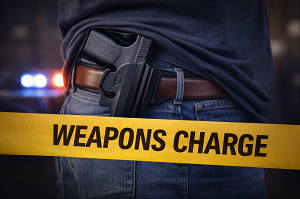
Understanding exactly what Texas Penal Code Chapter 46 prohibits (and where the law creates exceptions) is the starting point for any UCW defense.
What Is UCW Under Texas Law?
Texas Penal Code §46.02 defines the offense of Unlawful Carrying of a Weapon. A person commits UCW if they intentionally, knowingly, or recklessly carry a handgun on or about their person in a place other than their own premises or their own vehicle unless they are otherwise authorized to carry under Texas law.
The statute also covers carrying of illegal knives and clubs, but the vast majority of UCW charges involve handguns.
A few points that trip people up:
“On or about the person” is broader than “on the person.” You do not have to have the weapon on your body to face UCW charges. A handgun within your reach in a vehicle, a bag, or a nearby container may satisfy this element depending on the circumstances.
Premises vs. public spaces. Texas law allows individuals to carry on their own property without a license. The UCW statute applies when carrying moves into public spaces or locations where carry is restricted.
Intent matters — but only partially. The statute requires intentional, knowing, or reckless conduct. Reckless is a low bar. The fact that you forgot the firearm was in your bag, or that you didn’t know a location was prohibited, does not automatically provide a defense, though it is a factor the defense can raise.
Who May Lawfully Carry in Texas
Texas’s constitutional carry law, which took effect September 1, 2021, allows most adults 21 and older to carry a handgun (openly or concealed) without a License to Carry (LTC), provided they are not otherwise prohibited from possessing a firearm.
The 18–20 situation: Following the federal court’s ruling in Firearms Policy Coalition v. McCraw, U.S. District Judge Mark T. Pittman found Texas’s 21-and-older age requirement for handgun carry unconstitutional. As a result, the Texas Department of Public Safety now issues LTCs to otherwise eligible applicants who are 18 to 20 years old. However, the underlying Texas statute has not been legislatively amended to reflect this change. That means eligibility for 18 to 20-year-olds is based on the court ruling, not a change in the Penal Code itself. If you are in this age group and are facing a UCW charge, that procedural complexity is directly relevant to your defense and should be evaluated by your attorney.
To carry lawfully, a person must also not be:
- Convicted of a felony within the past five years
- A member of a criminal street gang
- Convicted of certain assault or domestic violence offenses within the past five years
- Subject to an active protective order
- Otherwise prohibited from possessing a firearm under federal law
- Intoxicated (except within their own residence or vehicle)
Prohibited Locations: Where UCW Charges Arise Even for Lawful Carriers
Even if you are otherwise authorized to carry, taking a firearm into a prohibited location can result in a UCW charge under Texas Penal Code §46.03. Prohibited locations include:
- Schools, school grounds, and school buses
- Polling places during elections
- Courtrooms and court offices
- Racetracks
- Secured areas of airports
- Establishments that derive 51% or more of income from alcohol sales (the “51% rule”)
- Government meetings open to the public
- Correctional facilities
Licensed carriers have some additional privileges. For example, LTC holders may carry on university campuses in designated areas under campus carry provisions but those exceptions are specific and have their own conditions.
The 51% alcohol establishment rule deserves particular attention. Carrying a handgun into a bar or restaurant that derives more than half its income from alcohol sales is not just a Class A misdemeanor. It is a third-degree felony under §46.02, carrying 2 to 10 years in state prison and a fine of up to $10,000. The elevation from misdemeanor to felony in this circumstance surprises many defendants who had no idea the establishment crossed that threshold.
Penalties for UCW in Texas
The penalty structure for UCW depends on the specific circumstances:
Class A misdemeanor — the baseline for most UCW offenses. Punishable by up to one year in county jail and a fine of up to $4,000.
Third-degree felony — applies when the defendant carries in a 51% alcohol establishment, or when the defendant has a prior felony conviction and carries a firearm before five years have elapsed from release from confinement, parole, or probation. Punishable by 2 to 10 years in state prison and a fine of up to $10,000.
The distinction between misdemeanor and felony UCW is not always obvious at the time of the arrest. It matters enormously for everything that follows, including bail, collateral consequences, and long-term record implications.
Defenses to UCW Charges
UCW charges are fact-specific, and the defense depends heavily on the circumstances of the arrest. Common defense avenues include:
Challenging the legal basis for the stop or search. In many UCW cases, the firearm was discovered during a traffic stop or a search of a vehicle. If the stop lacked reasonable suspicion, or if the search lacked proper legal authority, the evidence may be suppressible under both the Fourth Amendment and Texas Code of Criminal Procedure Article 38.23 which, unlike the federal good faith exception, has no good faith exception in Texas state court.
Challenging the prohibited location element. The prosecution must prove the location was actually prohibited. In 51% alcohol establishment cases, this requires establishing that the establishment actually derived more than half its income from alcohol sales. That is an element the prosecution must prove — not simply assert — and it can be contested.
Challenging the “on or about the person” element. If the firearm was in a location where the defendant did not have immediate access or control, that element may be contestable depending on the specific facts.
Lawful carry defense. If the defendant was in fact authorized to carry under constitutional carry provisions or a valid LTC, and was not in a prohibited location, the carry was not unlawful. Evidence of authorization (ex. LTC documentation, location analysis, and the specific facts of the encounter) is central to this defense.
Lack of knowledge. In cases where the defendant was genuinely unaware of the firearm’s presence (for example, a weapon left in a vehicle by another person) lack of knowledge may be a viable defense to the knowing or intentional element, though recklessness is also covered under the statute.
Collateral Consequences of a UCW Conviction
A UCW conviction, even at the misdemeanor level, carries consequences that extend beyond the immediate sentence:
Firearm rights. A Class A misdemeanor UCW conviction can affect the right to possess firearms under federal law for persons who fall within specific federal prohibitor categories. A felony UCW conviction results in loss of firearm rights under both Texas and federal law.
Professional licensing. Many licensing boards require disclosure of criminal convictions. UCW convictions can affect licenses in law enforcement, healthcare, education, and other regulated professions.
Immigration. Non-citizens face potential immigration consequences from UCW convictions, which can include grounds of inadmissibility or deportability depending on the specific offense level and immigration status.
Future enhancement. A UCW conviction on your record affects how any subsequent weapons charge is evaluated and sentenced.
Frequently Asked Questions
What is the difference between UCW under §46.02 and carrying in a prohibited place under §46.03? Section 46.02 covers carrying a handgun in a public place without authorization. Section 46.03 covers carrying in specific prohibited locations regardless of whether the carrier is otherwise authorized. Both can result in UCW-type charges, but the elements and penalties differ. In practice, many arrests involve overlapping theories.
Can I be charged with UCW if I have a valid LTC? Yes, if you carry in a prohibited location (including a 51% alcohol establishment, a courthouse, or a school) your LTC does not protect you. LTC holders are subject to §46.035, which governs where licensed carriers may and may not carry.
Does constitutional carry mean I can carry anywhere without a license? No. Constitutional carry allows eligible adults to carry without obtaining an LTC, but it does not override the prohibited location restrictions. You are still prohibited from carrying in schools, courthouses, 51% establishments, and other restricted locations whether or not you have an LTC.
What happens if I am charged with UCW and I am 18 to 20 years old? This is a legally complex area. The court ruling in Firearms Policy Coalition v. McCraw established that 18 to 20-year-olds may not be prosecuted for carrying based solely on age but the underlying statute has not been amended. The interaction between the court ruling and active UCW charges in this age group requires careful legal analysis specific to your case.
Can UCW charges be reduced or dismissed? Yes. Depending on the facts, the strength of the evidence, and the procedural history of the arrest, UCW charges may be reduced, dismissed on motion, or resolved through negotiation. Early engagement of an experienced criminal defense attorney gives you the most options.
Speak With Deandra Grant Law
If you are facing UCW or weapons charges in Texas, the specific facts of your arrest (i.e. how the weapon was found, where you were, what you were doing, and whether the stop and search were lawful) determine your defense options. Managing Partner Deandra Grant brings more than 30 years of criminal defense experience to your defense team. That background means evidence in your case (including the procedural validity of how it was obtained) is evaluated with the same rigor we bring to forensic science challenges.
Call (214) 225-7117 or visit texasdwisite.com to schedule a confidential consultation.
Which county your case is filed in changes how it is charged, who prosecutes it, and which court hears it.
Deandra M. Grant, JD, GC, MS, ACS-CHAL Forensic Lawyer-Scientist
She holds a Master of Science in Pharmaceutical Science and a Graduate Certificate in Forensic Toxicology, both from the University of Florida. She is the author of The Texas DWI Manual and has defended Texas DWI cases since 1994.
Facing Criminal Charges in Texas?
The sooner a defense lawyer is involved, the more can be done to protect your record and your freedom. Talk to us today.
Request a Free Case Evaluation
Tell us what happened. We'll respond as soon as possible.