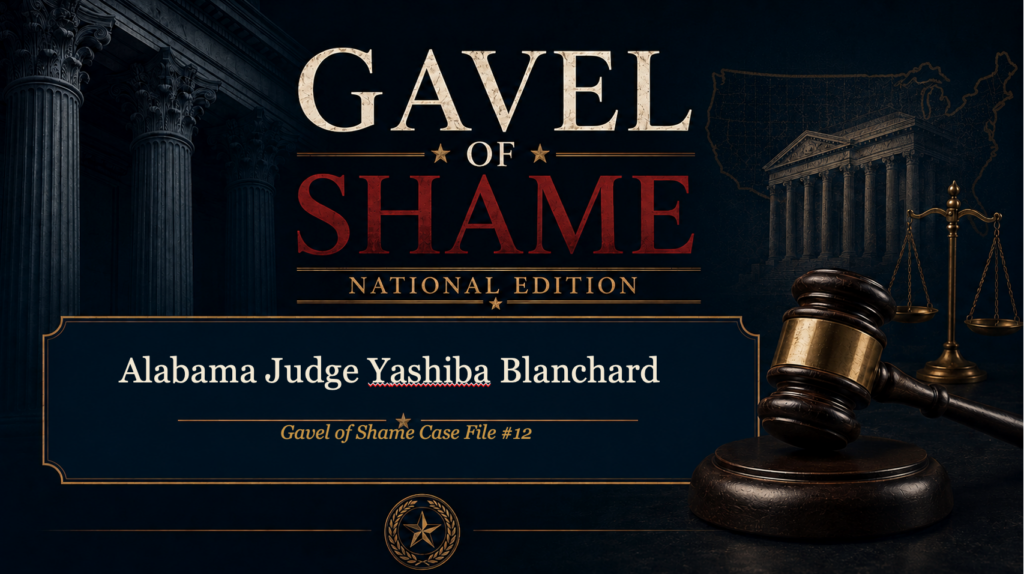
How a complaint by the Alabama Judicial Inquiry Commission led to the suspension of Jefferson County Probate Judge Yashiba G. Blanchard and what comes next
| THE QUICK ANSWER
On May 21, 2026, the Alabama Judicial Inquiry Commission filed a 120-page complaint against Jefferson County Probate Judge Yashiba G. Blanchard, charging her with seven categories of judicial misconduct from failing to timely hold involuntary commitment hearings to harassing court staff. Under Alabama law, the filing of formal charges automatically suspends the judge pending trial before the state’s Court of the Judiciary. The allegations have not been adjudicated. This case file is about what the complaint says, what comes next, and how the system works. |
| CASE FILE AT A GLANCE | |
| Judge | Hon. Yashiba G. Blanchard (suspended pending trial) |
| Court | Jefferson County Probate Court |
| State | Alabama |
| Case Number | Alabama Court of the Judiciary Case No. 67 |
| Charging Body | Alabama Judicial Inquiry Commission (JIC) |
| Trial Body | Alabama Court of the Judiciary |
| Complaint Filed | May 21, 2026 |
| Status | Charges pending; judge automatically suspended |
| AN IMPORTANT NOTE ON WHAT FOLLOWS
Every prior file in this series has examined a completed sanction such as a Public Admonition, Warning, or Reprimand issued by the Texas State Commission on Judicial Conduct after findings of fact and conclusions of law. This file is different. What we are reading here is a complaint which is a charging document. The Alabama Judicial Inquiry Commission has made detailed allegations against Judge Blanchard, and the Alabama Court of the Judiciary will eventually try those charges. As of this writing, Judge Blanchard has not been adjudicated guilty of any of them. She is entitled to defend herself, the JIC will have to prove its case, and the outcome could range from a full acquittal to a sanction at any level. Throughout this post, we describe allegations as allegations, not as findings. This is also the Gavel of Shame’s first National Edition case file. We will do these occasionally when a case is significant enough (and well documented enough) to be worth examining. The mechanics of judicial discipline vary from state to state, and part of the point of this file is to show how the Alabama system differs from ours in Texas. |
A Different State, A Different System
Texas readers of this series will be familiar with the State Commission on Judicial Conduct, which both investigates judicial misconduct and, in most cases, issues the sanction itself such as the admonition, warning, or reprimand you have seen in the prior case files. Alabama uses a two-body system, and the differences matter for understanding what is happening here.
The Alabama Judicial Inquiry Commission, or JIC, is the investigator and prosecutor. A nine-member body, it receives complaints, investigates in secret, and, if it concludes there is a basis for formal charges, files a complaint with the Alabama Court of the Judiciary, or COJ. The Court of the Judiciary is a separate nine-member tribunal that holds the trial and decides the case. The JIC does not sanction judges; it charges them. The COJ is what tries them and, if the charges are proven, imposes the sanction.
There is one feature of the Alabama system that explains why a complaint filed on a Thursday could suspend a sitting judge by that Thursday afternoon. Under the Alabama Constitution, when the JIC files formal charges against a judge, the judge is automatically disqualified (i.e. suspended) from acting as a judge until the charges are resolved. That suspension is procedural, not punitive: it does not depend on the COJ finding misconduct. It is what happens, by law, the moment formal charges land. That is why Judge Blanchard is off the bench right now even though her case has not yet been tried.
The Heart of the Complaint: A Court That Stopped Working
Judge Yashiba G. Blanchard was elected to the Jefferson County Probate judgeship in November 2024 and took office in January 2025. Jefferson County, which includes Birmingham, is Alabama’s most populous county with about 660,000 people. The probate court there handles wills and estates, guardianships, conservatorships, adoptions and, critically, involuntary commitments: hearings that decide whether someone in mental health crisis stays in inpatient care or goes home.
The JIC’s complaint frames its core allegation simply: Judge Blanchard has exhibited “a pattern and practice of failing to diligently discharge her judicial duties.” What that means, in the complaint’s telling, is best shown by the involuntary commitment docket.
It is worth correcting one detail that has appeared in some news accounts before going further. The complaint does not say that no involuntary commitment hearings occurred in Jefferson County for nine months. It says something more specific: from January 2025 until September 19, 2025, the other probate judge (the Place 2 judge) heard all involuntary commitment proceedings in the county. Hearings were being held. They simply were not being presided over by Judge Blanchard. On September 19, 2025, Judge Blanchard entered an administrative order assigning future involuntary commitments evenly between the two probate judges. Per the complaint, her first involuntary commitment docket was on September 30, 2025, which was nine months after she took the bench.
What the complaint says happened next is where the allegations turn from delay into something stranger. According to the JIC, Jefferson County’s probate court handles about sixty involuntary commitment cases a month. Judge Blanchard, the complaint alleges, gave a limiting instruction that she would hear only twelve such cases per month (roughly twenty percent of the load), leaving the remaining eighty percent to the Place 2 judge. The court’s mental health coordinator, the complaint says, ultimately had to assign cases that had to be heard to avoid due process violations to the other judge.
There are smaller details inside the larger picture. The complaint alleges Judge Blanchard was sometimes thirty to forty-five minutes late to her own commitment dockets, on one occasion over an hour late with patients, social workers, psychiatrists, and families waiting. On one occasion, the complaint alleges, she told her staff she was late because “she had three dogs to walk.”
| WHY THE TIMING MATTERS
An involuntary commitment hearing is not a routine docket call. It is a court proceeding that decides whether a person experiencing a mental health crisis is held in inpatient care against their will, or released. Alabama law specifically requires these proceedings to be timely so the court has only thirty days to hold the final hearing once a respondent is served. Cited delays compound: • People stay in inpatient care longer than they otherwise would, while a hearing they are entitled to keeps getting rescheduled. • People in the community who need a hearing to be picked up and placed in mental-health beds wait. The complaint quotes a court letter noting roughly 120 such patients on a “pick-up list” at one point. • Families, social workers, psychiatrists, and hospital staff who depend on these hearings to move people forward in their care have no way to do their jobs. This is the part of probate court that touches Alabamians at their worst moments. The complaint’s repeated focus on it is not incidental. It is the heart of why the JIC moved when it did. |
Attorneys, and the People Who Worked for Her
The involuntary commitment allegations are the centerpiece of the complaint, but the document does not stop there. The JIC also alleges patterns of conduct toward attorneys appearing before Judge Blanchard and toward her own probate court staff.
On attorneys, the complaint alleges that Judge Blanchard improperly removed lawyers serving as conservators in violation of black-letter statutory requirements, abused her power of contempt by holding an attorney in contempt, filed unfounded State Bar complaints against attorneys appearing in her court, and ordered an unwarranted forensic accounting of estates under the supervision of certain attorneys without providing notice or an opportunity to be heard. One of those allegations (filing a State Bar complaint against an attorney who had challenged one of her orders) is the kind of move that, if proven, weaponizes the disciplinary system against a lawyer for doing his or her job.
On her own court staff, the complaint alleges a pattern of bullying and retaliation. It alleges she transferred Birmingham-based staff to the court’s Bessemer office to keep them away from the main courthouse, told one clerk who wanted to return “I put you where I want you to be at,” and that another court official subject to her direction and control engaged in harassment of staff with her acquiescence. According to coverage of the complaint, one staff member who complied with a JIC subpoena had her desk moved into a cubicle in front of the bailiff afterward which is conduct that, the JIC alleges, amounted to retaliation against a witness in its own investigation.
The pattern the JIC pulls together across these strands (attorneys, staff, and the courthouse itself) is summarized in news coverage of the complaint with a striking framing reportedly used by Judge Blanchard herself: that she was the “ultimate authority” in her courtroom and had “no boss.” We have not independently located that exact language inside the 120-page filing, but the alleged pattern (a judge governing a court as if no rule, schedule, or higher authority applied to her) runs through the complaint from the first page to the last.
The Charges
The JIC’s complaint formally charges Judge Blanchard with seven categories of misconduct under the Alabama Canons of Judicial Ethics. They are listed below in the JIC’s own words. These are charges, not findings; each will have to be proven before the Court of the Judiciary.
| # | Charge |
| 1 | Pattern and Practice of Failing to Diligently Discharge Judicial Duties |
| 2 | Pattern and Practice of Failing to Follow the Law |
| 3 | Pattern and Practice of Exhibiting Bias Against Attorneys Appearing in Judge Blanchard’s Court |
| 4 | Failure to Disqualify from a Case in Which Judge Blanchard Served as an Attorney |
| 5 | Harassment, Intimidation, and Retaliation Against Probate Court Staff |
| 6 | Allowing Other Court Officials Subject to Judge Blanchard’s Direction and Control to Engage in Harassment and Intimidation of Probate Court Staff |
| 7 | Failure to Maintain Professional Competence in Judicial Administration |
Each charge cites multiple Canons of the Alabama Canons of Judicial Ethics, most prominently Canon 1 (uphold the integrity and independence of the judiciary), Canon 2 (avoid impropriety and the appearance of it), and Canon 3 (perform duties of the office impartially and diligently). The JIC does not charge a constitutional “willful or persistent” misconduct standard the way the Texas Commission sometimes does in its orders; Alabama’s framework is the Canons themselves, plus the Constitution’s grant of authority to the Court of the Judiciary to remove or sanction a judge who violates them.
What the Judge Has Said — So Far
Judge Blanchard has not yet had her formal opportunity to defend the charges. That happens in front of the Court of the Judiciary, with a hearing, evidence, and her own counsel. As of this writing, no trial date has been publicly set.
The complaint itself does record one earlier exchange. In December 2025, the Tenth Judicial Circuit’s presiding judge, Elisabeth French, hand-delivered a letter to Judge Blanchard summarizing complaints from the hospital, court staff, patients, and hospital police about the involuntary commitment dockets. The complaint says Judge Blanchard provided a written response three days later which the JIC characterizes as containing “pertinent misrepresentations.” That is the JIC’s characterization, not an established fact; Judge Blanchard will have the chance to dispute it. But it is part of the public record now.
Beyond that, the broader public record on Judge Blanchard’s side of the story is still developing. When she or her attorneys respond formally, we will update this case file. Our practice in this series is to give a judge’s defense real space; here, that space simply has not been filled yet.
The Suspension and What Comes Next
On May 21, 2026, the same day the JIC filed its complaint, Judge Blanchard was automatically disqualified from acting as a judge under Alabama Constitution Article VI, Section 159. That is the procedural suspension we described earlier: it is what happens by operation of law when formal charges are filed, and it stays in place until the case is resolved.
To keep the probate court running, the presiding circuit judge in Jefferson County appointed retired probate judge Sherri Friday (who held the seat before Judge Blanchard, from 2006 to 2024) to step back in on an interim basis. Retired circuit judge Carole Smitherman was separately appointed as the county’s interim Chief Election Official, a function the elected probate judge ordinarily holds. The probate court’s work is continuing.
The Court of the Judiciary will now hear the case. Possible outcomes range across a wide spectrum: the COJ can dismiss the charges, find that some are proven and others not, suspend Judge Blanchard for a defined period, censure her, or remove her from office entirely. The Alabama Court of the Judiciary has, in recent memory, removed a Jefferson County judge (Nakita Blocton of the domestic relations court) in 2022 over allegations that included staff mistreatment and chronic case delay. Whether this case follows that path, falls short of it, or ends in acquittal will be decided by the COJ on the record and not by news coverage.
The Takeaway
Even before any trial, this file already does two things worth keeping in mind. The first is to show, in detail, what a serious judicial-misconduct complaint actually looks like. A 120-page document with hundreds of numbered factual allegations, drawing on internal court emails, hospital communications, and named staff witnesses, is not a quick-and-dirty filing. It is the product of months of investigation, and the JIC does not build a case at that length unless it believes the underlying conduct is substantial.
The second is the contrast with the rest of this series. The Texas State Commission on Judicial Conduct, as we have shown in our earlier case files, almost always handles misconduct through its own informal process by issuing an admonition, warning, or reprimand, with the judge able to appeal to a Special Court of Review. Formal proceedings, where a separate body actually tries the case, are rare in Texas. In Alabama, formal proceedings are how every contested case ends up resolved: the JIC charges, the COJ tries. The Texas system, by design, is mostly self-contained inside one Commission. The Alabama system, by design, splits the prosecutor from the judge. Neither is inherently better. They are different tools for the same job (accountability for the people in robes) and seeing them side by side is part of why we open files like this one.
One notable exception Texas should adopt: suspend the judge pending resolution of the complaint(s). You’ll see a common theme in the Texas blogs and that is the CJC acts at the end of the judge’s term and/or when they are retiring or already retired. Judges should not be allowed on the bench while the complaints move forward.
Where Things Stand
Judge Yashiba G. Blanchard remains the elected Probate Judge of Jefferson County, but she is automatically suspended from the duties of that office pending resolution of the Court of the Judiciary case. She is entitled to a full defense, and the JIC has the burden of proving its charges.
Retired Probate Judge Sherri Friday is filling the seat on an interim basis for everyday probate court business; retired Circuit Judge Carole Smitherman is the county’s interim Chief Election Official. The Court of the Judiciary’s schedule for the case has not yet been publicly announced.
We will follow this one closely. When Judge Blanchard’s formal response is on the record, when the COJ sets a hearing, and when it ultimately rules, we will update this case file. For now, the most important thing to keep in mind is the one the complaint itself does not establish: she has been charged, not convicted. The Gavel of Shame will follow the case to its end before treating any of this as more than allegation.
| Whatever State, Whatever Court — Process Matters
A judge who shows up on time, hears every case on the docket, and treats the people in the courtroom with respect is not a luxury. It is the minimum a courtroom is supposed to deliver. At Deandra Grant Law, we expect that standard from every North Texas court our clients walk into, and we hold judges to it. If you are facing a DWI or criminal charge in Dallas, Tarrant, Collin, Denton, Rockwall, or McLennan County, put our experience to work for you. Call (214) 225-7117 • texasdwisite.com |
Sources
Primary source
- Alabama Judicial Inquiry Commission, Complaint against Yashiba G. Blanchard, Alabama Court of the Judiciary Case No. 67 (filed May 21, 2026). alabama.gov
- Alabama Constitution, Article VI, Sections 156–159 (Judicial Inquiry Commission and Court of the Judiciary; automatic disqualification on filing of complaint). org
News coverage
- Yellowhammer News, “‘I have no boss’: The 120-page complaint that took down a Jefferson County judge” (May 27, 2026). com
Background
- Judicial Inquiry Commission of the State of Alabama — agency overview, rules, and complaint procedures. alabama.gov
- Alabama Court of the Judiciary — about the court and how it operates. alabama.gov
This post summarizes a public charging document filed by the Alabama Judicial Inquiry Commission, supplemented by published news reporting. All factual allegations cited are described as allegations and have not been adjudicated. Judge Blanchard is entitled to defend herself before the Alabama Court of the Judiciary, and any findings or sanctions will be determined there. This is general commentary on a public record, not legal advice.