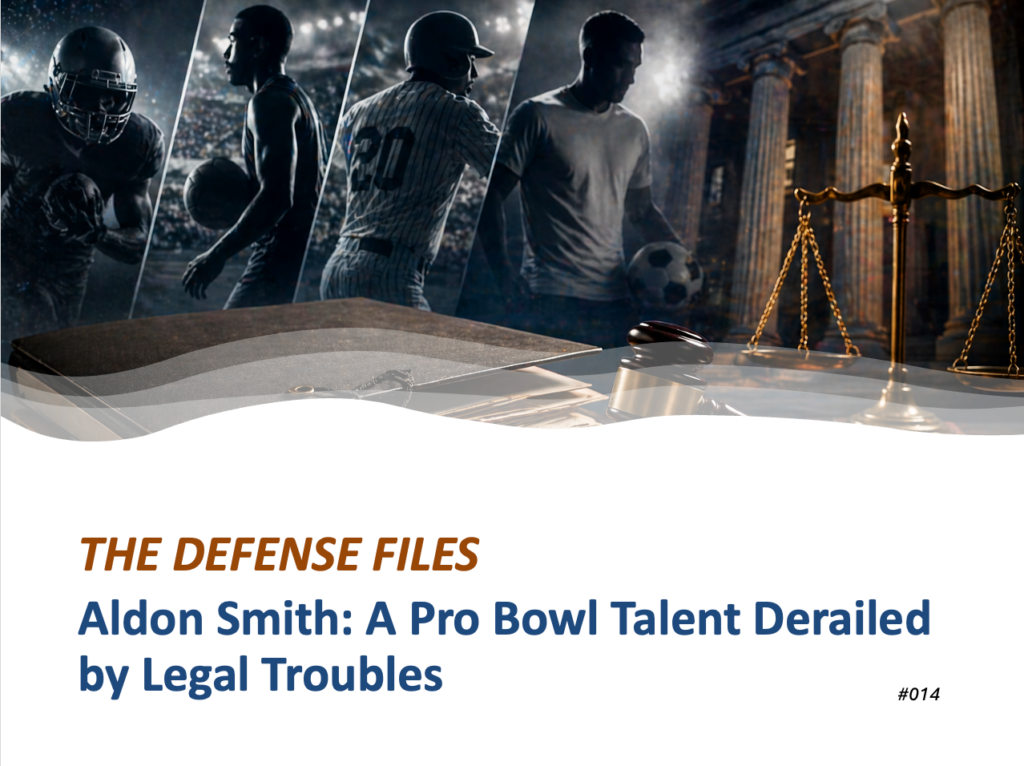
Welcome to The Defense File where we examine the criminal cases of public figures through the lens of Texas criminal law. Each entry looks at what happened in court, what the defense argued, and what a defendant would have faced (and how they might have been defended) if the same facts had occurred in Texas.
Few NFL careers showcase the gap between on-field talent and off-field collapse more starkly than that of Aldon Jacarus Smith. Born September 25, 1989, in Greenwood, Mississippi, he was a high school standout at Raytown High School in Missouri before playing for the Missouri Tigers in college. The San Francisco 49ers drafted him seventh overall in the 2011 NFL Draft. In his second season he posted 19.5 sacks (the most in 49ers history) and earned first-team All-Pro and Pro Bowl honors. Through three NFL seasons, he had 42 career sacks. He was 23 years old and being compared to Von Miller.
What followed was one of the longer arrest sheets in modern NFL history: four DUIs in three states, weapons charges, a felony domestic-violence case, a Louisiana battery case for choking a man unconscious in a coffee shop, and a 2021 felony DUI causing injury at a 0.288 BAC. Smith retired in 2023 and now works as a recovery coach. His story is the cleanest case study in The Defense File for how addiction and untreated substance abuse can convert a generational athletic talent into a multi-state criminal docket.
The Arrest Timeline
Smith’s public criminal history spans nearly a decade and four states. The chronology:
- January 28, 2012 — Miami Beach, Florida. DUI arrest. Reduced to reckless driving after Smith completed a first-time offender program.
- June 30, 2012 — Santa Clara County, California. Smith was stabbed while breaking up a fight at a party at his home. Two others were shot. The follow-up investigation revealed unlawfully possessed firearms; in October 2013, three felony charges for illegal possession of assault weapons were filed. Those charges were later reduced to misdemeanors.
- September 20, 2013 — San Jose, California. DUI and marijuana possession after a single-vehicle accident. Smith voluntarily entered rehab; the 49ers placed him on the non-football injury list.
- April 2014 — Los Angeles International Airport. Smith was detained for falsely claiming he had a bomb during a TSA screening. No charges were filed.
- August 6, 2015 — Santa Clara, California. Arrest for DUI, hit-and-run, and vandalism. The 49ers released him the next day.
- March 2018 — San Francisco, California. Felony domestic-violence allegations against his fiancée, including assault with force likely to produce great bodily injury, false imprisonment, and vandalism. Smith fled the scene, turned himself in on March 6, and posted $30,000 bail. He was arrested again later that month for violating a no-contact order.
- November 2018 plea. Pleaded no contest to false imprisonment and violating a court order. Received 90 days in jail (served partly in an alcohol treatment facility) and three years’ probation.
- June 2019 — Mission, Kansas. Fourth DUI arrest.
- April 17, 2021 — Chalmette, Louisiana. Smith allegedly choked a man unconscious during a confrontation at the French Press Coffee House. The victim was hospitalized but not held overnight. Smith turned himself in, posted $25,000 bond, and was released by the Seahawks in August 2021. The case is reportedly still unresolved.
- December 6, 2021 — Redwood City, California. Felony DUI causing injury after rear-ending a truck. BAC: 0.288% which is more than three times the California legal limit. Smith allegedly offered the driver $1,000 to avoid police involvement.
- January 2023 plea. Pleaded no contest in the 2021 DUI causing injury case. Received a one-year jail sentence (served six months, released October 4, 2023) and five years’ probation.
On top of the criminal proceedings, the NFL imposed a nine-game suspension in 2014, an indefinite suspension in 2015 that was not lifted until 2020, and additional discipline under the Personal Conduct Policy after several of the later incidents.
The Texas Analysis
Texas could have charged these cases under three different statutes: the DWI ladder in Penal Code Chapter 49, the assault statute in §22.01, and the intoxication-assault statute in §49.07. The Smith arrest history is the textbook case for showing how each operates and how they stack on top of each other when an addiction-driven series of incidents goes unaddressed.
DWI No. 1 at 0.288%: A Class A Misdemeanor With Mandatory Interlock
Under Texas Penal Code §49.04, a first-offense DWI is a Class B misdemeanor (up to 180 days county jail; fine up to $2,000) unless the recorded BAC was 0.15% or greater, in which case §49.04(d) elevates the charge to a Class A misdemeanor (up to one year county jail; fine up to $4,000).
Smith’s 2012 Florida DWI and 2013 San Jose DWI both predated any conviction, so a hypothetical Texas charge on those facts would be a first-offense DWI. The 0.288% on the 2021 case is the more important number: it sits well above the 0.15% threshold and would have triggered the Class A enhancement on a Texas first offense. It also forecloses the HB 3582 deferred adjudication pathway that Texas otherwise makes available to first-time DWI defendants with a BAC below 0.15%. At 0.288%, a Texas first-time defendant gets the Class A misdemeanor with mandatory ignition interlock and no deferred path to dismissal.
Felony DWI: The Texas Two- and Three-Prior Ladder
Smith’s 2021 DWI was at minimum his fourth alcohol-related driving arrest. Texas builds felony DWI on a different ladder than California:
- DWI 2nd, 49.09(a) — Class A misdemeanor (one prior).
- DWI 3rd or more, 49.09(b)(2) — third-degree felony (2–10 years TDCJ; fine up to $10,000) on a defendant with two prior DWI convictions.
- Habitual felony enhancement under 12.42(d) — with two prior felony convictions (sequential), the punishment range becomes 25–99 years or life. For a defendant with multiple prior felony DWI convictions, the State can attempt to use those priors as habitual enhancements.
Out-of-state priors can be used to enhance a Texas DWI if the prior offense “involves the operation of a motor vehicle while intoxicated” under §49.09(c), which a Florida, California, or Kansas DUI generally does. (Texas courts conduct a substantial-similarity analysis on the elements; the operation-while-intoxicated standard is what matters.) The 2012 Florida reckless-driving disposition is the wildcard because it was a reduced charge through a first-offender program so it may or may not count depending on the specific terms of the disposition. Defense counsel would litigate that admissibility question hard before trial.
Bottom line on the 2021 California facts as a Texas case: a defendant with three or four prior alcohol-related driving convictions arrested in Texas at 0.288% with injury to another driver would be looking at an indictment for felony DWI 3rd or more or felony intoxication assault.
The Injury Driver: §49.07 Intoxication Assault
The 2021 Redwood City rear-end collision was not just a DWI. The other driver was injured. In Texas, an intoxicated driver who causes serious bodily injury to another person commits intoxication assault under §49.07 which is a third-degree felony (2–10 years TDCJ; up to $10,000 fine).
“Serious bodily injury” is the statutory key under §1.07(a)(46): injury that creates a substantial risk of death, causes serious permanent disfigurement, or causes protracted loss or impairment of function. Whether a particular rear-end-collision injury meets that standard is a fact issue litigated through medical records and expert testimony.
The 2018 Domestic-Violence Case: Where Texas Would Have Charged a Felony
The March 2018 case in San Francisco involved allegations of domestic violence, assault with force likely to produce great bodily injury, false imprisonment, and vandalism against Smith’s then-fiancée. He pleaded no contest in California to false imprisonment and to violating the no-contact order.
In Texas, the same facts would be analyzed under several statutes simultaneously:
- 22.01(a)(1) assault causing bodily injury — Class A misdemeanor at the base level. Because Smith and the alleged victim were engaged (a dating relationship under Family Code §71.0021(b)), the conduct would carry a family-violence affirmative finding under §71.004 attaching to any conviction. That finding triggers a federal firearms ban under 18 U.S.C. §922(g)(9) (Lautenberg) on any misdemeanor conviction.
- 22.01(b)(2)(A) felony enhancement — A second qualifying-relationship assault, with a prior family-violence conviction shown at trial, becomes a third-degree felony.
- 20.02 unlawful restraint — Class A misdemeanor at the base, but a third-degree felony if the restraint exposed the victim to substantial risk of serious bodily injury, which is a common allegation in domestic-violence cases.
- 22.04 — If the State could prove the slap or restraint caused serious bodily injury to a person in a dating relationship, a second-degree or first-degree felony.
The California disposition (no contest to misdemeanor false imprisonment) is the kind of out-of-state plea that Texas prosecutors review carefully for use as a prior family-violence offense under §22.01(b)(2)(A) when negotiating any later Texas case. Substantially-similar prior convictions count.
The Louisiana Choking Case: A Texas Aggravated-Assault Issue, Not a §22.01(b)(2)(B) Strangulation Case
Smith’s April 2021 Louisiana case is the clearest example in this entry of where charging theory matters. The alleged conduct was that Smith choked an acquaintance unconscious during a confrontation at a coffee shop. The victim required hospital evaluation.
In Texas, §22.01(b)(2)(B) makes assault by impeding breathing or circulation a third-degree felony but only when the victim has a qualifying family, household, or dating relationship under Chapter 71 of the Family Code. The Smith–Louisiana victim was an acquaintance, not a family or dating partner. So §22.01(b)(2)(B) is off the table on these facts.
The Texas charging theory that actually fits is aggravated assault under §22.02. Two routes:
- Aggravated assault by serious bodily injury, §22.02(a)(1). Loss of consciousness from manual strangulation can qualify as serious bodily injury which is “protracted loss or impairment of the function of any bodily member or organ” under §1.07(a)(46). With a victim who lost consciousness and required hospital evaluation, the State has a credible serious-bodily-injury argument.
- Aggravated assault with a deadly weapon, §22.02(a)(2). Texas courts have held that hands or a forearm can be a deadly weapon when used to choke someone unconscious. The State has to plead and prove deadly-weapon use specifically, but on facts where the victim was rendered unconscious, the theory is well-established.
Either way, the Texas analog to the Louisiana case is a second-degree felony (2–20 years TDCJ; fine up to $10,000) with an affirmative deadly-weapon finding if charged under §22.02(a)(2) that affects parole eligibility under Government Code §508.145(d). The Louisiana “second-degree battery” label and the Texas “aggravated assault” label both produce felony exposure with substantially overlapping punishment ranges.
What This Case Illustrates: Substance Abuse, Structured Treatment, and Texas DWI Court
More than any other entry in The Defense File, the Smith arrest sheet is a substance-abuse case. The 2012 Florida DUI, the 2013 San Jose DUI, the 2014 LAX incident, the 2015 hit-and-run DUI, the 2018 domestic-violence case (which Smith’s own plea connected to alcohol treatment), the 2019 Kansas DUI, the 2021 Louisiana battery, and the 0.288% felony DUI causing injury in 2021 form a single arc and not a series of unrelated bad decisions.
That distinction matters for defense strategy, in Texas as much as anywhere else. Two structural realities:
- Texas has DWI courts. Under Texas Government Code Chapter 123, counties with a population of 200,000 or more must establish a DWI court program. Dallas, Tarrant, Collin, Denton, and McLennan counties all have specialty DWI courts that emphasize structured probation, mandatory treatment, frequent testing, and judicial monitoring. The federal All Rise (formerly NADCP) research on treatment courts shows substantially reduced recidivism in graduates compared with standard probation. For a client whose criminal history is fundamentally an addiction history, DWI court (not jail) is the defense outcome that actually prevents the next case.
- Ignition interlock and SCRAM are negotiated, not assumed. Under CCP Art. 17.441, ignition interlock is mandatory as a condition of bond for second-or-more DWIs and for first DWIs with a BAC of 0.15% or greater. SCRAM (Secure Continuous Remote Alcohol Monitoring) is an alternative or supplement that the defense should be raising at the bond hearing rather than waiting for the State to demand it. Demonstrating compliance early can drive plea outcomes a year later.
- Repeat-offender exposure compounds with every arrest. A first-offense Texas DWI at 0.15% or higher is a Class A misdemeanor. A second is still a misdemeanor. A third is a third-degree felony. A fourth is still charged as a DWI 3rd. The structural lesson of the Smith timeline is that each unresolved case becomes the predicate that makes the next one worse.
- Out-of-state priors don’t disappear at the Texas border. 49.09(c) and §22.01(f)(2) both contemplate the use of substantially-similar foreign convictions as Texas priors. Defense counsel needs to obtain certified judgment-and-sentence records from every prior jurisdiction and litigate substantial similarity case-by-case. A reduced disposition (like Smith’s 2012 Florida reckless driving) is a separate fight; a clean DUI conviction in Kansas or California will count.
How a Texas Defense Team Would Have Approached This
- Treatment as the centerpiece, not the afterthought. Voluntary treatment intake before the first appearance (ideally inpatient) reframes the bond hearing and every subsequent docket. A defendant who is already sober and in a structured program is a different defendant than the one the State expects to see.
- Challenge out-of-state-prior admissibility early. Challenge the admissibility of prior convictions as substantive evidence and as impeachment. Especially for the 2012 Florida disposition, where the reduction to reckless driving may sever the chain of substantial similarity.
- Forensic challenge to the breath/blood result. 288% is a high number, but it is also a number that can be examined for instrument calibration, partition-ratio variability, blood-draw chain of custody, and sample storage.
- Parallel-track civil exposure. Intoxication assault in Texas almost always produces a parallel civil suit by the injured driver. Defense counsel should be aware of any insurance coverage limits, MedPay applicability, and the impact of any guilty plea on a civil negligence per se theory.
- Document the sobriety arc for sentencing. Smith’s own narrative (sober since December 2021, recovery coach, public speaker) is the kind of mitigation Texas judges will hear at sentencing. Defense counsel builds that record contemporaneously with treatment records, testimony from counselors, and detailed plans for continuing care.
Where Are They Now
Aldon Smith retired from football. On the I Am Athlete podcast in October 2023, he said “I’m done with ball.” Public reporting indicates he has been sober since December 2021. He runs a company called Intelligent Movement through which he works as a recovery coach and speaker, and he has discussed plans for a documentary and book about his recovery journey. He lives in the Bay Area.
The Smith story is one of the better illustrations in this series of what addiction does to a career and what recovery, when it finally comes, can build in its place. The on-field talent that produced 19.5 sacks at age 22 is the same talent and intensity now directed at recovery work. That is a different ending than most of the case files in this series.
What This Case Tells Us
There are two takeaways from the Smith case for Texas clients and the lawyers who represent them. First: when the criminal history is fundamentally an addiction history, treatment is the case strategy. Every Texas defense plan for a multi-DWI client should start with the structured-treatment options available in this state (DWI courts, inpatient programs, SCRAM, and the continuum of care that runs from intake through long-term sobriety) and work backward from there to the charging document. Second: jurisdiction-by-jurisdiction charging analysis matters more than the labels. Louisiana “second-degree battery,” California “felony DUI causing injury,” and Florida “first-offense DUI” each map to different Texas statutes with different elements, different enhancement ladders, and different sentencing exposure. A defense team that treats every out-of-state prior the same way is doing the client a disservice.
Smith’s timeline took ten years and four states to reach the bottom. The Texas defense bar exists to help clients reach that bottom before it shows up in a felony indictment, or, when it does show up, to make sure the response is treatment-first and not jail-first when the facts and the client can support that path.
Related Reading on Deandra Grant Law
- DWI Defense in Texas — The Class B vs. Class A distinction, the 0.15% threshold, HB 3582 deferred adjudication, and Intoxilyzer 9000 challenges.
- Felony DWI Defense in Texas — DWI third-or-more, intoxication assault, intoxication manslaughter, and the habitual-offender ladder.
- Intoxication Assault in Texas (§49.07) — Third-degree felony exposure when a DWI causes serious bodily injury, plus the mandatory deadly-weapon finding.
- Assault and Family Violence Defense in Texas — The dating-relationship element, the strangulation enhancement, and the affirmative finding’s permanent consequences.
Sources
- Texas Penal Code Chapter 49 — Intoxication Offenses
- Texas Penal Code §22.01 — Assault
- Texas Penal Code §22.02 — Aggravated Assault
- Texas Government Code Chapter 123 — DWI Courts
- CCP Art. 42A.054 — Limitations on Judge-Ordered Community Supervision
The Defense File is an educational series. All Texas analysis is hypothetical and does not constitute legal advice about any specific case.
If you are facing felony DWI, intoxication assault, or family-violence charges in Texas, call (214) 225-7117 for a free, confidential consultation. Or schedule online at texasdwisite.com.