By Deandra Grant, J.D., M.S. (Pharmaceutical Science), ACS-CHAL Forensic Lawyer-Scientist
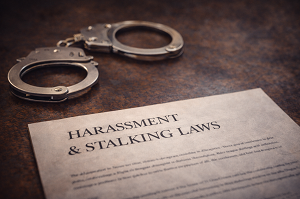
Harassment and stalking charges in Texas arise from a wide range of situations such as contentious breakups, neighbor disputes, workplace conflicts, and online communications that one party experienced as threatening. What often starts as a he-said-she-said dispute can escalate quickly into a criminal charge with serious consequences.
The Texas statutes governing these offenses have been significantly amended in recent years (in 2023, and again in 2025) and understanding the current law is essential to building an effective defense. This piece explains what harassment and stalking actually require the prosecution to prove, where the law changed, and what defense options exist.

"Deandra Grant Law – Criminal & DWI Defense handled my case with diligence and professionalism. Deandra Grant's reputation is stellar and now I know why. She has a team of individuals who provide quality service."
- N. Coulter
"Deandra Grant Law – Criminal & DWI Defense fights hard for their clients and is always willing to go above and beyond. They are the best firm for DWI cases in DFW and beyond. Definitely hire them to represent you in any pending cases."
- P. Williams
"Deandra Grant made a tough situation so much better. She listened to my concerns and helped me so much with my case. I would recommend her to anyone needing legal services."
- M. Haley
Harassment Under Texas Penal Code §42.07
Harassment is a misdemeanor offense under Texas Penal Code §42.07. To convict, the prosecution must prove two things: first, that the defendant engaged in specific prohibited conduct; and second, that the defendant acted with intent to harass, annoy, alarm, abuse, torment, or embarrass the other person.
The intent requirement is significant and it is a real attack point. The statute does not criminalize behavior that accidentally annoys or upsets someone. The defendant must have intended the harassing effect. Communications that are aggressive, unwelcome, or unpleasant but sent for a legitimate purpose (ex. to collect a debt, to resolve a dispute, to communicate about shared children) may not satisfy the intent element.
The prohibited conduct under §42.07 is specific. It is not a catch-all for any unwanted communication. The statute covers things like making obscene remarks, making threats, sending repeated electronic communications in a manner likely to harass or alarm, and sending false reports about injury or death to a family member. In 2023, the legislature added provisions covering tracking and monitoring another person without consent. In 2025, the legislature clarified the statute’s structure and added an enhanced Class A misdemeanor penalty for harassment directed at utility workers performing their job duties.
Penalty: Harassment is generally a Class B misdemeanor, punishable by up to 180 days in county jail and a fine of up to $2,000. Certain circumstances elevate it to a Class A misdemeanor, with up to one year in jail and a $4,000 fine. Notably, deferred adjudication is available for harassment which matters significantly for defendants focused on avoiding a permanent conviction.
Stalking Under Texas Penal Code §42.072
Stalking is a felony offense and it is significantly more serious than many defendants realize when they are first charged. The 2023 amendments to §42.072 expanded the statute considerably, and a 2025 change eliminated the possibility of probation for stalking convictions.
Under the current law, a person commits stalking if, on more than one occasion and pursuant to the same scheme or course of conduct, they knowingly engage in conduct directed at a specific other person that:
- The defendant knew or reasonably should have known the other person would regard as threatening, or that constitutes an offense under the harassment statute; and
- Caused the other person, a family or household member, or a dating partner to feel terrorized, frightened, intimidated, or harassed; and
- Would cause a reasonable person under circumstances similar to the circumstances of the other person to feel the same way.
The 2023 amendment changed this third element from the old “reasonable person” standard to one that is more contextual (i.e. tied to the specific circumstances of the victim). This makes the statute broader and more flexible for prosecutors. The 2023 amendments also expanded the protected class to include dating partners, and extended the definition of “same scheme or course of conduct” to explicitly include different types of conduct meaning a text message and a physical appearance at someone’s home can be combined as a single course of conduct.
Penalty: Stalking is a third-degree felony as a baseline, carrying 2 to 10 years in state prison and a fine of up to $10,000. If the defendant has a prior stalking conviction, the offense is elevated to a second-degree felony, carrying 2 to 20 years.
Critical 2025 change: As of September 1, 2025, stalking is ineligible for judge-ordered community supervision. This means a defendant convicted of stalking for conduct occurring on or after that date cannot receive probation. Incarceration is mandatory upon conviction. This change makes it even more critical to fight a stalking charge aggressively rather than assume probation is available as a fallback.
The Key Distinction Between the Two Charges
Harassment is a misdemeanor. Stalking is a felony. The line between them is not always obvious, and prosecutors have significant discretion in deciding which charge to file.
The stalking statute requires conduct occurring on more than one occasion (i.e. a pattern, not a single incident). If the prosecution can establish only a single event, a stalking charge should not survive. But prosecutors routinely combine multiple communications or contacts into a “course of conduct” to reach the pattern requirement.
A stalking charge can also be reduced to harassment in plea negotiations. Given the 2025 elimination of probation for stalking, defendants facing a stalking charge have strong incentive to fight for a reduction to harassment where deferred adjudication remains available.
Defense Strategies in Harassment and Stalking Cases
Challenging intent. For harassment, the prosecution must prove the defendant intended to harass. Communications made for legitimate purposes (ex. business disputes, co-parenting communications, legal notices) may lack the required intent even if the recipient found them alarming. Evidence of the defendant’s purpose in communicating is central to this defense.
Challenging the pattern element. For stalking, the prosecution must establish repeated conduct pursuant to the same scheme or course of conduct. Isolated incidents, even if distressing, do not constitute stalking. Defense analysis should examine whether the incidents the prosecution is grouping actually share a common scheme, or whether they are being artificially combined.
Challenging the reasonable person standard. The 2023 amendment tied the reasonable person standard to the specific circumstances of the victim but it still requires an objective assessment. If the victim’s fear was not objectively reasonable even given their circumstances, that element is contestable.
The First Amendment. Communications involving matters of public concern, criticism, opinion, or political speech may be constitutionally protected regardless of how they were received. In June 2025, the Texas Court of Criminal Appeals reversed a harassment conviction on grounds that touched on the scope of the electronic communications provision. This is a significant decision that defense attorneys must be aware of in any harassment case involving online or digital communications.
Challenging the electronic communications evidence. Many harassment and stalking charges today are built primarily on text messages, social media posts, emails, and other digital communications. The authenticity of that evidence, the completeness of the record, and whether the defendant was actually the sender are all contestable. Screenshots are not self-authenticating. Accounts can be compromised. Context matters enormously.
Challenging the search and seizure of digital evidence. If law enforcement obtained communications through a device seizure or account search, the validity of the warrant and the scope of the search are subject to challenge under both the Fourth Amendment and Texas Code of Criminal Procedure Article 38.23 which has no good faith exception in Texas state court.
Case Results
Collateral Consequences Worth Understanding
Protective orders. A criminal harassment or stalking charge frequently triggers an emergency protective order at the time of arrest, prohibiting contact with the alleged victim. Violating a protective order is a separate criminal offense. Even before conviction, these conditions can affect where the defendant can live and work.
Family violence findings. If the alleged victim is a family member, former partner, or dating partner, the charge may carry a family violence designation which has long-term consequences for firearm rights and future sentencing.
Immigration. Non-citizens face potential immigration consequences from harassment and stalking charges and convictions, including possible grounds of inadmissibility or deportability.
Professional licensing. Stalking is a felony conviction. The collateral licensing consequences for nurses, teachers, licensed professionals, and anyone with a security clearance are significant and must be factored into defense strategy from the beginning.
Speak With Deandra Grant Law
Harassment and Stalking cases demand the highest level of defense preparation. The stakes are too severe for anything less than a comprehensive, evidence-driven defense strategy.
With offices in Dallas, Fort Worth, Allen, Denton, Waco, and Rockwall, we defend harassment and stalking cases across North Texas. Call (214) 225-7117 or visit texasdwisite.com for a free consultation.
Firm Accolades

Better Business Bureaus

D Magazine