By Deandra Grant, J.D., M.S. (Pharmaceutical Science), ACS-CHAL Forensic Lawyer-Scientist
Drug possession is the most commonly charged drug offense in Texas. The penalties range from a Class B misdemeanor (up to 180 days in jail) to a first-degree felony with a mandatory minimum of 10 years in prison and what determines where your case falls on that spectrum is a combination of two factors: what substance you possessed (the penalty group) and how much you possessed (the quantity threshold). These two variables control the charge, the felony level, the punishment range, and the defense strategy.
If you have been charged with drug possession in Texas, understanding the statutory framework under the Texas Health & Safety Code Chapter 481 (the Texas Controlled Substances Act) is not optional. It is the foundation for everything that follows from the initial bond hearing to the suppression motion to the plea negotiation to the trial. This article explains that framework and the defenses that can reduce, dismiss, or defeat the charge.

"Deandra Grant Law – Criminal & DWI Defense handled my case with diligence and professionalism. Deandra Grant's reputation is stellar and now I know why. She has a team of individuals who provide quality service."
- N. Coulter
"Deandra Grant Law – Criminal & DWI Defense fights hard for their clients and is always willing to go above and beyond. They are the best firm for DWI cases in DFW and beyond. Definitely hire them to represent you in any pending cases."
- P. Williams
"Deandra Grant made a tough situation so much better. She listened to my concerns and helped me so much with my case. I would recommend her to anyone needing legal services."
- M. Haley
The Texas Controlled Substances Act: Penalty Groups
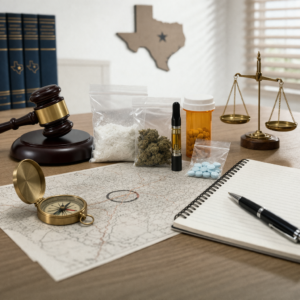
The Texas Controlled Substances Act classifies drugs into penalty groups based on their potential for abuse and accepted medical use. The penalty group determines which section of the Health & Safety Code applies to the possession charge and, combined with the quantity possessed, dictates the punishment range.
Penalty Group 1: §481.115
Penalty Group 1 includes the substances that carry the most severe penalties: cocaine, heroin, methamphetamine, fentanyl, oxycodone, hydrocodone (except in certain formulations), ketamine, and other opioids and stimulants. These are the substances most commonly involved in felony drug possession cases in Texas.
Possession penalties under §481.115 are determined by quantity:
- Less than 1 gram: State jail felony — 180 days to 2 years in a state jail facility, fine up to $10,000
- 1 to 4 grams: Third-degree felony — 2 to 10 years in prison, fine up to $10,000
- 4 to 200 grams: Second-degree felony — 2 to 20 years in prison, fine up to $10,000
- 200 to 400 grams: First-degree felony — 5 to 99 years or life, fine up to $10,000
- 400 grams or more: Enhanced first-degree felony — 10 to 99 years or life (10-year mandatory minimum), fine up to $100,000
The jump from less than 1 gram (state jail felony, maximum 2 years) to 1 to 4 grams (third-degree felony, maximum 10 years) is one of the most consequential thresholds in Texas drug law. The difference of a fraction of a gram can quintuple the maximum sentence.
Penalty Group 1-A: §481.1121
Penalty Group 1-A covers LSD (lysergic acid diethylamide) and its analogs. Penalties are based on the number of “abuse units” (dosage units) rather than weight:
- Fewer than 20 units: State jail felony
- 20 to 80 units: Third-degree felony
- 80 to 4,000 units: Second-degree felony
- 4,000 or more units: First-degree felony (5 to 99 years or life)
Penalty Group 2: §481.116
Penalty Group 2 includes MDMA (ecstasy/molly), PCP, mescaline, psilocybin (magic mushrooms), THC concentrates (including THC vape cartridges, edibles, and wax — which are treated very differently from marijuana plant material), and certain synthetic cannabinoids. The quantity thresholds and penalty ranges mirror Penalty Group 1.
The THC concentrate issue is particularly significant. Marijuana plant material (flower) is classified separately under §481.121 with significantly lower penalties. But THC concentrates (vape cartridges, wax, shatter, edibles, tinctures) are classified in Penalty Group 2 and punished at the same level as MDMA and PCP. A person caught with a single THC vape cartridge weighing more than 1 gram faces a third-degree felony (2 to 10 years) which is the same punishment range as possessing 1 to 4 grams of methamphetamine. Many defendants are shocked to learn this.
Penalty Group 2-A: §481.1161
Penalty Group 2-A covers synthetic cannabinoids (synthetic marijuana, “K2,” “Spice”). The penalty structure follows the same quantity-based framework, with possession of less than 2 ounces classified as a Class B misdemeanor and larger quantities escalating through the felony levels.
Penalty Group 3: §481.117
Penalty Group 3 includes certain prescription drugs with lower abuse potential: Xanax (alprazolam), Valium (diazepam), Ritalin (methylphenidate), anabolic steroids, and certain other benzodiazepines and stimulants. Penalties are lower than PG 1 and PG 2:
- Less than 28 grams: Class A misdemeanor — up to 1 year in jail, fine up to $4,000
- 28 to 200 grams: Third-degree felony
- 200 to 400 grams: Second-degree felony
- 400 grams or more: First-degree felony with enhanced fine up to $50,000
Penalty Group 4: §481.118
Penalty Group 4 covers compounds containing limited quantities of certain controlled substances, typically in pharmaceutical preparations: codeine-based cough syrups, certain opiate preparations, and other compounds not covered by PG 1–3. The penalty structure mirrors PG 3.
Marijuana: §481.121
Marijuana (plant material) is classified separately, not within any penalty group. Possession penalties under §481.121 are:
- 2 ounces or less: Class B misdemeanor — up to 180 days in jail, fine up to $2,000
- 2 to 4 ounces: Class A misdemeanor — up to 1 year, fine up to $4,000
- 4 ounces to 5 pounds: State jail felony
- 5 to 50 pounds: Third-degree felony
- 50 to 2,000 pounds: Second-degree felony
- 2,000 pounds or more: Enhanced first-degree felony with mandatory minimum and fine up to $50,000
As noted above, marijuana plant material and THC concentrates are treated very differently. This distinction trips up defendants, attorneys, and even some judges. A client who says “I only had a vape pen” may be facing a third-degree felony, while a client who possessed several grams of marijuana flower faces a misdemeanor.
Possession vs. Possession with Intent to Deliver
The distinction between simple possession (Chapter 481, Subchapter D) and possession with intent to deliver (Chapter 481, Subchapter C) is one of the most consequential charging decisions in drug cases. Intent to deliver elevates the offense by at least one felony degree and often more. The prosecution proves intent to deliver through circumstantial evidence: quantity (amounts inconsistent with personal use), packaging (individual baggies, scales, cutting agents), large amounts of cash, communications discussing sales, and customer testimony.
Challenging the intent-to-deliver inference is a critical defense strategy. The defense may argue that the quantity was consistent with personal use, that the packaging was for personal convenience rather than distribution, that the cash had a legitimate source, and that the communications were ambiguous. If the defense successfully defeats the intent element, the charge is reduced from delivery to possession which is often a reduction of one or more felony degrees.
Drug-Free Zone Enhancement: §481.134
Under Health & Safety Code §481.134, if a drug offense occurs within 1,000 feet of a school, playground, youth center, or swimming pool, or within 300 feet of certain other locations, the punishment is enhanced by one degree. A state jail felony becomes a third-degree felony. A third-degree felony becomes a second-degree felony. And so on.
In urban areas like Waco, Dallas, and Fort Worth, drug-free zones overlap extensively. A defendant arrested at their own apartment may be within 1,000 feet of a school without knowing it. The enhancement is based solely on proximity. The prosecution does not have to prove that the defendant knew they were near a school or that the offense had any connection to children or the school.
The defense can challenge drug-free zone enhancements by disputing the distance measurement (was it actually within 1,000 feet?), challenging the classification of the nearby property (is it actually a “school” or “playground” as defined by the statute?), or presenting evidence that the enhancement produces a disproportionate result. In some cases, the defense can negotiate with the prosecution to waive the enhancement in exchange for a plea to the base offense.
Defenses to Drug Possession Charges
Suppression of Evidence: The Fourth Amendment and Article 38.23
The most powerful defense in most drug possession cases is the same one that wins gun cases: suppressing the evidence. If the drugs were discovered through an unconstitutional search, the drugs are inadmissible and the case collapses.
Texas defendants have a significant advantage in suppression litigation. Under CCP Article 38.23(a), evidence obtained in violation of any provision of the Constitution or laws of Texas or the United States is inadmissible. Unlike the federal exclusionary rule, Article 38.23 has no good-faith exception. If the search was unlawful, even if the officer acted in good faith reliance on a defective warrant, the evidence is suppressed.
The most common search contexts in drug possession cases are:
- Traffic stops: Was the initial stop lawful? Was the stop extended beyond its original purpose without independent reasonable suspicion (Rodriguez v. United States, 2015)? Was the vehicle search supported by probable cause?
- Consent searches: Was the consent voluntary? Was the scope of the consent exceeded? Did the defendant withdraw consent during the search?
- Warrant searches: Did the affidavit establish probable cause? Was the information stale? Did the warrant describe the place and items with particularity (CCP Art. 18.04)? Were there execution violations?
- Plain view: Was the officer lawfully present? Was the incriminating nature of the substance immediately apparent (could the officer tell it was drugs without testing)?
- Inventory searches: Was the impoundment lawful? Did the officer follow the department’s standardized inventory procedures?
Even if the judge denies the pretrial suppression motion, Article 38.23(a) provides a second chance: if there is a factual dispute about how the evidence was obtained, the defendant is entitled to a jury instruction allowing the jury to disregard the evidence if they believe it was obtained unlawfully. This is a Texas-specific protection that does not exist in federal court.
Case Results
Challenging Possession: “The Drugs Weren’t Mine”
To convict for drug possession, the prosecution must prove that the defendant knowingly and intentionally exercised care, custody, control, or management over the contraband. When drugs are found in a shared space (ex. a car with passengers, an apartment with roommates, a house where multiple people live) the prosecution must establish that this defendant possessed the drugs, not just that the drugs were present.
The Texas Court of Criminal Appeals has held that mere presence in the vicinity of drugs is not sufficient to establish possession. The prosecution must present affirmative links connecting the defendant to the contraband. Affirmative links can include: the drugs were in the defendant’s personal space (pocket, purse, bedroom), the defendant made incriminating statements, the defendant’s fingerprints or DNA were on the packaging, the defendant exhibited nervous behavior or attempted to flee, drug paraphernalia was found on the defendant’s person, and the defendant had a large amount of cash or other indicia of drug activity.
The fewer affirmative links the prosecution can establish, the weaker the possession case. In cases where the drugs were found in a common area or in a vehicle with multiple occupants, the defense can argue that the prosecution has failed to prove that the defendant, rather than another person with equal access, possessed the drugs. This defense is fact-intensive and requires a thorough investigation of the circumstances of the search and the locations where the drugs were found.
Challenging the Substance: Lab Testing and Forensic Analysis
The prosecution must prove that the substance recovered is actually the controlled substance alleged in the indictment. This requires laboratory analysis — often GC-MS (gas chromatography–mass spectrometry) or similar confirmatory testing performed by a DPS crime lab or accredited private lab.
The defense can challenge the lab results on several grounds: chain of custody gaps (was the substance properly tracked from seizure to lab to court?), contamination (was the sample handled and stored properly?), analytical methodology (did the lab follow validated procedures and quality control protocols?), and the analyst’s qualifications and proficiency testing history.
Deandra Grant’s Master’s Degree in Pharmaceutical Science and ACS-CHAL Forensic Lawyer-Scientist designation give her the credentials to evaluate crime lab reports at the scientific level, not just the conclusion on the final page, but the chromatograms, the calibration data, the quality control results, and the analyst’s bench notes. When the lab work has problems, she finds them. Her training at Axion Analytical Labs in gas chromatography and mass spectrometry was specifically designed to give defense attorneys the scientific foundation to challenge the state’s forensic evidence.
Challenging the Weight: Aggregate vs. Pure
The quantity thresholds in the penalty group statutes are based on the aggregate weight of the controlled substance, including any adulterants or dilutants. This means that if a defendant possesses 2 grams of a substance that is 10% methamphetamine and 90% cutting agent, the legal weight for charging purposes is 2 grams, not 0.2 grams. This aggregate-weight rule can dramatically inflate the apparent severity of a possession case.
However, the defense can present evidence of the substance’s actual purity to the jury during the punishment phase to argue for a lower sentence. A jury that understands the defendant possessed 2 grams of a heavily diluted substance may impose a significantly different sentence than one that believes the defendant possessed 2 grams of pure methamphetamine. The weight challenge is primarily a sentencing tool, not a guilt-innocence tool, but it can make a meaningful difference in the outcome.
Entrapment: Penal Code §8.06
Under Penal Code §8.06, entrapment is a defense to prosecution if the defendant engaged in the conduct charged because they were induced to do so by a law enforcement agent using persuasion or other means likely to cause persons to commit the offense. Texas uses a subjective test for entrapment, which focuses on the defendant’s predisposition. If the defendant was not predisposed to commit the offense and was induced by law enforcement, the defense applies.
Entrapment is most commonly raised in cases involving confidential informants or undercover operations where the defendant was pressured, manipulated, or repeatedly solicited by an agent or informant to engage in drug activity they would not otherwise have undertaken. The defense must present evidence of the inducement, and the prosecution bears the burden of disproving entrapment beyond a reasonable doubt once the defense has raised the issue.
Valid Prescription: §481.062
Under Health & Safety Code §481.062, possession of a controlled substance pursuant to a valid prescription issued by a practitioner acting in the course of professional practice is not an offense. This exemption applies to Schedule II through V substances (opioids, benzodiazepines, stimulants) that were lawfully prescribed to the defendant.
The defense must establish that the prescription was valid (issued by a licensed practitioner for a legitimate medical purpose), that the prescription was for the defendant (not someone else’s prescription), and that the quantity possessed was consistent with the prescription. The exemption does not apply to marijuana (no legal prescription in Texas), to substances obtained through forged or altered prescriptions, or to “doctor shopping” (obtaining prescriptions from multiple practitioners without disclosure).
Lack of Knowledge
The prosecution must prove that the defendant knowingly possessed the controlled substance. If the defendant genuinely did not know the substance was present (for example, a package was placed in their vehicle without their knowledge, or they were transporting a bag they believed contained something else) the knowledge element is not satisfied. This defense is difficult to prove but can be effective when supported by circumstances that make the defendant’s claimed ignorance plausible.
Diversion and Alternative Sentencing Options
Drug Court
McLennan County operates a drug court program that offers eligible defendants an alternative to incarceration. Drug court combines intensive supervision, regular drug testing, mandatory treatment, and judicial oversight. Successful completion can result in dismissal of charges. Eligibility typically requires a non-violent offense, a substance use disorder diagnosis, and no prior drug court participation. Your attorney can evaluate whether drug court is available and strategically advantageous in your case.
Deferred Adjudication
Under CCP Article 42A.101, a judge may place a defendant on deferred adjudication community supervision for certain drug offenses. If the defendant successfully completes the probationary period, the case is dismissed and no conviction is entered. However, deferred adjudication is not available for all drug offenses. Certain repeat offenses and offenses involving large quantities are excluded. Additionally, deferred adjudication for a drug offense still appears on the defendant’s record unless an order of nondisclosure is obtained under Government Code §411.0726 (which has specific eligibility requirements and waiting periods).
State Jail Diversion
For state jail felony drug offenses (the most common drug possession classification for PG 1 substances under 1 gram), the judge has the option under §12.44 to reduce the punishment to a Class A misdemeanor. This judicial discretion can mean the difference between a state jail sentence and county jail or probation. The defense can present mitigation evidence, treatment compliance, and other favorable factors to support a §12.44 reduction.
Related Videos
Judge or Jury Trial?
ARVE error: <a href="https://nextgenthemes.com/plugins/arve/documentation/installation/">ARVE Pro</a> license not activated or valid
Choosing a Criminal Defense Attorney
ARVE error: <a href="https://nextgenthemes.com/plugins/arve/documentation/installation/">ARVE Pro</a> license not activated or valid
Drug Possession Cases in Waco and McLennan County
Drug possession cases in McLennan County are prosecuted through the McLennan County District Attorney’s Office and heard in the county’s district and county courts. Misdemeanor drug offenses are handled in the McLennan County Courts at Law. Felony drug offenses proceed through the 19th, 54th, or 74th District Courts at the McLennan County Courthouse in Waco.
McLennan County has historically taken an aggressive approach to drug enforcement, and the I-35 corridor running through Waco is a primary interdiction route for law enforcement agencies conducting highway drug stops. Many drug possession cases in McLennan County originate from traffic stops on I-35, which means the legality of the initial stop and the subsequent search are central defense issues in a disproportionate number of cases.
At Deandra Grant Law, our Waco office allows us to respond immediately to drug possession arrests in McLennan County. We are familiar with the local courts, the judges, the prosecutors, and the specific dynamics of drug enforcement along the I-35 corridor. When the case turns on the legality of a traffic stop and the constitutionality of a vehicle search, as many McLennan County drug cases do, our suppression analysis under Article 38.23 is the most important work we do.
Drug Possession Defense at Deandra Grant Law
Drug possession cases are won through three capabilities: the scientific training to challenge the state’s lab evidence, the constitutional law expertise to suppress illegally obtained evidence, and the strategic judgment to navigate the penalty group framework toward the best possible outcome whether that means dismissal, charge reduction, diversion, or acquittal.
Deandra Grant’s ACS-CHAL Forensic Lawyer-Scientist designation, Master’s Degree in Pharmaceutical Science, and training at Axion Analytical Labs in GC-MS methodology give her the credentials to challenge crime lab results at the scientific level. Doug Huff’s ACS-CHAL credential and Garrett Discovery digital forensics training allow us to evaluate digital evidence (ex. phone records, text messages, GPS data) that the prosecution uses to establish possession, intent, and distribution. Combined with our deep experience in Fourth Amendment suppression litigation under Article 38.23, our drug defense practice attacks the prosecution’s case at every pressure point.
With offices in Dallas, Fort Worth, Allen, Denton, Waco, and Rockwall, we defend drug possession cases across North Texas. Call (214) 225-7117 or visit texasdwisite.com for a confidential consultation.
Firm Accolades

Better Business Bureaus

D Magazine