
Overview
If you are pulled over for DWI in Texas, pull over safely, be polite, and hand over your license, insurance, and registration when asked, because Texas law requires that. You are not required to answer questions about whether you have been drinking, where you are coming from, or how much you have had. You are not required to perform field sobriety tests, and you are not required to take a roadside portable breath test.
What you say and do at the side of the road shapes the rest of the case, so the safest approach is to stay calm, decline tests and questions politely, and let your lawyer fight the case from a clean record. This page explains what the officer is doing, the legal standards for the stop and arrest, what you must provide, what you can decline, and why the traffic stop is where DWI cases are won.
What the officer is doing from the moment the lights come on
A DWI traffic stop is not a conversation. It is an evidence-gathering encounter, and treating it that way is the single most useful thing to understand. From the moment the lights come on, the officer is building a case. Every observation, every word you say, and every movement you make is being noted, and in most stops it is being recorded on a body-worn camera and an in-car camera.
The officer is looking for facts to support three things in sequence: reasonable suspicion that you committed a traffic offense, probable cause to investigate further, and ultimately probable cause to arrest you for DWI under Texas Penal Code section 49.04. Officers are trained to look for specific signs: bloodshot eyes, slurred speech, the odor of alcohol, fumbling for documents, and statements that suggest recent drinking. Some of those signs are real. Many have innocent explanations such as fatigue, allergies, contact lenses, illness, anxiety, or a recent meal. In the moment, the officer’s job is not to weigh the innocent explanations. The officer’s job is to gather evidence. Knowing that is what changes how you handle the stop.
The legal foundation: reasonable suspicion and probable cause
A DWI stop has to begin with a legal reason. The vocabulary of Fourth Amendment law can be confusing, so here are the two terms that decide most DWI stops.
A traffic stop is a brief investigative detention, often called a Terry stop after Terry v. Ohio. To make one, an officer needs reasonable suspicion, meaning specific, articulable facts that suggest a traffic violation or criminal activity. A hunch is not enough. Common stated reasons include speeding, failure to signal, weaving or drifting, an equipment problem like a broken taillight, or a report of a possible impaired driver.
To move from a stop to an arrest, the officer needs probable cause, a higher standard built from the officer’s observations and your performance on field sobriety tests. The gap between those two standards is where many DWI cases are won. If the officer lacked reasonable suspicion to make the stop in the first place, everything that followed, including the tests, the statements, and the arrest, can be challenged and potentially thrown out under Texas Code of Criminal Procedure Article 38.23. Texas has no broad good-faith exception, so illegally obtained evidence is excluded even when the officer believed the stop was lawful. See how police prove a DWI.
One note on checkpoints: unlike some states, Texas does not conduct DWI sobriety checkpoints. If you were stopped at something resembling a checkpoint, the stop itself may be challengeable. Learn more about DWI checkpoints.
Pull over safely, because the stop is the first piece of evidence
When you see lights behind you, signal, slow down, and pull over to the right shoulder as soon as it is safe. If you are on a highway and the right shoulder is unsafe, take the next exit or pull into a well-lit lot. Use your turn signal, and do not slam on the brakes, swerve, or stop in a lane of traffic.
How you pull over is the first piece of evidence the officer collects. A smooth, controlled stop in a safe location helps you. An erratic, delayed, or panicked stop hurts you, and officers note these things in the report where they are often visible later on the dashcam video the defense will request.
What you must provide, and what you can decline
Two categories govern everything at the roadside. One is required. The other is not.
What you must provide. Texas Transportation Code section 521.025 requires a driver to display a driver’s license on demand of a peace officer. You also have to provide proof of insurance and, if requested, your registration. Refusing to identify yourself or produce these documents is itself a basis for arrest. So hand them over calmly, keep your hands visible, and if you need to reach into the glove box, say so first.
What you can decline. You are not required to answer investigative questions such as whether you have been drinking, where you are coming from, or how much you have had. You can decline politely and say you would prefer not to answer questions without your lawyer. You are also not required to perform field sobriety tests, and you are not required to blow into a roadside portable breath test device. These are voluntary, and declining them does not carry the automatic license penalty that refusing an official post-arrest breath or blood test does.
The reason this distinction matters is that field sobriety tests and roadside statements are the raw material the officer uses to build probable cause. Declining them politely is not an admission of guilt. It is the lawful exercise of a right, and it keeps the record cleaner for your defense.
The window games: how clues get built before you step out
Officers are trained to use the moments at your window to gather evidence, not just paperwork. A common technique is to ask for two things at once, like your license and your insurance, while also asking a distracting question such as where you are coming from. The goal is to divide your attention. If you hand over the wrong document, dig through your wallet, or answer slowly, the officer can write down fumbling fingers, failed to follow instructions, or divided attention as signs of impairment. Knowing this is deliberate helps you slow down, handle one request at a time, and not let ordinary nervousness get logged as a clue.
If the officer asks you to step out of the vehicle
Comply. Under Pennsylvania v. Mimms, an officer can lawfully order you out of the vehicle during a traffic stop. Stepping out is not the same as consenting to tests, answering questions, or admitting anything. Step out, follow lawful commands, and continue to decline questions and field sobriety tests politely. Once you are out of the car, the officer may ask you to perform those tests, and the same rule applies: you can decline.
Miranda: why so much damaging conversation happens before any warning
Many people believe police must read Miranda warnings the moment they start asking questions. The rule is narrower than that. Under Miranda v. Arizona, the warning is required only when two things are both present, custody and interrogation, and it does not have to be given at the moment of arrest. In DWI cases, the practical reality is that a great deal of damaging conversation happens at the roadside before any formal warning is given, because the officer treats the stop as non-custodial questioning. That is exactly why declining to discuss the night is so important from the first second of the stop, not just after an arrest.
The roadside do-not list
A few simple rules protect the record more than anything else you can do.
- Do not argue. The roadside is not the venue. Save the argument for your lawyer in a courtroom. A defendant who was calm and respectful is a defendant whose video looks good in front of a jury.
- Do not run. Fleeing turns a misdemeanor stop into a felony and gives the officer probable cause for everything that follows.
- Do not consent to a vehicle search. If asked, decline politely. The officer may search anyway under an exception, but your declined consent is on the record.
- Do not lie. False statements come back to harm you in ways that simple silence does not. You can stay silent without lying.
- Do not post about it on social media. Before, during, or after. Prosecutors and investigators check.
- Do not call the officer later to explain or apologize. Anything you say can be used against you.
What the officer is collecting to prove intoxication
Even when you do everything right, the officer will document the case. Knowing what the state later uses to prove its case tells you why the roadside matters so much. Prosecutors typically build a DWI on four kinds of evidence:
- Driving behavior. Weaving, speeding or unusually slow driving, failure to maintain a lane, missing a stop sign, hitting a curb, or an accident.
- Officer observations. Bloodshot eyes, slurred speech, the odor of alcohol, fumbling for documents, unsteady balance, and confused responses.
- Field sobriety test performance. Officer-scored clues on the eye test, walk-and-turn, and one-leg stand.
- Statements. Admissions of drinking, comments about the night, and anything inconsistent with normal mental functioning.
Each of these can be challenged. The driving facts often have innocent explanations, the observations are subjective, the field sobriety tests are easy to administer incorrectly, and statements obtained improperly can be suppressed. One detail worth knowing: speeding by itself is not on NHTSA’s list of impairment cues. Alcohol tends to slow reactions, not make people drive faster, and driving well under the limit is actually a listed cue. So while speeding may justify the stop, it is weak evidence on its own that you were intoxicated.
After the stop: what comes next
If the officer decides there is probable cause, you will be arrested and asked to provide a breath or blood sample. Refusing has consequences under Texas’s implied consent law, and police can seek a warrant for a forced blood draw. You will be booked into jail and then released on bond. Critically, a DWI arrest also starts a separate 15-day clock to protect your driver’s license through the ALR process, which runs whether or not you are ever convicted.
Why the traffic stop is where DWI cases are won
The first hour on the side of the road decides more of a DWI case than most people realize. The legality of the stop, the way the tests were administered, and the statements collected are all reviewed frame by frame in a serious defense. At Deandra Grant Law, we review every traffic stop video, every offense report, and every warrant affidavit for the issues that determine whether the stop, the arrest, and the testing hold up. Managing Partner Deandra Grant is an ACS-CHAL Forensic Lawyer-Scientist and certified SFST instructor who has defended DWI cases across North and Central Texas for more than 30 years.
Frequently Asked Questions
Do I have to pull over for a DWI stop, and what do I have to give the officer?
Yes. When an officer signals you to stop, pull over safely and provide your driver’s license, proof of insurance, and registration on request, because Texas Transportation Code section 521.025 requires it. Refusing to identify yourself can be a basis for arrest on its own.
Do I have to answer the officer’s questions about drinking?
No. You are not required to answer questions about whether you have been drinking, where you are coming from, or how much you have had. You can decline politely and say you would prefer not to answer questions without your lawyer. Declining is not an admission of guilt.
Do I have to do field sobriety tests in Texas?
No. Field sobriety tests are voluntary, and so is the roadside portable breath test. Unlike refusing an official post-arrest breath or blood test, declining roadside tests does not trigger an automatic license suspension. The tests are designed to build probable cause to arrest you.
Can the officer make me get out of the car?
Yes. Under Pennsylvania v. Mimms, an officer can order you out of the vehicle during a lawful traffic stop. Stepping out is not consent to anything else. You can step out and still decline questions and field sobriety tests.
What if the officer did not have a good reason to stop me?
The stop must be supported by reasonable suspicion of a traffic violation or criminal activity. If it was not, the evidence gathered afterward can be challenged and potentially suppressed under Article 38.23, and Texas has no broad good-faith exception. An unlawful stop can unravel the entire case.
Are there DWI checkpoints in Texas?
No. Texas does not conduct DWI sobriety checkpoints. Police use roving or saturation patrols and no refusal enforcement periods instead. If you were stopped at something resembling a checkpoint, the stop may be challengeable.
Why did the officer ask for two documents at once?
It is a divided-attention technique. Officers are trained to ask for your license and insurance together, often while asking distracting questions, so that fumbling or a slow answer can be written down as a clue of impairment. Take one request at a time and stay calm.
Is speeding a sign of drunk driving?
Not under NHTSA’s research. Speeding is not one of the standardized cues officers use to detect impairment, because alcohol slows reactions rather than speeding drivers up. It may justify the stop, but it is weak evidence of intoxication.
Arrested After a DWI Stop? The Clock Is Already Running.
A DWI arrest starts a 15-day deadline to protect your license, and the evidence from your stop is being reviewed by the state right now. Deandra Grant Law has defended DWI cases across Dallas, Fort Worth, North Texas, and Waco for more than 30 years. Call (214) 225-7117 for a free, confidential consultation.
Attorneys Who Handle This Charge

Douglas E. Huff
Read Attorney Profile
Jada Fairley
Read Attorney Profile
Jason Bowes
Read Attorney Profile
Kevin Sheneberger
Read Attorney ProfileOffices Handling These Cases
Allen
1333 W. McDermott Drive, Suite 180, Allen, TX 75013 Visit This Office
Dallas (HQ)
3300 Oak Lawn Avenue, Suite 700, Dallas, TX 75219 Visit This Office
Denton
1317 E. McKinney Street, Suite 101A, Denton, TX 76209 Visit This Office
Fort Worth
4500 Airport Freeway, Suite 101, Fort Worth, TX 76117 Visit This Office
Waco
605 Austin Avenue, Suite 5, Waco, TX 76701 Visit This OfficeBooks & Guides
The Texas DWI Manual
Get the Book
Surviving Your DWI in McLennan County
Get the Book
Surviving Your DWI in Bell County
Get the Book
Surviving Your DWI in Hays County
Get the Book
Surviving Your DWI in Tarrant County
Get the Book
Surviving Your DWI in Travis County
Get the Book
Surviving Your DWI in Kaufman County
Get the Book
Surviving Your DWI in Rockwall County
Get the Book
Surviving Your DWI in Ellis County
Get the Book
Surviving Your DWI in Grayson County
Get the Book
Surviving Your DWI in Cooke County
Get the Book
Surviving Your DWI in Collin County
Get the Book
Surviving Your DWI in Denton County
Get the Book
Surviving Your DWI in Dallas County
Get the BookBlogs

Ask Deandra: What Should I Do If I’m Pulled Over and the Officer Thinks I’m Drunk?
Read Article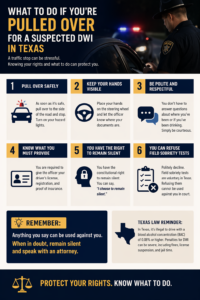
Pulled Over for DWI in Texas: What to Do at Every Stage of the Stop
Read Article
How Likely is Your Model of Car to be Stopped for a DWI Investigation?
Read ArticleVideos
What Signs Do Officers Look for When Deciding to Escalate a Traffic Stop into a DWI? | Texas Answers
Watch the Video
Pulled Over for DWI in Texas? Here’s What to Do Next — Call Deandra Grant Law Now
Watch the Video
Should You Take a Field Sobriety Test During a Traffic Stop in Texas? Deandra Grant Law | DWI Lawyer
Watch the Video
What to Do If You’re Pulled Over for DWI in Texas? | Deandra Grant Law | Contact Our Lawyers Today!
Watch the Video