Texas is one of the most active states in the country for federal drug prosecutions. The state’s 1,254-mile border with Mexico, its network of interstate highways, and its major metropolitan areas make it a focal point for federal drug enforcement operations. The Drug Enforcement Administration (DEA), the FBI, Homeland Security Investigations (HSI), and the Bureau of Alcohol, Tobacco, Firearms and Explosives (ATF) all maintain significant operations in Texas.
If you are facing federal drug charges in Texas—or if you believe you may be under investigation by a federal agency for drug-related activity—the stakes could not be higher. Federal drug convictions carry some of the harshest penalties in the entire federal criminal code, including mandatory minimum prison sentences that a federal judge cannot reduce except in very limited circumstances.
At Deandra Grant Law, our attorneys hold the ACS-CHAL Forensic Lawyer-Scientist designation from the American Chemical Society, with specialized training in forensic drug analysis. We don’t just understand the law—we understand the science the government uses to build its drug cases. That gives us the ability to challenge federal drug evidence in ways that most defense attorneys cannot.

"Deandra Grant Law – Criminal & DWI Defense handled my case with diligence and professionalism. Deandra Grant's reputation is stellar and now I know why. She has a team of individuals who provide quality service."
- N. Coulter
"Deandra Grant Law – Criminal & DWI Defense fights hard for their clients and is always willing to go above and beyond. They are the best firm for DWI cases in DFW and beyond. Definitely hire them to represent you in any pending cases."
- P. Williams
"Deandra Grant made a tough situation so much better. She listened to my concerns and helped me so much with my case. I would recommend her to anyone needing legal services."
- M. Haley
How Drug Cases Become Federal
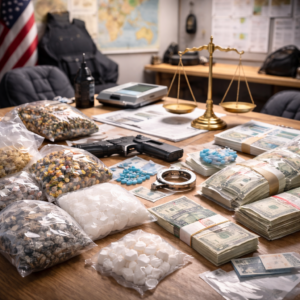
Not every drug case in Texas is a federal case. The majority of drug possession and even drug delivery cases are prosecuted in state court under the Texas Health and Safety Code. A drug case typically becomes federal when certain factors are present.
The alleged drug activity crosses state lines or international borders. This is the most common trigger for federal jurisdiction. If the government believes drugs were transported from Mexico into Texas, or from Texas to another state, the case will almost certainly be federal.
The investigation was conducted by a federal agency. When the DEA, FBI, or HSI initiates or leads an investigation, the resulting charges are typically brought in federal court. Joint task force investigations—where federal and state agents work together—can go either way, but federal prosecutors often claim jurisdiction when the quantities are large or the network is complex.
The quantities involved exceed the thresholds for federal mandatory minimum sentences. Federal prosecutors are more likely to take a case when the drug quantities trigger mandatory minimums, because these sentences serve as powerful leverage during plea negotiations.
The alleged activity occurred on federal property. Drug crimes committed on military installations, in national parks, in federal buildings, or on other federal property fall under federal jurisdiction regardless of the quantity involved.
Federal Drug Trafficking Penalties and Mandatory Minimums
Federal drug penalties are primarily governed by 21 U.S.C. §§ 841 and 960, and the mandatory minimum sentences are among the most severe in federal law. The penalties are determined by the type and quantity of drugs involved, and they escalate dramatically.
For offenses involving 500 grams or more of cocaine, 28 grams or more of crack cocaine, 100 grams or more of heroin, 5 grams or more of methamphetamine (pure), 50 grams or more of methamphetamine (mixture), or 100 kilograms or more of marijuana, the mandatory minimum sentence is five years in federal prison with no possibility of parole. The maximum is 40 years.
For offenses involving 5 kilograms or more of cocaine, 280 grams or more of crack cocaine, 1 kilogram or more of heroin, 50 grams or more of methamphetamine (pure), 500 grams or more of methamphetamine (mixture), or 1,000 kilograms or more of marijuana, the mandatory minimum sentence is ten years in federal prison with no possibility of parole. The maximum is life.
If a defendant has a prior felony drug conviction, these mandatory minimums double. A five-year mandatory minimum becomes ten years. A ten-year mandatory minimum becomes twenty years. And if a defendant has two or more prior felony drug convictions, certain offenses carry a mandatory minimum of twenty-five years to life in federal prison.
If death or serious bodily injury results from the use of a distributed substance, the penalties are even more severe—a mandatory minimum of twenty years for a first offense and mandatory life imprisonment for a second offense.
The Federal Safety Valve and Substantial Assistance
There are only two primary mechanisms for getting below a federal mandatory minimum sentence, and understanding them is essential for anyone facing federal drug charges.
The first is the safety valve provision under 18 U.S.C. § 3553(f). To qualify, a defendant must meet specific criteria: no more than one criminal history point under the Sentencing Guidelines, no use of violence or credible threat of violence in connection with the offense, the offense did not result in death or serious bodily injury, the defendant was not an organizer or leader or manager of others in the offense, and the defendant has truthfully provided the government with all information and evidence concerning the offense. If all criteria are met, the judge can sentence below the mandatory minimum.
The second is substantial assistance under § 5K1.1 of the Sentencing Guidelines and 18 U.S.C. § 3553(e). If a defendant provides information to the government that leads to the investigation or prosecution of others, the government can file a motion asking the court to impose a sentence below the mandatory minimum. The amount of the reduction depends on the significance of the defendant’s assistance. This is the primary mechanism the government uses to incentivize cooperation.
Case Results
Federal Drug Charges Commonly Seen in Texas
The most common federal drug charge in Texas is conspiracy to possess with intent to distribute a controlled substance under 21 U.S.C. § 846. Conspiracy charges allow the government to cast a wide net, charging everyone from major drug traffickers to low-level couriers as part of the same conspiracy. Because drug conspiracy does not require an overt act, the government only needs to prove an agreement to distribute drugs.
Possession with intent to distribute under 21 U.S.C. § 841(a)(1) is the primary substantive drug trafficking charge. The government must prove that the defendant possessed a controlled substance and intended to distribute it. Intent to distribute can be inferred from the quantity of drugs, the presence of packaging materials, scales, large amounts of cash, or other indicia of distribution.
Continuing criminal enterprise under 21 U.S.C. § 848—sometimes called the “drug kingpin” statute—is reserved for organizers and leaders of large-scale drug operations. A CCE conviction carries a mandatory minimum of twenty years and a maximum of life, with no possibility of parole.
Importation offenses under 21 U.S.C. § 960 target the importation of controlled substances into the United States. Given Texas’s border with Mexico, these charges are common in the Southern and Western Districts of Texas.
Challenging Federal Drug Evidence
At Deandra Grant Law, our forensic science training gives us a unique advantage in federal drug cases. The government’s case typically relies on laboratory analysis to identify the substance and determine its weight—both of which directly affect the charges and the mandatory minimum sentence. Our attorneys have completed intensive coursework in forensic drug analysis at Axion Labs in Chicago, the same training that qualifies forensic analysts who process drug evidence.
We know how to challenge the chain of custody of drug evidence, the calibration and maintenance records of analytical instruments, the methodology used by the lab analyst, and the accuracy of the reported drug weight. In a case where the difference between 499 grams and 500 grams of cocaine is the difference between no mandatory minimum and a five-year mandatory minimum, the precision of the government’s drug analysis is not a technicality. It is the entire case.
We also challenge the government’s evidence of intent to distribute, the legality of the search and seizure that produced the drug evidence, the reliability of cooperating witness testimony, and the government’s efforts to attribute drug quantities to our client in conspiracy cases.
Facing Federal Criminal Charges in Texas? Contact Deandra Grant Law Today.
If you or someone you love is facing a federal criminal investigation or federal charges in Texas, time is not on your side. The federal government has already been building its case. You need a defense team that understands how the federal system works and has the experience to fight back.
At Deandra Grant Law, our attorneys include ACS-CHAL Forensic Lawyer-Scientists, published legal scholars, and former public defenders who have tried hundreds of cases across Texas. We handle federal criminal matters in the Northern District of Texas, the Eastern District of Texas, the Western District of Texas, and the Southern District of Texas.
Call us at (214) 225-7117 or schedule a free consultation at texasdwisite.com/schedule-consultation/. Se habla español: (972) 347-8833.
The defense is ready.
Firm Accolades

Better Business Bureaus

D Magazine