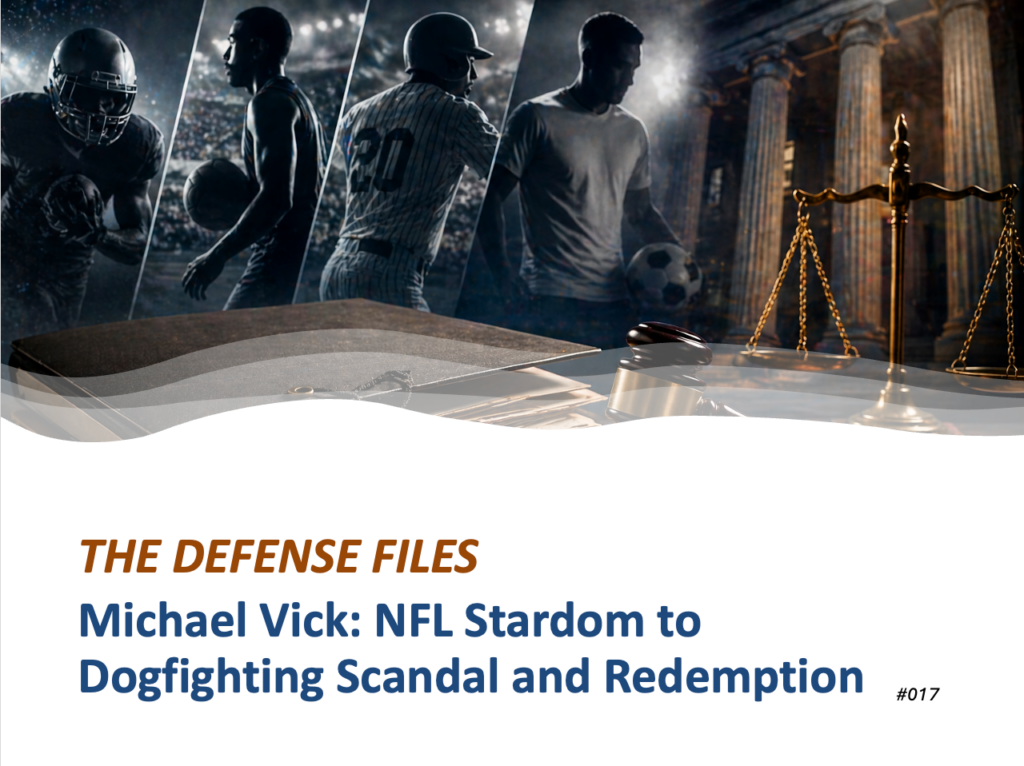
Welcome to The Defense File where we examine the criminal cases of public figures through the lens of Texas criminal law. Each entry looks at what happened in court, what the defense argued, and what a defendant would have faced (and how they might have been defended) if the same facts had occurred in Texas.
Few NFL careers have arced as dramatically as that of Michael Dwayne Vick. Born June 26, 1980, in Newport News, Virginia, he led Virginia Tech to the 2000 BCS National Championship Game as a redshirt freshman, finishing third in Heisman voting. The Atlanta Falcons selected him first overall in the 2001 NFL Draft. In 2004 he signed a ten-year, $130 million contract, briefly making him the highest-paid player in NFL history. His dual-threat athleticism reshaped what teams expected from the quarterback position.
And then, in 2007, federal investigators executed a search warrant on his Surry County, Virginia, property and found a dogfighting operation that had been running since 2001. Within eight months, Vick pleaded guilty to federal conspiracy charges, was sentenced to 23 months in federal prison, and lost his contract, his endorsements, and (briefly) his career. The Texas analysis here is different from most entries in this series because the Vick case is fundamentally a federal case, prosecuted under the federal Animal Welfare Act and the federal conspiracy statute, with a parallel state proceeding in Virginia. We walk through both, then map the conduct onto the Texas state-court analog under Penal Code §42.10.
The Investigation and Charges
On April 25, 2007, Surry County, Virginia investigators executed a search warrant on a 15-acre property Vick owned. The original investigation had been triggered by an unrelated drug arrest of Vick’s cousin Davon Boddie. Inside the property, investigators found 66 dogs (55 of them pit bulls), many showing scars and injuries consistent with fighting, and dogfighting paraphernalia such as a “rape stand” used in forced breeding, treadmills for conditioning, training equipment, and fighting pits. The operation, called Bad Newz Kennels, had been running since 2001.
On July 17, 2007, a federal grand jury in the Eastern District of Virginia indicted Vick and three co-defendants (Purnell Peace, Quanis Phillips, and Tony Taylor) on federal conspiracy charges. The lead count was conspiracy under 18 U.S.C. § 371 to violate the federal Animal Welfare Act (7 U.S.C. § 2156) by sponsoring an animal fighting venture, and to violate the Travel Act (18 U.S.C. § 1952) by using interstate facilities to promote gambling on the fights.
The structure of the federal case matters because federal conspiracy is the prosecutorial tool that connects multi-jurisdictional, multi-actor schemes that no single state could fully reach:
- The Animal Welfare Act provision (§2156) makes it a federal offense to sponsor or exhibit an animal in an animal fighting venture, or to use interstate commerce to do so.
- The Travel Act adds federal jurisdiction whenever a defendant uses interstate travel or interstate facilities (including telephones, money transfers, or vehicle travel across state lines) in furtherance of unlawful activity, including gambling.
- Conspiracy under §371 ties the entire scheme together, allowing the government to charge the planning and coordination of the operation independently of the individual acts.
How the Federal Case Proceeded
Federal cases tend to move quickly when the government brings a strong evidentiary record. The Vick prosecution was an unusually fast example of that dynamic.
- July 30, 2007 — Taylor pleads guilty. The first cooperator. He agreed to provide substantial assistance to the prosecution.
- August 17, 2007 — Peace and Phillips plead guilty. Both cooperators implicated Vick directly, describing his financial backing of the operation and his participation in the execution of underperforming dogs.
- August 20, 2007 — Vick signs a plea agreement. In a statement of facts attached to the agreement, Vick admitted he had bankrolled the gambling activities and had personally participated in the killing of six to eight dogs by hanging, drowning, or slamming them to the ground.
- August 27, 2007 — Guilty plea entered. Before U.S. District Judge Henry E. Hudson in Richmond.
- September 2007 — Bail violations. While on pre-sentencing release, Vick tested positive for marijuana, violating the conditions of his release. He also failed a polygraph test regarding his personal role in the dog killings.
The Federal Sentence
On December 10, 2007, Judge Hudson sentenced Vick to 23 months in federal prison which was above the 12- to 18-month guidelines range his attorneys had argued for. The court cited Vick’s failure to fully accept responsibility and the positive marijuana test as justifying an upward variance. Vick served roughly 19 months followed by two months of home confinement.
Vick paid nearly $1 million in restitution for the long-term care of 48 dogs rescued from the property. Many of those dogs were rehabilitated and adopted, in a widely reported rescue effort coordinated by the ASPCA, BAD RAP, Best Friends Animal Society, and the federal government.
The Virginia State Case
In November 2008, Vick pleaded guilty to a Virginia state dogfighting charge under Va. Code §3.2-6571 (the Virginia animal fighting statute). He received a three-year suspended sentence and a $2,500 fine. The state plea was largely cumulative (the conduct had already been prosecuted federally) but it closed the state’s parallel jurisdiction. Federal and state prosecution of the same conduct does not violate double jeopardy because of the dual sovereignty doctrine (most recently reaffirmed in Gamble v. United States, 587 U.S. 678 (2019)).
NFL Suspension, Bankruptcy, and Restitution
The NFL suspended Vick indefinitely without pay in August 2007. He lost his Falcons contract, all major endorsements (Nike, EA Sports, Reebok, Coca-Cola, Rawlings), and filed for Chapter 11 bankruptcy in 2008 reporting more than $20 million in debts. The NFL conditionally reinstated him in July 2009, and he signed with the Philadelphia Eagles. He won the 2010 NFL Comeback Player of the Year award, started for the Eagles, and continued playing through the 2017 season with the Jets and Steelers.
The Texas Analysis
Texas would have prosecuted the same conduct under Texas Penal Code §42.10 (the state dogfighting statute) with substantial overlap from §42.092 (Cruelty to Nonlivestock Animals) and §47.03 (Gambling Promotion) depending on the specific facts pleaded. The conduct Vick admitted to in his federal plea (sponsoring fights, using real estate for fighting, killing underperforming dogs, and running an interstate gambling operation) lines up across at least three Texas statutes, and would also have remained federally prosecutable under the Animal Welfare Act if any element crossed state lines.
§42.10: Dog Fighting
The Texas dogfighting statute creates a two-tier offense structure based on the type of conduct involved.
State jail felony conduct under §42.10(a)(1)–(3):
- Causing a dog to fight with another dog;
- Participating in the earnings of, or operating, a facility used for dog fighting;
- Using or permitting another to use any real estate, building, room, tent, arena, or other property for dog fighting.
Class A misdemeanor conduct under §42.10(a)(4)–(6):
- Owning or possessing dog-fighting equipment with intent that it be used to train a dog for, or in furtherance of, dog fighting;
- Owning or training a dog with intent that it be used in a dog-fighting exhibition;
- Attending a dog-fighting exhibition as a spectator.
Penalties:
- State jail felony (§42.10(a)(1)–(3)): 180 days to 2 years in a state jail facility; fine up to $10,000.
- Class A misdemeanor (§42.10(a)(4)–(6)): up to 1 year in county jail; fine up to $4,000.
Applied to the Vick facts: every category of state jail felony conduct under §42.10(a)(1)–(3) is present. He used the Surry County real estate to host fights (subsection (3)), operated the facility and participated in its earnings via gambling stakes (subsection (2)), and the conduct admitted in his federal plea included causing dogs to fight one another (subsection (1)). The misdemeanor subsections (owning training equipment, training fighting dogs, spectator attendance) would also be available to the State and could be charged as lesser-included or alternative counts.
§42.092: Cruelty to Nonlivestock Animals
The Vick plea included an admission to killing six to eight dogs personally by hanging, drowning, or slamming them to the ground. In Texas, that conduct sits squarely under §42.092, the cruelty-to-nonlivestock-animals statute, which prohibits (among other things) killing or seriously injuring an animal without legal authority.
Critically, cruelty under §42.092 is a separate offense from dogfighting under §42.10. A Texas prosecutor could plead both: dogfighting counts for the operation, plus cruelty counts for each dog killed. Each killed dog is a separate transactional unit, allowing the State to file multiple counts of cruelty to run consecutively or concurrently at the court’s discretion under Penal Code §3.03 (which generally requires concurrent sentences in a single criminal episode, but with significant exceptions).
That is an important charging point. Six to eight separately admitted killings means six to eight separate §42.092 counts in a Texas state-court indictment, on top of the §42.10 dogfighting felony.
§47.03 / §47.04: Gambling Promotion and Keeping a Gambling Place
The federal indictment alleged that Bad Newz Kennels was, in part, a gambling operation, with stakes on individual fights and on the broader betting structure organized around the kennel. In Texas, that conduct triggers parallel exposure under Chapter 47 of the Penal Code:
- 47.03 — Gambling Promotion. A Class A misdemeanor for operating, becoming a custodian of bets, or selling chances on a gambling scheme.
- 47.04 — Keeping a Gambling Place. A Class A misdemeanor for knowingly using or permitting another to use property owned or controlled by the actor as a gambling place.
Neither rises to a felony in Texas standing alone. But the combination of dogfighting plus gambling plus cruelty produces a multi-count indictment that, even in a single criminal episode, has substantial cumulative sentencing exposure.
The Federal Hook: Why Texas Wouldn’t Have Acted Alone
Even in a hypothetical Texas-only universe, this case would almost certainly have remained a federal prosecution. The federal hook is the use of interstate facilities and interstate commerce. Bad Newz Kennels involved:
- Travel by Vick and co-conspirators across state lines to attend and stage fights;
- Wire transfers of money to fund the operation;
- Acquisition of dogs from breeders and sellers across state lines; and
- Gambling proceeds and stakes moving in interstate commerce.
Once the federal government has jurisdiction (through the Animal Welfare Act’s interstate-commerce nexus, the Travel Act, and §371 conspiracy) it makes the call on whether to take the case. Federal sentencing under the U.S. Sentencing Guidelines §2E3.1 (the guideline applicable to gambling/violation of state, federal, or local laws) and the related cross-references for animal fighting produced the 12- to 18-month guidelines range that Judge Hudson exceeded based on Vick’s pretrial conduct. A Texas state prosecution running parallel to a federal one is constitutional under Gamble, but as a practical matter most state attorneys allow the federal case to move first and then resolve a state plea later (as Virginia did with the November 2008 plea).
What This Case Illustrates: Federal Prosecution Mechanics and the Acceptance-of-Responsibility Multiplier
Several elements of the Vick case are instructive for any Texas defendant whose conduct might attract federal attention, particularly where multi-jurisdictional or interstate facts give federal prosecutors a hook:
- Federal sentencing rewards full acceptance of responsibility and punishes its absence. Under USSG §3E1.1, a defendant who clearly demonstrates acceptance of responsibility receives a two-level reduction (and, on government motion, a third level for early plea cooperation). Vick lost some or all of that benefit by testing positive for marijuana while on pretrial release and by failing a polygraph about his personal role in the dog killings. The 12-to-18-month guidelines argument became a 23-month sentence largely because of conduct during pretrial release. In federal practice, what a defendant does between the indictment and the sentencing can be very important.
- Cooperators set the timeline. Three of Vick’s four co-defendants pleaded and cooperated within a month of the indictment. That sequence drove the strength of the government’s case against Vick and the speed of his own plea. In Texas federal practice (Northern, Eastern, Southern, and Western Districts of Texas), the same dynamic plays out routinely: the first co-defendant to cooperate gets the best deal, and the last in line gets the worst.
- Dual sovereignty means a federal plea does not foreclose a state plea. Vick’s federal plea in August 2007 did not prevent the November 2008 Virginia state plea. Gamble v. United States confirms the constitutional foundation. The practical question for defense counsel in any Texas case with federal exposure is how to coordinate the two proceedings to avoid a worse cumulative result.
- Pretrial release conditions are real conditions. Federal pretrial release under 18 U.S.C. § 3142 typically prohibits unlawful drug use and may include polygraph or other testing. Violation can produce a sentencing variance, a separate §3148 sanction, or detention pending sentencing. In Texas, a parallel issue arises under CCP Art. 17.40 bond conditions. Violations can trigger bond revocation and substantially worse plea posture.
- Restitution is part of the sentence. The nearly $1 million Vick paid in restitution was not optional or settlement money. Under the Mandatory Victims Restitution Act, 18 U.S.C. § 3663A, restitution to victims of certain federal offenses is mandatory at sentencing. Texas state cases handle restitution under CCP Art. 42.037, which similarly authorizes restitution as part of a sentence for offenses against the person or property.
How a Texas Defense Team Would Have Approached This
- Parallel federal-and-state planning from day one. Any case with interstate facts, gambling proceeds, or animal cruelty allegations that crosses state lines should be analyzed for federal exposure immediately. Coordination with federal counsel (or retention of a single attorney admitted in both forums) is essential. The federal case shapes the state case; the state case can complicate the federal case.
- Cooperation analysis at the front of the case. In a multi-defendant indictment, the cooperation race is real. Defense counsel must understand the client’s relative position in the conspiracy structure, the strength of the evidence against the client compared with co-defendants, and the timing of co-defendant cooperation, before counseling on plea options.
- Pretrial release compliance. Any drug use, missed appointment, polygraph failure, or unauthorized contact with a co-defendant or witness during pretrial release is a sentencing event in federal court. Texas state cases see the same dynamic, with bond revocations and acceptance-of-responsibility reductions tied to pretrial behavior.
- Restitution as part of the plea negotiation. Where restitution is mandatory or substantial, defense counsel works with the government to scope what is recoverable and to structure payment terms that the defendant can actually meet without further default.
- Asset-management for post-plea life. Federal pleas in cases involving substantial financial gain often produce parallel civil exposure, bankruptcy filings, and IRS-related issues. Vick’s 2008 Chapter 11 bankruptcy was foreseeable from the moment the federal plea was signed; the planning to manage what comes after the plea should begin during the plea negotiation, not after sentencing.
Legislative Aftermath: What the Vick Case Changed
The case is rare among modern criminal cases for the speed with which it produced legislation:
- Animal Fighting Prohibition Enforcement Act of 2007. Enacted shortly after Vick’s indictment, this law upgraded the maximum federal penalty for sponsoring or exhibiting an animal in an animal fighting venture to three years’ imprisonment.
- 2008 Farm Bill. The Food, Conservation, and Energy Act of 2008 further strengthened federal animal-fighting penalties and provisions for forfeiture of property used in animal-fighting ventures.
- Animal Fighting Spectator Prohibition Act of 2013. Made it a federal offense to knowingly attend an animal fighting venture, and an enhanced offense to bring a minor under 16 to one.
- State law changes. By the end of 2008, all 50 states had made dogfighting a felony offense. Texas had already classified the principal forms of dogfighting as state jail felonies under §42.10 since the 2007 amendments to that statute (§42.10(a)(1)–(3)).
Where Are They Now
In December 2024, Norfolk State University hired Michael Vick as its 19th head football coach. He completed his first season in 2025, finishing the year with the program in a transition phase but earning a 34-31 overtime victory over Virginia State in the annual Labor Day Classic. He had previously worked since 2017 as an NFL analyst for FOX Sports.
Vick has been a public advocate against dogfighting since his release from prison, working with the Humane Society of the United States on outreach programs. His 2020 Pro Bowl Legend selection drew controversy that produced petition activity questioning the appropriateness of the recognition. Public sentiment has remained divided in the way long-criminal-case redemption narratives almost always do: some praise the post-release advocacy and the rebuilt career; others continue to focus on the severity of the underlying conduct. Both responses are honest. Both have a basis in the record.
What This Case Tells Us
For Texas clients and their lawyers, the Vick case is the cleanest illustration in this series of how federal prosecution works when a multi-actor, multi-jurisdictional scheme has interstate facts that pull it across the federal jurisdictional line. Three takeaways: First, federal cases move faster than state cases, with stronger evidence at indictment and tighter cooperation incentives, and a defense team needs to be ready to operate on a federal timeline from the moment the search warrant executes. Second, the Federal Sentencing Guidelines weight pretrial conduct heavily so a positive drug test, a failed polygraph, or a missed report can move a sentence by months. Third, dual sovereignty means a federal resolution is rarely the end of the legal exposure. State, civil, league, employer, licensing, and reputational consequences run on independent tracks.
And the parallel between dogfighting under §42.10 and cruelty under §42.092 in Texas is the kind of charging-stacking decision that prosecutors make at intake and that defense counsel has to be ready to litigate from the moment the indictment is returned. The Vick conduct, transposed to Texas, is a multi-count indictment combining state jail felony dogfighting, multiple counts of cruelty to nonlivestock animals, gambling-promotion misdemeanors, and — if any interstate element pulled it across the federal line — a parallel federal conspiracy charge running independently of the state case. The job of the defense is to manage all of that, in two forums, on two clocks.
Related Reading on Deandra Grant Law
- Federal Criminal Defense in Texas — The federal sentencing guidelines, dual sovereignty, and the Northern, Eastern, Southern, and Western Districts of Texas.
Sources
- New York Times — Vick sentenced to 23 months (Dec. 11, 2007)
- Norfolk State Athletics — Vick named head football coach (Dec. 20, 2024)
- 18 U.S.C. § 371 — Conspiracy to Commit Offense or to Defraud United States
- 7 U.S.C. § 2156 — Animal Fighting Venture Prohibition
- 18 U.S.C. § 1952 — Travel Act
- 18 U.S.C. § 3663A — Mandatory Restitution to Victims of Certain Crimes
- Gamble v. United States, 587 U.S. 678 (2019)
- Texas Penal Code §42.10 — Dog Fighting
- Texas Penal Code §42.092 — Cruelty to Nonlivestock Animals
- Texas Penal Code §47.03 / §47.04 — Gambling Promotion / Keeping a Gambling Place
The Defense File is an educational series. All Texas analysis is hypothetical and does not constitute legal advice about any specific case.
If you are facing federal charges in Texas — in the Northern, Eastern, Southern, or Western District — call (214) 225-7117 for a free, confidential consultation. Or schedule online at texasdwisite.com.