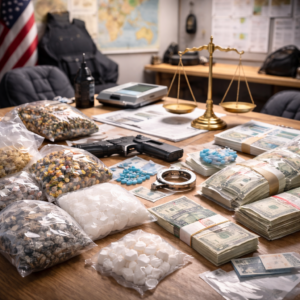
If you have been charged with a drug offense in Texas, one of the most important factors determining your future is which system is prosecuting you. State and federal drug cases involve different statutes, different penalties, different procedures, different judges, and fundamentally different approaches to prosecution and sentencing. Understanding these differences is not academic — it directly affects your defense strategy, your sentencing exposure, and whether you will serve your time in a state facility or a federal prison.
At Deandra Grant Law, Attorney James Lee Bright practices exclusively in federal court, with more than 25 years of experience defending federal drug cases. Our firm’s ACS-CHAL Forensic Lawyer-Scientist credentials give us the additional ability to challenge the government’s forensic evidence at a scientific level.
Different Statutes, Different Structures
Texas State Drug Law
Texas drug offenses are prosecuted under the Texas Health and Safety Code, Chapters 481–486. The Texas system organizes controlled substances into Penalty Groups (1, 1-A, 1-B, 2, 2-A, 3, and 4) and Marijuana. Penalties are determined primarily by the type of substance and the weight of the substance in the defendant’s possession.
Federal Drug Law
Federal drug offenses are prosecuted primarily under 21 U.S.C. §841 (manufacturing, distributing, or possessing with intent to distribute) and 21 U.S.C. §846 (conspiracy). The federal system uses Schedules I through V to classify controlled substances. Penalties are driven by drug type and quantity, but the federal system layers on mandatory minimums, Sentencing Guidelines calculations, and enhancements that can dramatically increase the sentence.
Firm Accolades

Better Business Bureaus

D Magazine























Penalty Comparisons
The differences in potential sentences are stark:
- Possession of 1–4 grams of cocaine: In Texas state court, this is a third-degree felony carrying 2–10 years and up to a $10,000 fine, with probation possible. In federal court, simple possession is a misdemeanor for first offense (up to 1 year), but if the government charges possession with intent to distribute, the case enters the Sentencing Guidelines framework and can produce significantly longer sentences especially with criminal history.
- Distribution of 500+ grams of cocaine: In Texas, this weight of delivery would be a first-degree felony (5–99 years). In federal court, 500+ grams of cocaine triggers a 5-year mandatory minimum under §841(b)(1)(B), with a 40-year maximum. With a prior drug felony, the mandatory minimum doubles to 10 years.
- Distribution of 5+ kilograms of cocaine: In federal court, this triggers a 10-year mandatory minimum with a life maximum. With a prior drug felony, the mandatory minimum becomes 20 years. If death or serious injury resulted, the mandatory minimum is 20 years (life with a prior). Texas has no comparable mandatory minimum structure.

"Deandra Grant Law – Criminal & DWI Defense handled my case with diligence and professionalism. Deandra Grant's reputation is stellar and now I know why. She has a team of individuals who provide quality service."
- N. Coulter
"Deandra Grant Law – Criminal & DWI Defense fights hard for their clients and is always willing to go above and beyond. They are the best firm for DWI cases in DFW and beyond. Definitely hire them to represent you in any pending cases."
- P. Williams
"Deandra Grant made a tough situation so much better. She listened to my concerns and helped me so much with my case. I would recommend her to anyone needing legal services."
- M. Haley
The Parole Difference
This is perhaps the most consequential difference for defendants. In the Texas state system, most drug offenders become parole-eligible after serving 25% to 50% of their sentence, depending on the offense. A defendant sentenced to 10 years in state prison might serve 2.5 to 5 years before parole.
In the federal system, there is no parole. Federal defendants must serve at least 85% of their sentence, reduced only by limited good-time credit (up to 54 days per year served). A defendant sentenced to 10 years in federal prison will serve approximately 8.5 years. This means a federal 10-year sentence results in more actual time served than a state 20-year sentence in many cases.
Different Prosecutors, Different Approaches
State prosecutors handle high volumes of cases and are often open to plea negotiations, deferred adjudication, and probation. Federal prosecutors (AUSAs) are selective about which cases they bring and have extensive resources to prepare. The federal discovery process produces volumes of evidence such as wiretap transcripts, financial records, cooperating witness statements, forensic lab reports that require experienced federal defense counsel to evaluate and challenge effectively.
Case Results
Why Federal Drug Cases Require Federal Experience
Lee Bright’s exclusive federal practice means he understands the Sentencing Guidelines calculations that drive federal drug sentences, the mandatory minimum framework and the limited exceptions (safety valve, substantial assistance) and challenging forensic evidence including drug identification and quantity determination.
A state-court criminal defense attorney handling a federal drug case for the first time is at a severe disadvantage. Federal practice is a specialized field, and the stakes are too high for on-the-job learning.
Contact Deandra Grant Law
If you are under investigation or have been charged with a federal offense, contact Deandra Grant Law for a free, confidential consultation with Attorney James Lee Bright. Lee has more than 25 years of federal trial experience and is admitted to practice in all four federal districts in Texas, the District of Columbia, the Fifth Circuit Court of Appeals, and the United States Supreme Court.