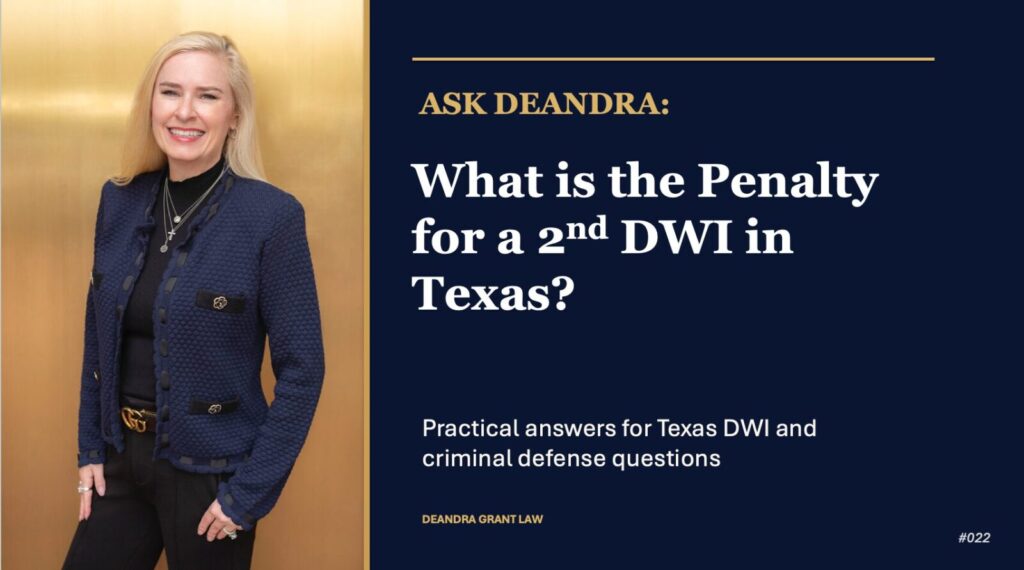
The question: What is the penalty for a second DWI in Texas?
| THE SHORT ANSWER
A second DWI in Texas is a Class A misdemeanor under Penal Code § 49.09(a). The statutory sentencing range is 30 days to one year in county jail plus a fine of up to $4,000. But in practice, the great majority of DWI 2nd cases that result in conviction are resolved through community supervision (probation), not straight jail. Probation comes with a mandatory confinement period imposed as a condition of supervision, and that period is much shorter than the 30-day statutory floor: 72 hours to 30 days if the prior DWI conviction was more than five years before the current offense, or 5 days to 30 days if the prior was within five years. License suspension can run up to two years. Ignition interlock is essentially mandatory under Article 17.441. HB 3582 deferred adjudication, available on some first offenses, is not available on a DWI 2nd. And a second DWI sits one conviction away from a felony because a third Texas DWI is automatically a third-degree felony with two-to-ten-year prison exposure. |
Here is the longer answer: what the statute actually requires, what jail and probation look like, what mandatory interlock means in practice, and why a second DWI deserves more aggressive defense than most defendants assume.
The Statutory Framework: Penal Code § 49.09(a)
Texas Penal Code § 49.09(a) provides that a DWI is a Class A misdemeanor if the defendant has been previously convicted one time of an offense relating to the operating of a motor vehicle while intoxicated. The phrase “offense relating to the operating of a motor vehicle while intoxicated” is broad. It captures DWI under § 49.04, DWI with Child Passenger under § 49.045, BWI under § 49.06, and certain other related offenses, including some out-of-state DWI convictions if they meet Texas’s statutory definition.
The prior conviction does not need to be recent. Texas does not have a “lookback” period for § 49.09(a) enhancement. A DWI conviction from twenty years ago is just as available for enhancement as a conviction from last year. This catches many defendants completely off guard. Someone who has had a clean record for two decades since a youthful DWI can find themselves charged as a second offender on a new arrest.
Note the distinction. The age of the prior conviction does not affect whether the case is a Class A second-offense case. It does affect the mandatory confinement period imposed as a condition of probation which is a separate question discussed below.
The Statutory Sentencing Range
The statutory sentencing range for DWI 2nd is 30 days to 365 days (one year) in county jail, plus a fine of up to $4,000. That is the range a judge can sentence within if the case results in straight jail time. It is the upper boundary of what is possible and not what most cases produce.
Probation (community supervision) is available on a Class A misdemeanor DWI 2nd, and it is the disposition the great majority of defendants receive. The 30-day-to-one-year statutory range is sometimes referenced as if it were the operational reality of every second-offense case. It is not. Straight jail without probation does happen, particularly in cases involving aggravating facts or in cases where probation is denied for other reasons, but it is not the dispositional norm. The norm is probation with the structure described in the next section.
The Real-World Outcome: Probation with Mandatory Confinement as a Condition
On a Class A DWI 2nd that is resolved through community supervision, Article 42A.401(b) of the Texas Code of Criminal Procedure requires the court to impose a term of confinement as a condition of probation. That confinement requirement is calibrated to the age of the prior conviction:
- If the prior DWI conviction was more than five years before the current offense: confinement of not less than 72 hours and not more than 30 days as a condition of community supervision.
- If the prior DWI conviction was within five years of the current offense: confinement of not less than 5 days and not more than 30 days as a condition of community supervision.
The court has discretion within those ranges, and the actual number of days imposed varies by county, by judge, by the facts of the case, and by the quality of the defense presentation. A defendant with a prior conviction from twenty years ago and a strong record since may be eligible for the statutory minimum of 72 hours. A defendant with a more recent prior may receive closer to the higher end of the 5-to-30-day range. The lower numbers in those ranges are real, and they are achievable in the right case.
The 30-day number that gets associated with DWI 2nd in casual conversation is actually the statutory minimum for a defendant sentenced to straight jail without probation. With probation (the dispositional norm) the operative number is much smaller. Telling a client to expect 30 straight days in jail on a second DWI without explaining the probation framework is, in most cases, simply inaccurate.
A few additional facts about the probation framework on a DWI 2nd are worth understanding before any plea discussion:
- Probation length is typically one to two years. The maximum probation term for a Class A misdemeanor is two years.
- Probation conditions on a DWI 2nd include mandatory ignition interlock, DWI education class, victim impact panel, substance abuse evaluation and any recommended treatment, community service hours, alcohol and drug abstention, monitoring fees, and travel and residence restrictions.
- Revocation exposure. Technical violations (missing a class, failing a UA, missing a payment) can produce real exposure to extended jail time. Probation is not a free pass.
- Straight jail remains possible. A defendant who is not granted probation faces the full statutory range of 30 days to one year. That outcome is uncommon as a percentage of cases, but it is the default if probation is denied. Aggravating facts, prior violations, or refusal of probation conditions can push a case in that direction.
Fines, Costs, and the Real Financial Picture
Fines and court costs on a second DWI are higher than on a first:
- Criminal fine. Up to $4,000 which is double the $2,000 maximum on a Class B first offense. Set by the judge at sentencing.
- Court costs and program fees. Several hundred dollars in court costs, plus DWI education, victim impact panel, substance abuse evaluation, and any required treatment programs.
- Probation fees. Monthly supervision fees for the duration of any probation term which are typically $60 to $75 per month for one to two years.
- Ignition interlock costs. Installation, monthly monitoring, removal, and any service or violation fees. On a second DWI, interlock is typically required for both bond and probation, often running for the full probation term and into the post-suspension licensing period.
- State DWI conviction fee under Government Code § 102.021. Imposed on conviction.
- Insurance impact. A second DWI conviction may produce a larger insurance impact than a first. Some carriers drop the driver entirely.
The total out-of-pocket cost of a second DWI in Texas (fines, costs, fees, interlock, insurance) runs $10,000 or more over the first few years following conviction. That is on top of the cost of legal defense, which is typically higher in second-offense cases because the stakes are higher.
Driver’s License Consequences
A second DWI triggers significantly longer license consequences than a first:
- License suspension on conviction. Texas Department of Public Safety can suspend the license for 180 days to two years on a DWI 2nd conviction.
- ALR consequences. Refusal of a breath or blood test on a second case carries a two-year ALR suspension if there has been a prior alcohol-related enforcement contact. Failure on a second case carries a one-year ALR suspension if there has been a prior contact.
- Occupational driver’s license. Available under Texas Transportation Code §§ 521.242–521.248, but the conditions will require an interlock device.
- Ignition interlock restricted license. Available under § 521.2462, with the interlock requirement essentially mandatory for the licensing period.
- Reinstatement after a second DWI suspension typically requires both an SR-22 filing and an ignition interlock for an extended period.
Loss of driving privileges on a second DWI is not a brief inconvenience. It is a meaningful, multi-year disruption that affects employment, family, and daily life.
Mandatory Ignition Interlock — Article 17.441
On a second DWI, ignition interlock is essentially mandatory. Texas Code of Criminal Procedure Article 17.441 directs the court to require an interlock as a condition of bond for any defendant charged with a second or subsequent DWI offense. The interlock typically continues as a probation condition if probation is granted and is required as a licensing condition during the post-conviction suspension period and for some time thereafter.
The practical result: anyone charged with a second DWI in Texas should expect to live with an ignition interlock device for an extended period. The cost, the daily inconvenience, and the social stigma are all part of the punishment that does not appear in the headline statute.
HB 3582 Deferred Adjudication Is Not Available
On a first DWI, qualifying defendants can sometimes secure HB 3582 deferred adjudication which is a disposition that, when successfully completed, avoids a final conviction. On a second DWI, that path is closed entirely. HB 3582 amended Article 42A.102 of the Code of Criminal Procedure to permit deferred adjudication only for first-offense DWI cases meeting specific criteria. A defendant with a prior DWI conviction is, by definition, not a first offender.
The practical consequence: a second DWI that results in a plea or conviction generally produces a final conviction on the record. The deferred-adjudication path that would have avoided a final conviction on a first offense is unavailable on a second.
The Felony Threshold
The most important strategic fact about a second DWI is that it sits one conviction away from a felony. Under Penal Code § 49.09(b), a third or subsequent DWI is a third-degree felony which is punishable by two to ten years in TDCJ. There is no time limit on prior convictions under § 49.09(b), the same as under § 49.09(a).
That means a defendant with two prior DWI convictions on their record (of any age) faces felony exposure on the next arrest. The decisions made on a second DWI affect not just that case, but every future case the defendant will ever face. Pleading a second DWI without a real fight may save short-term resources at the cost of locking in the prior conviction that converts the next case into a felony.
Why a Second DWI Deserves Aggressive Defense
Several reasons make second-DWI defense strategically important even for clients tempted to “just get it over with”:
- The collateral consequences scale up. Background checks for employment, professional licensing, security clearances, immigration, and federal positions are all affected more severely by a second DWI conviction than by a first.
- Insurance impact is substantial. Some carriers drop second-DWI defendants entirely. SR-22 requirements run for years.
- Career consequences are real. Professional licensing boards review second DWIs more aggressively than first DWIs. Some industries effectively bar candidates with two DWI convictions on the record.
- The CDL consequence is permanent. Federal commercial driver rules disqualify a CDL holder for life on a second DWI conviction.
- The next case is a felony. Locking in a second conviction makes the next arrest a third-degree felony with prison exposure. That risk does not go away with time.
The defense response is the same forensic and procedural rigor used on any DWI case (attacking the stop, the arrest, the field sobriety tests, the chemical evidence, and the warrant) plus specific attention to whether the State has properly pleaded and proven the prior conviction. The judgment, the waiver of counsel, and the identity proof all matter. A defective prior conviction can defeat the § 49.09(a) enhancement even when the substantive DWI is provable.
Defending the Prior Conviction
In a second-DWI case, the prior conviction is not just background. It is an element the State has to prove. Defense counsel should always evaluate:
- The judgment of the prior case. The signed judgment establishing the conviction. Missing waivers of counsel, missing acknowledgments of admonishments, or other procedural defects can sometimes support a collateral attack on the prior.
- The State must prove the defendant in the current case is the same person convicted in the prior case. Common-name issues, unverified fingerprint matches, and identity proof gaps are real defense territory.
- Out-of-state priors. If the prior is from another state, defense counsel should verify that the prior offense meets Texas’s statutory definition of a DWI-related offense. Not every state’s DUI conviction enhances a Texas DWI to a Class A.
- Pleading defects. The State’s charging instrument must properly plead the prior conviction. Pleading defects can defeat the enhancement even when the proof is otherwise available.
Defeating the § 49.09(a) enhancement does not necessarily defeat the underlying DWI but it converts a Class A second-offense case back into a Class B first-offense case.
What to Do if You Are Charged with a Second DWI
Immediate considerations:
- Hire a defense lawyer with second-offense experience. The procedural and strategic landscape on a second DWI is meaningfully different from a first. Generic DWI defense is not enough.
- Address the bond. Mandatory interlock as a condition of bond is the default on a second DWI. Bond conditions can be challenged or modified through proper motion practice.
- Address the ALR deadline. The 15-day administrative license deadline still runs from the date of service of the notice of suspension. ALR consequences on a second case are more severe than on a first.
- Stop talking about the case. Anything you say can be used against you, and it can also affect any future third case. Talk only to your lawyer.
- Do not assume the case is unwinnable. Second-DWI cases are won regularly. The forensic, procedural, and prior-conviction defenses are all real, and the right defense team can produce outcomes most defendants would not have predicted.
The Bottom Line
A second DWI in Texas is a Class A misdemeanor under § 49.09(a) with a statutory sentencing range of 30 days to one year in county jail and a fine of up to $4,000. But in the great majority of cases, the disposition is probation with mandatory confinement as a condition of probation running 72 hours to 30 days if the prior was more than five years ago, or 5 days to 30 days if the prior was within five years. License suspension can run up to two years. Mandatory ignition interlock under Article 17.441 is essentially the default for both bond and probation. HB 3582 deferred adjudication is unavailable. The financial cost over the first few years routinely reaches $20,000 to $40,000. CDL holders face permanent lifetime disqualification. The next DWI arrest is a felony. Your case deserves a defense calibrated to those stakes and not a quick plea negotiated under time pressure, and not a misunderstanding of what the jail-time exposure actually is.
| SECOND DWI DEFENSE AT DEANDRA GRANT LAW
Deandra Grant Law defends DWI and intoxication-offense cases across North and Central Texas including Dallas, Fort Worth, Plano, McKinney, Frisco, Allen, Lewisville, Denton, Rockwall, and Waco. We approach every second-DWI case with the same rigor we apply to felony DWI cases because the next arrest will be a felony. Our team includes an ACS-CHAL Forensic Lawyer-Scientist with a Master of Science in Pharmaceutical Science and a Graduate Certificate in Forensic Toxicology and the felony trial experience required for the cases that move to district court. If you have been arrested for a second DWI in Texas, call Deandra Grant Law at (214) 225-7117 or visit texasdwisite.com to schedule a confidential consultation. And remember — the 15-day ALR deadline runs from the date of service of the notice of suspension. |
Have a DWI question you want answered in this series? Submit it at texasdwisite.com — you might see it featured in a future Ask Deandra post.