By Deandra Grant, J.D., M.S. (Pharmaceutical Science), ACS-CHAL Forensic Lawyer-Scientist
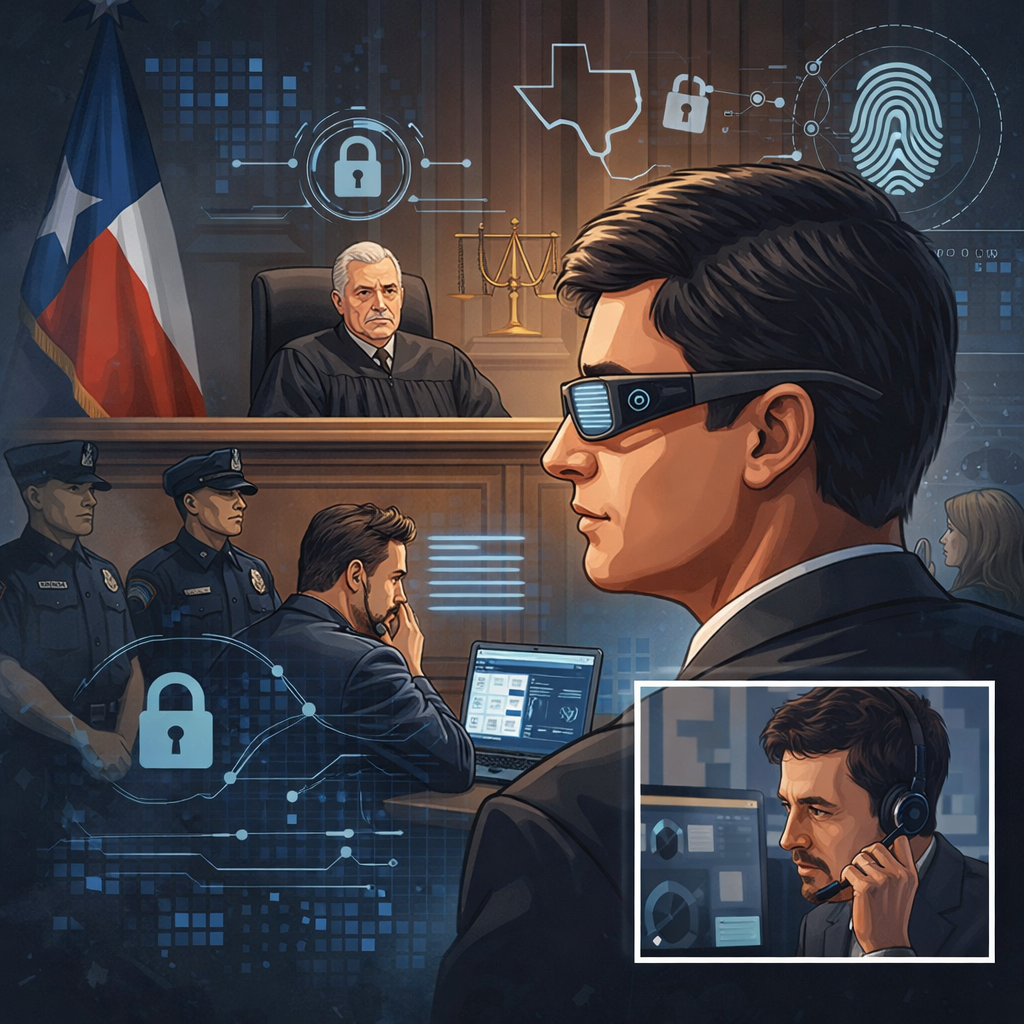
A UK High Court judge recently caught a litigant receiving real-time coaching through smart glasses while being cross-examined. The man, co-owner of a Lithuanian company trying to get his firm off an insolvency list, was wearing glasses that were connected to his phone via Bluetooth. Someone on the other end of the call was feeding him answers.
Judge Raquel Agnello KC noticed the witness paused conspicuously before each answer during cross-examination. She ordered him to remove the glasses. Once disconnected, he couldn’t answer basic questions. His phone records showed multiple calls during testimony to a contact listed as “abra kadabra” who he unconvincingly claimed was a taxi driver. The judge rejected his testimony entirely, concluding he had been “assisted or coached” and that his evidence was “unreliable and untruthful.”
The case is getting attention because the cheating was so brazen. But for criminal defense lawyers, the more important story is what smart glasses and wearable technology mean for evidence, courtroom procedure, and digital forensics on both sides of a criminal case.

"Deandra Grant Law – Criminal & DWI Defense handled my case with diligence and professionalism. Deandra Grant's reputation is stellar and now I know why. She has a team of individuals who provide quality service."
- N. Coulter
"Deandra Grant Law – Criminal & DWI Defense fights hard for their clients and is always willing to go above and beyond. They are the best firm for DWI cases in DFW and beyond. Definitely hire them to represent you in any pending cases."
- P. Williams
"Deandra Grant made a tough situation so much better. She listened to my concerns and helped me so much with my case. I would recommend her to anyone needing legal services."
- M. Haley
Wearable Technology as Evidence: What Prosecutors Are Using
Smart glasses are the headline, but they are part of a much broader shift. Wearable devices (ex. smartwatches, fitness trackers, smart rings, earbuds, and smart glasses) generate forensic data that prosecutors are increasingly using in criminal cases:
- Location data. Smartwatches and fitness trackers record GPS coordinates, step counts, and movement patterns that can place a defendant at a specific location at a specific time. Apple Watch health data, Fitbit activity logs, and Google Fit records have all been introduced as evidence in criminal cases nationwide.
- Communication logs. Smart glasses connected via Bluetooth to a phone create connection logs, call records, and in some cases audio or video recordings. These logs can establish who the defendant was communicating with and when.
- Biometric data. Heart rate spikes, stress indicators, and sleep patterns recorded by wearable devices have been used to corroborate or contradict a defendant’s account of events. A heart rate spike at the time of an alleged offense can be used as circumstantial evidence of consciousness of guilt or, from the defense perspective, of fear consistent with self-defense.
- Audio and video recordings. Smart glasses with built-in cameras and microphones (like Meta’s Ray-Ban glasses or Omi glasses) can record conversations and interactions without the other party’s knowledge. These recordings can become evidence if captured pursuant to a search warrant or if voluntarily provided.
- App activity and notifications. Wearable devices sync with phone apps, creating a parallel record of the defendant’s digital activity: text message notifications, social media alerts, navigation directions, and ride-share confirmations.
The common thread is that wearable devices create a second forensic trail beyond the phone itself. A defendant who factory-resets their phone may not realize that their smartwatch, fitness tracker, or smart glasses retained synced data that tells the same story.
Challenging Wearable Device Evidence: The Defense Perspective
The same data that prosecutors rely on can be challenged and wearable device evidence has significant vulnerabilities that a forensically trained defense team can exploit.
Who Was Wearing the Device?
A smartwatch on a nightstand records the same location data whether the defendant is wearing it or not. A fitness tracker left in a gym bag shows movement data for whoever is carrying the bag. GPS data from a wearable device proves where the device was but not necessarily where the defendant was. The prosecution must establish that the defendant was actually wearing or carrying the device at the relevant time, and that is not always provable.
Accuracy and Precision
Wearable device GPS is generally less precise than phone GPS because of smaller antennas and lower power. A smartwatch GPS fix can be off by 15–50 meters or more in urban environments, near tall buildings, or indoors. Fitness tracker step counts can be triggered by arm movements unrelated to walking. Heart rate data varies in accuracy depending on skin contact, device fit, and the wearer’s skin tone and body composition. The defense should evaluate the specific device’s known accuracy limitations and the conditions under which the data was recorded.
Data Extraction and Integrity
How was the data extracted from the device? Was the extraction performed using forensically validated tools (Cellebrite, GrayKey, Oxygen Forensic Detective), or was it a manual screen-capture that may not reflect the complete dataset? Was the device imaged before extraction to preserve the original data? Was the chain of custody maintained from seizure to analysis to courtroom presentation?
Doug Huff’s Garrett Discovery digital forensics training gives our defense team the ability to independently evaluate device extractions, whether the extraction methodology was forensically sound, identify data that was omitted or misinterpreted, and present the complete digital picture to the jury. When the prosecution presents a curated selection of wearable device data, the defense must be equipped to show what the full dataset reveals.
Bluetooth and Connection Logs
The UK smart glasses case turned on Bluetooth connection logs. The judge determined the glasses were connected to the witness’ phone during testimony. In Texas criminal cases, Bluetooth pairing records, connection timestamps, and device proximity data are becoming relevant evidence. But Bluetooth connections are not always reliable indicators of intentional use: devices can auto-connect, maintain passive connections, and show “connected” status without active communication. The defense should scrutinize what the connection log actually proves versus what the prosecution assumes it proves.
Smart Glasses in Texas Courtrooms
Texas courtroom rules on electronic devices were written for phones, not glasses. Most Texas courts operate under local rules that prohibit recording devices and restrict cell phone use in the courtroom. But smart glasses, which look like ordinary eyeglasses, create an enforcement gap.
The Zuckerberg incident in February 2026 (where a Los Angeles judge threatened contempt for anyone wearing smart glasses in her courtroom) signals that courts are beginning to adapt. Texas judges have broad authority under Government Code §21.001 to maintain order and decorum in the courtroom, which includes the power to prohibit specific devices. Federal courts in the Northern District of Texas have their own local rules on electronic devices that will likely be updated as smart glasses proliferate.
For criminal defendants, the practical takeaway is straightforward: do not bring smart glasses, smartwatches with communication capability, or any connected device into a courtroom without discussing it with your attorney first. What happened in the UK case, where the defendant’s credibility was destroyed and his testimony rejected in its entirety, is the best possible illustration of why attempting to use technology to gain an advantage in court will backfire catastrophically.
The Next Frontier: AI Coaching in Real Time
The UK witness was being coached by a human on the other end of a phone call. But the technology already exists to replace that human with an AI. Smart glasses with integrated AI assistants (including Meta’s Ray-Ban glasses with Meta AI) can process questions in real time and generate suggested responses. It is a matter of when, not whether, someone attempts to use an AI to provide real-time coaching during testimony.
From a legal perspective, this would constitute the same violation as human coaching: a witness is required to testify from their own knowledge and recollection, and receiving outside assistance of any kind during testimony (whether from a person, a written note, or an AI) is a form of fraud on the court. But detecting it will be harder than detecting a phone call, because AI-generated responses do not require a human on the other end making audible sounds.
Courts will need to develop new protocols for wearable technology screening, and defense attorneys need to be prepared for the possibility that prosecution witnesses , including law enforcement officers, may also have access to AI-assisted tools during testimony. The technology cuts both ways.
Case Results
What This Means for Criminal Defense
The proliferation of wearable technology is expanding the universe of digital evidence in criminal cases. For defendants, this means more data for the prosecution to seize, analyze, and present. But it also means more data for the defense to challenge and wearable device data is often less reliable, less precise, and less forensically rigorous than traditional phone data.
At Deandra Grant Law, digital forensics is a core component of our defense practice. Doug Huff’s digital forensics training allow us to more easily evaluate device extractions and the prosecution’s digital evidence to present the complete forensic picture to the judge or jury. As wearable technology generates an ever-larger share of the evidence in criminal cases, the defense team’s ability to understand, challenge, and contextualize that evidence becomes more important with every case.
If you are facing criminal charges and digital evidence — from a phone, a smartwatch, a fitness tracker, smart glasses, or any other connected device — is part of the prosecution’s case, call (214) 225-7117 or visit texasdwisite.com. The technology is evolving. Your defense team should be too.
Firm Accolades

Better Business Bureaus

D Magazine