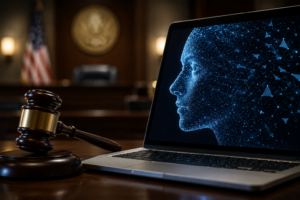
Federal prosecutors have embraced digital evidence. Text messages, direct messages on social media platforms, posts, comments, photos, location data, and metadata from your phone and accounts are now standard components of the government’s evidence in drug trafficking, fraud, child exploitation, firearms, and virtually every other category of federal case. If you have been charged with a federal offense, there is a near-certainty that the government has obtained or is seeking to obtain your digital communications.
At Deandra Grant Law, Attorney James Lee Bright has more than 25 years of federal experience handling cases involving complex digital evidence which means evaluating how digital evidence was obtained, whether it was properly preserved, and whether the government’s interpretation of that evidence is accurate.
How the Government Gets Your Digital Communications
Search Warrants for Devices
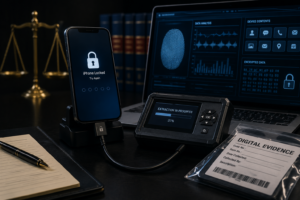
When federal agents execute a search warrant at your home or during an arrest, they seize electronic devices such as phones, computers, tablets, external drives. These devices are then subjected to forensic examination using tools like Cellebrite, GrayKey, and EnCase that can extract text messages, deleted messages, app data, call logs, photos, videos, browsing history, location data, and metadata. Modern forensic tools can often recover data that the user believed was permanently deleted.
Legal Process to Service Providers
The government uses multiple legal mechanisms to obtain data directly from technology companies and service providers:
- Search warrants (required for content). Under the Stored Communications Act (18 U.S.C. §2703) and the Supreme Court’s decision in Carpenter v. United States (2018), the government generally needs a warrant supported by probable cause to obtain the content of stored communications including emails, text messages stored on a provider’s servers, direct messages, and cloud-stored files.
- Court orders (§2703(d) orders). For non-content records, such as subscriber information, IP addresses, login times, and connection logs, the government can obtain a court order based on “specific and articulable facts” showing relevance to an investigation. This is a lower standard than probable cause.
- For basic subscriber information (name, address, billing records), the government can issue an administrative subpoena without judicial approval.
- National Security Letters (NSLs). In national security investigations, the FBI can issue NSLs for certain categories of records without judicial involvement.
Preservation Requests
Before obtaining a warrant or court order, the government can send a preservation request to a service provider under 18 U.S.C. §2703(f), requiring the provider to preserve a user’s data for 90 days (renewable). This prevents data from being automatically deleted while the government prepares its legal process. You will not be notified of a preservation request.
What the Government Does with Digital Evidence
In federal cases, digital evidence is used in multiple ways:
- Direct evidence of criminal conduct. Text messages discussing drug transactions, photos of contraband, or social media posts displaying firearms are used as direct evidence of the charged offense.
- Evidence of conspiracy and association. Communication patterns, group chats, and contact lists are used to establish relationships between co-conspirators and the organizational structure of alleged criminal enterprises.
- Timeline and location evidence. GPS data, cell site location information (CSLI), and metadata timestamps are used to place the defendant at specific locations at specific times.
- Prior statements in text messages or social media posts can be used to contradict a defendant’s testimony or other evidence presented at trial.
- Sentencing evidence. Even evidence that is inadmissible at trial may be considered at sentencing under the more relaxed evidentiary standards that apply in federal sentencing proceedings.
Firm Accolades

Better Business Bureaus

D Magazine



















How We Challenge Digital Evidence
Our ACS-CHAL forensic credentials and Lee’s federal trial experience combine to challenge digital evidence at every stage:
- Fourth Amendment challenges. Was the search warrant for the device or provider data supported by probable cause? Was the warrant sufficiently particular? Did agents exceed the scope of the warrant during the forensic examination? Lee files motions to suppress unlawfully obtained digital evidence.
- Authentication challenges. The government must prove that the digital evidence is what it claims to be. Who actually sent a text message? Was the social media account controlled by the defendant? Could someone else have had access to the device? Were messages altered, fabricated, or taken out of context?
- Forensic methodology challenges. Was the device properly imaged with write-blocking? Was chain of custody maintained? Were forensic tools properly calibrated and validated? Were extraction reports accurately interpreted? Our forensic team evaluates the government’s digital forensic work at a technical level.
- Metadata and timestamp challenges. Digital timestamps can be affected by time zone settings, device clock errors, and platform-specific behaviors. We examine whether the government’s timeline narrative is actually supported by the metadata.
- Completeness challenges. The government may present selected messages out of context while omitting surrounding communications that change the meaning. Lee demands complete production and presents the full context to the jury.

"Deandra Grant Law – Criminal & DWI Defense handled my case with diligence and professionalism. Deandra Grant's reputation is stellar and now I know why. She has a team of individuals who provide quality service."
- N. Coulter
"Deandra Grant Law – Criminal & DWI Defense fights hard for their clients and is always willing to go above and beyond. They are the best firm for DWI cases in DFW and beyond. Definitely hire them to represent you in any pending cases."
- P. Williams
"Deandra Grant made a tough situation so much better. She listened to my concerns and helped me so much with my case. I would recommend her to anyone needing legal services."
- M. Haley
Contact Deandra Grant Law
If you are under investigation or have been charged with a federal offense, contact Deandra Grant Law for a free, confidential consultation with Attorney James Lee Bright. Lee has more than 25 years of federal trial experience and is admitted to practice in all four federal districts in Texas, the District of Columbia, the Fifth Circuit Court of Appeals, and the United States Supreme Court.