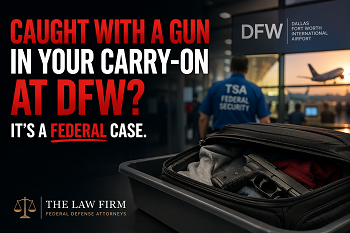
DFW International Airport intercepted 378 firearms at its security checkpoints in 2024 which is the second highest total of any airport in the United States (behind only Atlanta’s Hartsfield-Jackson). Texas is the number one state in the country for airport gun seizures. Of the firearms detected at DFW, the overwhelming majority were loaded.
Almost none of these were brought to the checkpoint intentionally. The typical DFW firearm case involves a Texas gun owner (often someone who carries legally every day) who forgot the firearm was in their range bag, everyday carry bag, or purse before heading to the airport. The gun that goes everywhere with them went to the airport. TSA found it.
What almost no one anticipates: the case that follows is federal, not state. DFW International Airport is a federal facility. When TSA detects a firearm at a DFW checkpoint, the case is referred to federal law enforcement and prosecuted by the United States Attorney’s Office for the Northern District of Texas, Dallas Division. This is not a Tarrant County DA matter. It is not handled in Tarrant County courts. It is a federal criminal case, and it requires federal defense counsel from the first hour.
The Federal Charge: 49 U.S.C. §46505
The primary federal statute governing firearms at airport checkpoints is 49 U.S.C. §46505, which prohibits knowingly carrying a concealed dangerous weapon on or about the individual or in carry-on luggage intended to be carried in the passenger cabin of an aircraft operated by an air carrier. It is a federal felony.
Penalty: Up to 10 years in federal prison. Federal sentences are served in the Bureau of Prisons, not TDCJ. Federal defendants serve at least 85 percent of their sentence. There is no parole in the federal system.
The statute does not require that the defendant intended to use the weapon on the aircraft or intended to threaten anyone. Knowingly carrying a concealed weapon in carry-on luggage intended for the cabin is the offense. The intent element attaches to the carrying, not to any downstream criminal purpose.
The word “knowingly” in the statute is where most accidental checkpoint cases focus. The government must prove the defendant knowingly carried the weapon. A traveler who genuinely forgot the firearm was in their bag and can establish that the presence of the gun in that bag was inadvertent rather than deliberate presents a legitimate mens rea defense. Whether that defense succeeds depends on the specific facts: how the gun got into the bag, whether the traveler has a consistent pattern of carrying that specific bag without a firearm, the traveler’s response when TSA flagged the item, and any statements made at the scene.
Why Federal, Not State
DFW International Airport is a federally regulated transportation facility. TSA is a federal agency. The security checkpoint is a federal security zone. When a weapon is detected at that checkpoint by federal officers, the matter is within federal jurisdiction.
Texas Penal Code §46.03 does make it a state offense to carry a firearm in the secured area of an airport (a third-degree felony under state law). That statute exists and is valid. But in practice, gun charges at DFW are prosecuted federally. The U.S. Attorney’s Office handles these cases. The Northern District of Texas, Dallas Division, is the district with jurisdiction over DFW.
This distinction matters enormously for how you respond and who you call. A defense attorney who handles state felonies in Tarrant County is not the right counsel for a federal firearms prosecution in the Northern District of Texas. Federal court operates under different procedural rules, the Federal Sentencing Guidelines govern the sentence, and the relationship between cooperation, guideline calculations, and case resolution is a specialized practice area. You need a federal criminal defense attorney.
Constitutional Carry Does Not Apply at the Checkpoint
This is the most common misunderstanding among the licensed Texas gun owners who make up most DFW checkpoint cases. Texas’s constitutional carry law (HB 1927, effective September 1, 2021) permits most Texans 21 and older to carry a handgun without a License to Carry in most public places. The TSA security checkpoint at DFW is not most public places.
Federal law and TSA regulations prohibit firearms at security checkpoints and in the sterile area of airports, regardless of state law. A Texas License to Carry does not override federal jurisdiction over a federal facility. Constitutional carry applies nowhere in the equation. A person who carries entirely legally under Texas law at every other location in their daily life is still subject to federal criminal prosecution for bringing that firearm to the DFW checkpoint.
The Federal Sentencing Guidelines and the Accidental Case
Federal criminal cases are sentenced under the United States Sentencing Guidelines (USSG). For a §46505 violation, the base offense level, any applicable enhancements, and the defendant’s criminal history category produce a guidelines range that the sentencing judge considers. The guidelines are advisory, not mandatory, after United States v. Booker (2005), but they remain the starting point for every federal sentencing hearing.
In practice, first-offense accidental checkpoint cases prosecuted under §46505 have a range of outcomes. The guidelines range for a typical first-time offender with no criminal history and a genuinely accidental checkpoint case may produce a recommendation well below the 10-year statutory maximum. Whether the case resolves by plea agreement, by pretrial diversion, or by trial depends on the specific facts, the defendant’s background, and the approach of the assigned Assistant U.S. Attorney.
Early engagement of federal defense counsel is the most important factor in determining which resolution options are available. A defendant who retains experienced federal counsel before making any statement, before any proffer, and before any contact with federal investigators is in a meaningfully better position than one who attempts to explain themselves to law enforcement without counsel present.
The TSA Civil Penalty: A Separate Track Running in Parallel
In addition to the federal criminal prosecution, TSA maintains its own civil penalty process. Civil penalties for bringing a firearm to a checkpoint run up to $14,950, with the specific amount determined by whether the firearm was loaded and whether accessible ammunition was present. A first-offense loaded firearm typically produces a TSA civil demand in the range of $3,000 to $10,000.
The TSA civil penalty is completely separate from the criminal case. It is an administrative process managed by TSA, not by the U.S. Attorney’s Office. Receiving and responding to a civil demand letter does not affect the criminal case, and the criminal case outcome does not automatically resolve the civil penalty. Both must be addressed, and the civil penalty process has its own response deadlines.
An attorney can engage with TSA on the civil penalty process in parallel with the criminal defense. Civil penalty amounts can often be negotiated, particularly for first-time offenders with clean records who cooperate appropriately with the checkpoint process and make no false statements.
TSA PreCheck is revoked for at least five years following a checkpoint firearm detection, regardless of the criminal outcome.
What Most of These Cases Actually Look Like
The three most common accidental DFW checkpoint scenarios:
The everyday carry gun in the wrong bag. A traveler who normally carries moves items into a travel bag without checking for the firearm, or uses a bag that doubles as a range bag. The gun goes through the X-ray. TSA flags it.
The forgotten gun from a prior trip. A traveler transported a firearm legally in checked baggage on a previous trip, did not remove it, and the bag has been sitting in the closet with the gun inside ever since. At the next airport trip, the bag goes to the checkpoint.
The compact firearm in a purse or briefcase. A small pistol or revolver that has been carried in a bag for months is overlooked when the bag is packed for travel. The traveler does not think of that bag as a “gun bag” and does not check it.
The accidental nature of the conduct is a significant factor in how these cases resolve at the federal level. It is the foundation of the “knowingly” defense under §46505, it affects the guidelines calculation, and it shapes the prosecutor’s assessment of the appropriate disposition. It is not a complete defense on its own, but it is a significant one that an experienced federal defense attorney builds into the case from the first day.
What to Do If You Are Stopped at DFW with a Firearm
Comply with TSA and law enforcement instructions. Do not attempt to leave, conceal the firearm, or interfere with the process. Any of those actions convert an accidental checkpoint case into something materially worse.
Say as little as possible. You will need to identify yourself and claim your property. You are not required to explain how the gun got in the bag, where you were going, or anything about your intent. The statement you make at the checkpoint becomes part of the federal investigation record. Exercise your right to remain silent.
Do not consent to additional searches. If investigators ask to search your phone, your other bags, or any other belongings, you can decline. The firearm at the checkpoint is the issue. Do not expand the investigation voluntarily.
Call a federal criminal defense attorney before anything else. Not a general criminal defense attorney. A federal criminal defense attorney with experience in the Northern District of Texas. The federal case, the TSA civil penalty, and the Sentencing Guidelines calculation all need to be managed from the outset by counsel who knows federal practice.
Deandra Grant Law handles federal firearms charges and federal criminal defense in the Northern District of Texas and across all four Texas federal districts. Of Counsel James Lee Bright has more than 25 years of federal trial experience including all four Texas federal districts, the Fifth Circuit, and the United States Supreme Court. Call (214) 225-7117 for a free, confidential consultation.