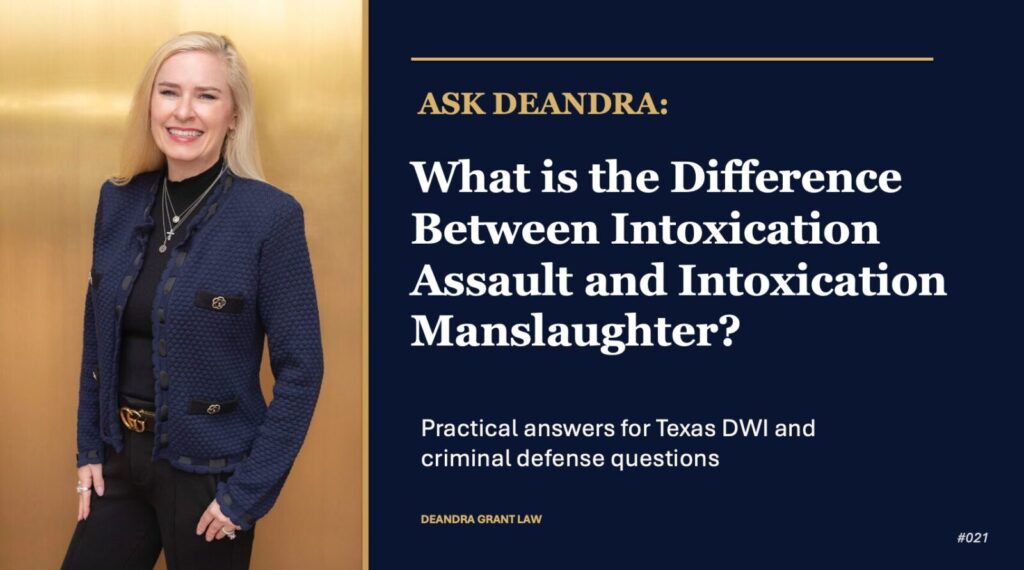
The question: What is the difference between intoxication assault and intoxication manslaughter in Texas?
The short answer: Both are felony intoxication offenses under Chapter 49 of the Texas Penal Code, but they differ in the severity of harm and the punishment range. Intoxication Assault under §49.07 applies when intoxicated operation of a vehicle, watercraft, aircraft, or amusement ride causes serious bodily injury to another person. It is a third-degree felony carrying two to ten years in TDCJ, fine up to $10,000. Intoxication Manslaughter under §49.08 applies when intoxicated operation causes the death of another. It is a second-degree felony carrying two to twenty years in TDCJ, fine up to $10,000. Each offense carries enhancement provisions that can elevate the punishment further including first-degree felony enhancement in manslaughter cases involving first responders. These are the most serious intoxication-related offenses prosecuted in Texas, and they require defense calibrated to the gravity of the stakes.
Here is the longer answer: what each statute requires, what the practical defense issues are, and why these cases demand a coordinated defense from the moment of arrest.
A Note Before Continuing
If you or someone in your family is facing an Intoxication Assault or Intoxication Manslaughter charge in Texas, this post is informational. The actual defense of these cases is a matter of expert legal counsel and not a blog post. The information below is intended to help readers understand the framework, the stakes, and the categories of work involved. Specific case decisions belong with your lawyer.
Intoxication Assault — Penal Code §49.07
Penal Code §49.07 makes it an offense for a person to, by accident or mistake, while operating a motor vehicle in a public place while intoxicated, by reason of that intoxication cause serious bodily injury to another. The statute also reaches operation of an aircraft, watercraft, and amusement ride while intoxicated. The elements are:
- Operating a motor vehicle in a public place, an aircraft, a watercraft, or an amusement ride.
- The same definition under §49.01 of either a BAC of 0.08 or above, or loss of normal use of mental or physical faculties due to alcohol, drugs, or any combination.
- Causation by accident or mistake. The injury must occur “by accident or mistake” — the statute does not require intent to cause harm.
- Serious bodily injury to another. Penal Code §1.07 defines “serious bodily injury” as bodily injury that creates a substantial risk of death, causes serious permanent disfigurement, or causes protracted loss or impairment of the function of any bodily member or organ. This is a meaningfully higher threshold than ordinary bodily injury.
- Causation — the intoxication caused the injury. The State must prove that the intoxication, not some other factor, caused the serious bodily injury.
Intoxication Assault is classified as a third-degree felony under §49.07(c), with the standard third-degree punishment range of two to ten years in TDCJ and fine up to $10,000.
Enhancements to Intoxication Assault
Several enhancements can elevate Intoxication Assault to second-degree felony status — punishment range of two to twenty years in TDCJ:
- Injury to a peace officer, firefighter, or emergency medical services personnel. Where the serious bodily injury is caused to a public servant acting in the actual discharge of an official duty, §49.09(b-1) and related provisions enhance the punishment.
- Traumatic brain injury producing a persistent vegetative state. Where the injury places the victim in a persistent vegetative state, §49.09(b-2) enhances Intoxication Assault to a second-degree felony.
In specific aggravated circumstances, additional enhancements may apply. The defense lawyer’s first task in any Intoxication Assault case is identifying every potential enhancement the State could plead and assessing each one.
Intoxication Manslaughter — Penal Code §49.08
Penal Code §49.08 makes it an offense for a person to operate a motor vehicle in a public place, an aircraft, a watercraft, or an amusement ride while intoxicated and, by reason of that intoxication, cause the death of another by accident or mistake. The elements are essentially the same as Intoxication Assault with the death of another rather than serious bodily injury as the harm element.
Intoxication Manslaughter is classified as a second-degree felony under §49.08(b), with the standard second-degree punishment range of two to twenty years in TDCJ and fine up to $10,000.
Enhancements to Intoxication Manslaughter
Where the deceased is a peace officer, firefighter, or emergency medical services personnel acting in the discharge of an official duty, Intoxication Manslaughter is enhanced to a first-degree felony under §49.09(b-2) and related provisions. First-degree felony exposure is dramatically higher ar five years to ninety-nine years or life in TDCJ, fine up to $10,000.
This is not theoretical. Intoxication Manslaughter cases involving first responders (deceased officers, firefighters, or EMS personnel)n are prosecuted vigorously, draw extensive media attention, and produce sentences in the upper range of the enhanced exposure. Any case involving a deceased first responder should be approached as a first-degree felony from day one.
Comparison: §49.07 vs. §49.08
Side by side, the two statutes differ in three key dimensions:
- Intoxication Assault requires serious bodily injury. Intoxication Manslaughter requires death. The line between them is the survival of the victim.
- Intoxication Assault is a third-degree felony (two to ten years TDCJ). Intoxication Manslaughter is a second-degree felony (two to twenty years TDCJ).
- Enhancement potential. Both can be enhanced based on the victim’s status as a public servant. Intoxication Manslaughter can be enhanced to a first-degree felony (five years to life). Intoxication Assault can be enhanced to a second-degree felony.
Otherwise, the prosecutorial framework is similar. The same operation, intoxication, causation, and accident-or-mistake elements appear in both. The same forensic challenges apply to both. The same defense investigation (accident reconstruction, medical causation, toxicology, mitigation) applies to both.
What These Cases Look Like in Practice
Intoxication Assault and Intoxication Manslaughter cases involve a category of defense work that goes well beyond standard DWI practice:
- Bond conditions are extensive. Continuous alcohol monitoring (SCRAM), ignition interlock, no-driving conditions, no-contact orders with the alleged victim or victim’s family, GPS, travel restrictions, and substantial bond amounts.
- Investigation is multi-track. Standard DWI defense work plus accident reconstruction, medical investigation, witness investigation, and victim impact considerations.
- Discovery is voluminous. Crash scene reports, vehicle inspections, paramedic and hospital records, autopsy reports in manslaughter cases, witness statements, body camera footage, traffic camera footage, cellular records, and toxicology reports.
- Expert witnesses are essential. Accident reconstruction experts, biomechanical engineers, toxicology experts, and medical experts are routinely required.
- Mitigation work begins early. Counseling, treatment, AA participation, mental health treatment, voluntary engagement with the victim’s family in some cases — mitigation work in serious intoxication cases begins on day one and continues throughout the case.
- Trial preparation is months or years. These cases routinely take a year or more to reach trial. Pretrial motions, discovery battles, expert preparation, and witness preparation all consume substantial time.
- Plea negotiations are layered. On serious intoxication cases, plea negotiations involve the prosecutor’s office, sometimes the elected District Attorney personally, and (in cases where the victim’s family’s position impacts the resolution) the victim’s family.
None of this is exotic. It is the work that intoxication assault and manslaughter cases require. A defense team that does not approach the case this way is not adequately defending it.
Defense Issues Specific to Intoxication Assault and Manslaughter
In addition to all of the standard DWI defenses (attacking the stop, the arrest, the field sobriety tests, the chemical evidence, and the warrant) these cases involve specific issues that do not arise in standard DWI practice:
- The State must prove that the defendant’s intoxication (not some other factor) caused the injury or death. Other contributing causes (the other driver’s conduct, road conditions, mechanical failure, third-party actions, the victim’s own behavior) are defense territory and often the most important issue in the case.
- Accident reconstruction. Independent accident reconstruction is essential. The State’s reconstruction is one perspective; a defense reconstruction often produces a different picture of speed, point of impact, sequence, and contribution. Cases have turned on reconstruction findings.
- Medical causation. In Intoxication Assault cases, was the injury actually “serious bodily injury” under §1.07? Medical record review and independent medical evaluation can affect this element. In Intoxication Manslaughter cases, was the death actually caused by the collision or by some other intervening cause?
- Operator identity. In single-vehicle accidents, multi-vehicle accidents with multiple potential drivers, or cases without direct observation of operation, the State must still prove the defendant was operating the vehicle at the relevant moment.
- Toxicology timing. In serious-injury and fatality cases, blood draws often occur hours after the incident. Pharmacokinetic analysis of the gap between operation and draw can substantially affect the State’s ability to establish intoxication at the time of the incident.
- Warrant issues. The warrant authorizing the blood draw (and the affidavit supporting it) is fully reviewable. Defective affidavits can produce suppression of the central piece of forensic evidence.
- Victim impact and sentencing. Where the case proceeds to a sentencing phase, victim impact statements, the defendant’s post-offense conduct, treatment efforts, and life history all matter substantially.
The Mitigation Picture
Intoxication Assault and Intoxication Manslaughter cases that proceed to a punishment phase (whether after trial or as part of a plea) are decided in significant part by mitigation. The defendant’s background, employment, family responsibilities, treatment efforts, expressions of remorse, community ties, and post-offense conduct can substantially affect the sentence imposed.
Categories of mitigation that matter:
- Treatment and rehabilitation. Voluntary substance abuse treatment, AA or other recovery program participation, mental health treatment, counseling — all documented and ongoing.
- Work and family stability. Stable employment, family responsibilities, and community ties.
- Character evidence. Letters from employers, family members, friends, clergy, community leaders provided in support of sentencing.
- Acceptance of responsibility. Where the defense has decided that resolution rather than trial is the right path, acceptance of responsibility can substantially affect sentencing.
- Engagement with the victim or family. In appropriate cases and through appropriate channels, engagement with the victim or victim’s family (always through counsel, never directly) can affect outcomes.
Mitigation work in serious intoxication cases is a discipline of its own. Mitigation specialists (trained professionals who develop the defendant’s biographical, family, and treatment history into a coherent presentation) are often part of the defense team in these cases.
What to Do if You or a Family Member Is Charged
Immediate considerations:
- Hire defense counsel immediately. These cases are not for solo or generalist defense. Look for forensic credentials, felony trial experience at the highest level, and a team approach. Local courthouse experience matters. These cases are tried in district court before judges and prosecutors who develop reputations and tendencies that experienced counsel know.
- Address the bond and conditions immediately. Bond conditions in serious intoxication cases are often the most onerous in the criminal system. SCRAM monitoring, ignition interlock, no-driving conditions, no-contact orders, and GPS monitoring all merit careful review and, where possible, modification.
- Address the ALR deadline. Even in the most serious cases, the 15-day administrative license deadline applies, running from the date of service of the notice of suspension.
- Stop talking. Friends, family, jail visitors, jail phone calls (recorded), social media — all of these have appeared in serious intoxication prosecutions. The only safe rule is to talk only to your lawyer.
- Avoid contact with the victim or family. Direct contact with the victim of an Intoxication Assault, or with the family of a deceased victim in an Intoxication Manslaughter case, can produce additional charges, bond violations, and devastating evidentiary consequences. All communications, where appropriate, go through counsel.
- Begin treatment voluntarily. Substance abuse evaluation, treatment, AA participation, mental health treatment where appropriate — documented and ongoing engagement begun before the case resolves is powerful mitigation.
- Preserve evidence. Photographs of the vehicle and scene, witness contact information, prior driving and treatment records, employment and family records. The mitigation case in a serious intoxication prosecution often depends on this kind of evidence.
- Be prepared for a long process. Serious intoxication cases routinely take a year or more to reach trial or final resolution. The instinct to resolve quickly almost always costs defendants outcomes they could have achieved with patience.
The Bottom Line
Intoxication Assault under Penal Code §49.07 and Intoxication Manslaughter under §49.08 are the most serious intoxication-related offenses in Texas. They are felonies; they carry significant TDCJ exposure; they involve enhancements that can elevate the punishment further; and they require the kind of multi-track defense investigation (forensic, accident reconstruction, medical, mitigation) that distinguishes serious felony defense from generalist DWI work. They are also defendable. Cases turn on causation, accident reconstruction, medical analysis, toxicology timing, and warrant issues. Outcomes turn on mitigation. The defense work begins on day one and continues for many months. If you or someone you love is facing one of these charges, the first step is finding a defense team that approaches the case with the rigor and the resources it requires.
Intoxication Assault and Manslaughter Defense at Deandra Grant Law
Deandra Grant Law defends serious intoxication-offense cases across North and Central Texas including Dallas, Fort Worth, Plano, McKinney, Frisco, Allen, Lewisville, Denton, Rockwall, and Waco. We handle Intoxication Assault, Intoxication Manslaughter, and aggravated intoxication cases with the forensic, investigative, and trial depth they require. Our team includes an ACS-CHAL Forensic Lawyer-Scientist with a Master of Science in Pharmaceutical Science and a Graduate Certificate in Forensic Toxicology, partner-level felony trial experience, and Of Counsel federal experience for the small subset of cases where federal jurisdiction is implicated. We approach these cases as multi-month engagements with a team-based defense because that is what these cases require.
If you or a family member has been charged with Intoxication Assault or Intoxication Manslaughter in Texas, call Deandra Grant Law at (214) 225-7117 or visit texasdwisite.com to schedule a confidential consultation. And remember that the 15-day ALR deadline runs from the date of service of the notice of suspension.
Have a DWI question you want answered in this series? Submit it at texasdwisite.com — you might see it featured in a future Ask Deandra post.