By Deandra Grant, J.D., M.S. (Pharmaceutical Science), ACS-CHAL Forensic Lawyer-Scientist, and Sol Bobst, Ph.D., DABT, ToxSci Advisors LLC
A person uses a Vicks VapoInhaler for a stuffy nose. They are on probation. At their next urinalysis, the immunoassay screen comes back positive for methamphetamine. The lab performs a standard GC-MS confirmation: methamphetamine confirmed. No further analysis is performed. The probation officer files a motion to revoke. The person, who has never touched illicit methamphetamine in their life, faces prison.
This is not hypothetical. It is a predictable consequence of a testing system that treats all methamphetamine as the same molecule, when in fact it is not.
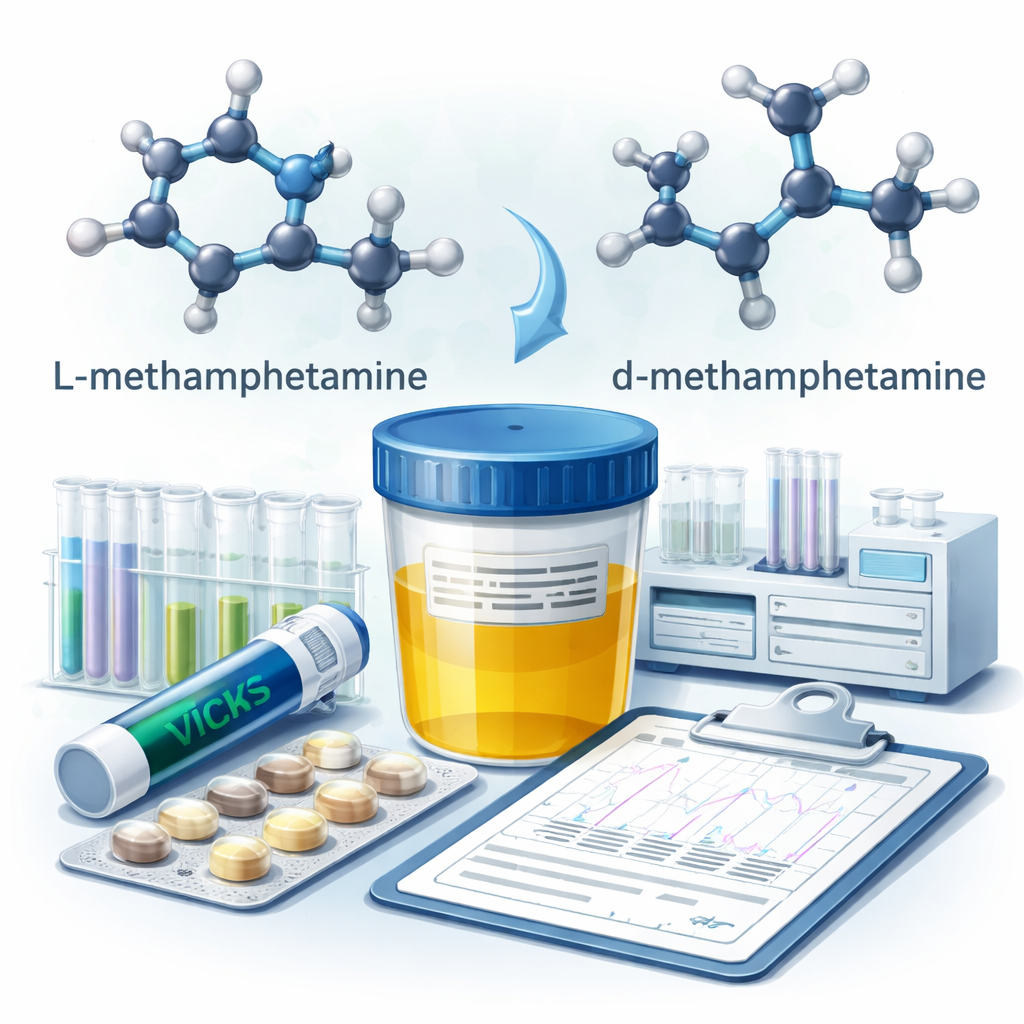
Methamphetamine exists as two mirror-image molecules called enantiomers: d-methamphetamine (the illicit, psychoactive form that is a Schedule II controlled substance) and l-methamphetamine (a legal, over-the-counter nasal decongestant with minimal stimulant activity in the central nervous system). The standard drug tests used by crime labs, probation departments, employers, and the military often cannot distinguish between them. And recent research has revealed additional pathways, including metabolic conversion from legal amphetamine medications, that can produce low-level methamphetamine in a person who has never used the drug in any form.
We wrote this article together because this problem sits at the intersection of pharmaceutical science, forensic toxicology, and criminal defense and because the consequences of getting it wrong are devastating. What follows is the science that every defense attorney, prosecutor, judge, probation officer, and defendant in a methamphetamine case needs to understand.

"Deandra Grant Law – Criminal & DWI Defense handled my case with diligence and professionalism. Deandra Grant's reputation is stellar and now I know why. She has a team of individuals who provide quality service."
- N. Coulter
"Deandra Grant Law – Criminal & DWI Defense fights hard for their clients and is always willing to go above and beyond. They are the best firm for DWI cases in DFW and beyond. Definitely hire them to represent you in any pending cases."
- P. Williams
"Deandra Grant made a tough situation so much better. She listened to my concerns and helped me so much with my case. I would recommend her to anyone needing legal services."
- M. Haley
The Chemistry: Why Two Identical Molecules Are Not the Same Drug

Methamphetamine has a chiral center which means it has a carbon atom bonded to four different groups. This means the molecule exists in two non-superimposable mirror-image forms, like a left hand and a right hand. These mirror images are called enantiomers. They have identical molecular formulas (C₁₀H₁₅N), identical molecular weights, identical melting points, and identical chemical reactivity in non-chiral environments. They are, for most analytical purposes, the same molecule.
But biology is a chiral environment. Enzymes, receptors, and transport proteins are three-dimensional structures that interact differently with molecules depending on their spatial configuration. This is why the two enantiomers of methamphetamine have dramatically different pharmacological profiles:
D-methamphetamine (also designated S-(+)-methamphetamine) is the enantiomer that produces powerful CNS stimulation. It increases dopamine release at the synaptic cleft through multiple mechanisms, including reversal of the dopamine transporter (DAT) and inhibition of monoamine oxidase (MAO). This is the form responsible for the euphoria, compulsive redosing, and addictive potential that make methamphetamine a Schedule II controlled substance under federal law. D-methamphetamine is the active component of illicit “crystal meth” and is also the active ingredient in the rarely prescribed medication Desoxyn (used for refractory ADHD and short-term obesity treatment).
L-methamphetamine (also designated R-(−)-methamphetamine) has the same atoms arranged as a mirror image. This seemingly small spatial difference translates into a dramatically different pharmacological profile. L-methamphetamine has potent vasoconstrictive properties in the nasal passages (constricting blood vessels to relieve congestion) but its ability to cross the blood-brain barrier and stimulate central dopamine release is markedly weaker than the d-form. This is why l-methamphetamine is approved by the FDA as an over-the-counter nasal decongestant. It is the active ingredient in the Vicks VapoInhaler, sold legally in every pharmacy in America under the pharmaceutical name levmetamfetamine.
From a toxicological perspective, the distinction is profound. The d-enantiomer is a drug of abuse with well-characterized neurotoxic effects at high doses, including oxidative stress, mitochondrial dysfunction, and dopaminergic neuron damage. The l-enantiomer, at OTC doses, produces peripheral vasoconstriction with negligible CNS effects. Treating them as pharmacologically equivalent in a forensic context is scientifically indefensible.
The Testing Problem: Three Steps, Two Blind Spots
Step 1: The Immunoassay Screen
The first step in virtually all drug testing programs (ex. workplace, criminal justice, military, and clinical) is an immunoassay screen. This is a rapid, antibody-based test that detects the presence of amphetamine-class compounds. Immunoassays are designed as a screening tool, for a quick yes/no answer. This is a qualitative test for throughput and sensitivity, not specificity. The antibodies bind to the methamphetamine molecule based on its overall shape and functional groups, but the spatial difference between the d- and l-enantiomers is too subtle for the antibody’s binding site to differentiate.
A controlled study by Smith et al. published in the Journal of Analytical Toxicology (2014) administered Vicks VapoInhaler to 22 healthy adults at manufacturer-recommended doses (two inhalations per nostril every two hours for a total of 28 inhalations over two days) and tested all 391 urine specimens with three commercial immunoassays: EMIT II Plus, KIMS II, and DRI. The EMIT II Plus assay, which has a manufacturer-reported cross-reactivity of 38% with l-methamphetamine, produced a 2.2% false-positive rate meaning that normal, directed use of a legal OTC product triggered a positive drug screen in some subjects (9 of 415 total specimens tested, including quality control samples). The KIMS II assay produced one false positive (99.6% specificity), while the DRI assay produced no false positives (100% specificity). Despite the generally high efficiencies, the EMIT II Plus false-positive rate was higher than anticipated based on the manufacturer’s stated cross-reactivity.
Conversely, a 2024 study from the University of Bonn (Plenert et al., Drug Testing and Analysis) documented the opposite problem: cases of confirmed R-(−)-methamphetamine (l-methamphetamine) consumption that were not detected by immunoassay screening, because the assay’s cross-reactivity was substantially lower for the R-enantiomer than for the S-enantiomer. This means the immunoassay can both falsely include (report a positive when only the legal form is present) and falsely exclude (miss the presence of one enantiomer due to differential antibody affinity).
Bottom line: A positive immunoassay screen for methamphetamine does not tell you whether the methamphetamine detected is the illegal form or the legal form. And a negative screen does not guarantee the absence of either.
Step 2: The Standard Confirmation (GC-MS or LC-MS/MS)
When an immunoassay screen is positive, the sample is typically sent for confirmation by gas chromatography–mass spectrometry (GC-MS) or liquid chromatography–tandem mass spectrometry (LC-MS/MS). These are powerful analytical techniques that can definitively identify methamphetamine by its molecular fragmentation pattern. GC-MS is widely considered the “gold standard” of forensic drug confirmation.
But here is the critical point that many attorneys, judges, and probation officers do not understand: standard GC-MS and standard LC-MS/MS cannot distinguish between d-methamphetamine and l-methamphetamine. Both enantiomers produce identical mass spectra because they have identical molecular structures and fragment the same way. Mass spectrometry characterizes compounds by mass and fragmentation and not by spatial configuration. A standard confirmation will report “methamphetamine confirmed” without specifying which enantiomer was detected.
The Smith et al. study demonstrated this clearly: using a chiral-specific GC-MS method with MTPA derivatization (>99% enantiomeric purity), the researchers found zero d-methamphetamine or d-amphetamine in any of the 391 urine specimens from subjects who used the VapoInhaler at recommended doses, at a lower limit of quantification (LLOQ) of 10 µg/L. Every positive result was exclusively l-methamphetamine. But a standard, non-chiral GC-MS confirmation would have reported these specimens simply as “methamphetamine positive” which is indistinguishable from illicit use.
If the lab stops here and, in our experience, many forensic and clinical laboratories do unless specifically instructed to perform chiral analysis, the result is reported as positive for methamphetamine, period.
Step 3: Chiral Analysis (The Test That Answers the Question)
The only way to distinguish d-methamphetamine from l-methamphetamine is through chiral analysis which is an additional analytical step that separates the enantiomers before or during detection. There are several validated approaches:
- Chiral derivatization followed by GC-MS: The sample is treated with a chiral derivatizing agent that reacts differently with each enantiomer, converting them into chromatographically separable diastereomers. The derivatives are then separated on a standard GC column by their different retention times and identified by MS. The most common derivatizing agent in U.S. drug-testing programs is N-trifluoroacetyl-L-prolyl chloride (L-TPC), introduced by Fitzgerald et al. in 1988. However, the Smith et al. study noted an important limitation: the L-TPC reagent contains a small and variable amount of the D-TPC impurity, which produces a derivative of l-methamphetamine that co-elutes with the L-TPC derivative of d-methamphetamine. This co-elution artifact can be mistaken for d-methamphetamine and was one reason that federal guidance requires a minimum of 20% d-methamphetamine to define a positive specimen. The Smith team used the superior R-(−)-MTPA chloride derivatization method (>99% enantiomeric purity), which eliminates this co-elution problem.
- Chiral HPLC or LC-MS/MS with a chiral stationary phase: Liquid chromatography using a chiral column (such as the Astec CHIROBIOTIC V2 or cyclodextrin-based phases) directly separates the enantiomers without derivatization. The separated peaks are quantified by tandem mass spectrometry. A recent method using Marfey’s reagent achieved enantioselective separation with 1 µg/L sensitivity in both plasma and oral fluid which is more than adequate for forensic purposes.
- Standard C18 column with chiral derivatization: A January 2026 method published by Restek demonstrated that chiral separation of d- and l-methamphetamine and amphetamine can be achieved on a standard reversed-phase C18 column after simple precolumn derivatization which eliminates the need for expensive, specialized chiral columns. Separation was accomplished in under seven minutes with a linear range of 50–5,000 ng/mL. This is significant because it removes one of the primary barriers laboratories have cited for not performing chiral testing: the cost and maintenance of dedicated chiral instrumentation.
- Capillary electrophoresis with chiral selectors: CE-MS methods using anionic cyclodextrin selectors can separate all enantiomers of methamphetamine, amphetamine, and related compounds in a single run. While less widely deployed in forensic labs, this approach offers excellent resolution.
All chiral methods require additional reagents, additional time, and analytical expertise. They are more expensive than standard confirmation. As a result, chiral analysis is not routinely performed unless specifically requested. In many forensic and clinical laboratories, if the standard GC-MS or LC-MS/MS confirms methamphetamine, the case is reported as positive and the analysis ends. The question of which methamphetamine was detected is simply never asked.
Beyond Vicks: Every Source of Methamphetamine That Is Not Illicit
The Vicks VapoInhaler is the most commonly discussed source, but a thorough forensic toxicology evaluation must consider the full range of licit sources that can produce a positive methamphetamine result:
- Vicks VapoInhaler (levmetamfetamine): Contains approximately 50 mg l-methamphetamine per inhaler. The Smith et al. controlled study found that manufacturer-recommended use (28 inhalations over two days) produced urine l-methamphetamine concentrations with a median peak of 62.8 µg/L but a range extending up to 1,440 µg/L with substantial intersubject variability. L-methamphetamine was detectable in most subjects 11 hours after the last inhalation. Only two of 22 subjects produced concentrations at or above 250 µg/L (the federal workplace drug testing confirmation cutoff), but this means that even manufacturer-directed use can produce concentrations in the range that triggers confirmatory testing. Critically, no d-methamphetamine or d-amphetamine was detected in any specimen at an LLOQ of 10 µg/L, confirming the product contains either no d-methamphetamine or an amount too small to detect in human urine, though NLCP proficiency testing laboratories have reported up to 2.5% d-methamphetamine in VapoInhaler extracts.
- Selegiline (Deprenyl/Eldepryl/Emsam): A monoamine oxidase B (MAO-B) inhibitor prescribed for Parkinson’s disease, major depression (as the Emsam transdermal patch), and dementia. Selegiline undergoes first-pass metabolism to l-methamphetamine and l-amphetamine. A patient taking selegiline as prescribed will test positive for methamphetamine on both immunoassay and standard GC-MS confirmation. Only chiral analysis will reveal that the methamphetamine present is exclusively the l-enantiomer, consistent with selegiline metabolism rather than illicit use.
- Benzphetamine (Didrex): A Schedule III anorectic prescribed for short-term weight management. Benzphetamine is metabolized to both d-methamphetamine and d-amphetamine. This is a legitimate prescription source of the d-form meaning a patient taking Didrex as prescribed will produce a chiral profile identical to illicit methamphetamine use. In these cases, verification of the prescription and correlation with expected metabolite ratios becomes essential.
- Amphetamine N-methylation (2025 research): A 2025 study by Helander et al. published in Drug Testing and Analysis demonstrated that amphetamine itself can undergo metabolic N-methylation to produce low concentrations of methamphetamine in urine. The researchers found that patients receiving d-amphetamine-based ADHD medications (such as Adderall or Dexedrine) (which contain no methamphetamine whatsoever) produced detectable d-methamphetamine in their urine. Similarly, users of illicit racemic amphetamine produced methamphetamine with a matching l/d enantiomeric ratio, confirming the metabolic origin. The study concluded that methamphetamine concentrations below approximately 2% of the amphetamine level do not warrant clinical or forensic concern for separate methamphetamine use. This is a critical finding: a person taking legally prescribed amphetamine for ADHD can test positive for d-methamphetamine without ever having used methamphetamine in any form.
- Illicit methamphetamine composition: Depending on the synthetic route, illicit methamphetamine may be enantiopure d-methamphetamine (most common in North America), a racemic mixture (50/50 d- and l-), or predominantly one enantiomer. European seizure data shows both enantiopure l- and d-methamphetamine on the market. The enantiomeric ratio in a biological sample can provide information about the source and synthetic method but only if chiral analysis is performed.
How This Destroys Innocent People: The Legal Consequences
The scenarios where an incomplete drug test leads to devastating legal consequences are not rare edge cases. They are structural vulnerabilities in the system:
- Probation and parole revocation: A person on supervised release tests positive for methamphetamine on a standard screen and confirmation. No chiral analysis is performed. The probation officer files a motion to revoke. The burden of proof for a revocation is preponderance of the evidence which is far lower than beyond a reasonable doubt. The positive confirmation is often treated as dispositive. The person faces incarceration for using a legal nasal decongestant.
- CPS investigations: A parent tests positive for methamphetamine during a child protective services investigation. The result triggers removal proceedings. The parent has been using a Vicks VapoInhaler but does not know it contains methamphetamine (the label reads “levmetamfetamine,” a name few consumers would recognize as a form of methamphetamine).
- Employment termination: A workplace drug test returns positive for methamphetamine. The Medical Review Officer (MRO) may or may not inquire about OTC medications. If the employee does not know to mention the VapoInhaler, or if the MRO does not request chiral analysis, the result is reported as confirmed positive. The employee loses their job.
- Military separation: The U.S. military has documented cases requiring chiral analysis to resolve. In one Navy case, a service member tested positive for methamphetamine; chiral analysis revealed 95% d-methamphetamine, which was inconsistent with VapoInhaler use and confirmed illicit use. That case was resolved correctly because chiral testing was performed. In cases where it is not, the truth remains hidden, and a service member’s career can be destroyed.
- New drug charge prosecution: In jurisdictions that prosecute methamphetamine possession based on metabolite detection in urine (internal possession statutes), a positive methamphetamine confirmation without chiral analysis could theoretically support a criminal charge where the “possessed” substance was nothing more than a legal decongestant.
What Defense Attorneys Must Do: A Forensic Toxicology Checklist
If your client is charged with methamphetamine possession, use, or violation of supervision based on a positive methamphetamine test, the following steps are essential. We have designed this checklist to reflect the analytical and pharmacological realities described above:
- Demand the lab’s full analytical methodology. Determine whether the lab performed standard GC-MS/LC-MS/MS only, or whether chiral analysis was conducted. Ask specifically: “Was enantiomeric separation performed?” If the answer is no, the test cannot establish that the methamphetamine detected was the controlled substance.
- Ask your client about OTC medications. Specifically ask whether they have used Vicks VapoInhaler, any nasal decongestant inhaler, or any product containing levmetamfetamine. Many clients will not volunteer this information because they do not know that a nasal inhaler contains a form of methamphetamine.
- Ask about prescription medications. Selegiline (for Parkinson’s, depression, or dementia) metabolizes to l-methamphetamine. Benzphetamine (for weight management) metabolizes to d-methamphetamine. Critically: amphetamine-based ADHD medications (Adderall, Dexedrine, Vyvanse/lisdexamfetamine) can produce low-level d-methamphetamine through metabolic N-methylation per the 2025 Helander study. Request pharmacy records and prescriber verification.
- Request chiral analysis of the original sample. If the lab did not perform chiral testing, file a motion requesting that the remaining sample be submitted for enantiomer-specific analysis. Modern methods (including the 2026 Restek C18 derivatization method) can accomplish this on standard laboratory equipment in under seven minutes. If the lab claims chiral analysis is “not available” or “too expensive,” this is increasingly untenable given the availability of validated methods on standard instrumentation.
- If no sample remains, challenge the sufficiency of the evidence. A positive methamphetamine confirmation without chiral analysis is an incomplete analysis. It tells you that methamphetamine was present. It does not tell you whether the controlled substance was present. The state cannot meet its burden without answering that question.
- Evaluate the methamphetamine-to-amphetamine ratio. If both methamphetamine and amphetamine were detected, examine the concentration ratio. The 2025 Helander study established that methamphetamine concentrations below approximately 2% of the amphetamine level are consistent with metabolic N-methylation of amphetamine and not with separate methamphetamine use. If your client takes prescribed amphetamine and the methamphetamine concentration is a small fraction of the amphetamine level, metabolic origin should be considered.
- Retain a forensic toxicology expert. The science of enantiomers, chiral chromatography, immunoassay cross-reactivity, metabolic pathways, and pharmacokinetic interpretation is not intuitive. A board-certified toxicologist or forensic toxicology consultant can explain to the court why a standard drug test is insufficient to establish that the methamphetamine detected was the controlled substance, and can interpret the analytical results in the context of the client’s medication history and physiology.
- Preserve the product and documentation. If your client was using a VapoInhaler or any medication that could explain the result, have them preserve the product, the packaging, the receipt, and any pharmacy records. Contemporaneous documentation is far more persuasive than after-the-fact explanation.
Quick Reference: Sources of Methamphetamine in Drug Tests
| Source | Enantiomer | Legal Status | Key Point |
| Illicit meth (street) | d-meth (usually) | Schedule II | Most common in U.S.; may be racemic |
| Vicks VapoInhaler | l-meth only | OTC legal | 50 mg per inhaler; median peak 62.8 µg/L, range up to 1,440 µg/L; detectable 11+ hrs |
| Selegiline | l-meth + l-amp | Rx (not scheduled*) | Metabolite; Parkinson’s/depression Rx |
| Benzphetamine | d-meth + d-amp | Rx (Schedule III) | Metabolite mimics illicit profile |
| Desoxyn | d-meth | Rx (Schedule II) | Rare ADHD/obesity Rx; same as illicit form |
| Adderall/Dexedrine | Trace d-meth | Rx (Schedule II) | N-methylation metabolite; <2% of amp level |
*Selegiline is not a controlled substance under federal scheduling, though its metabolites are.
Case Results
The Science Behind the Defense
The distinction between l-methamphetamine and d-methamphetamine is not a legal technicality. It is the difference between a legal over-the-counter product and a Schedule II controlled substance. The two molecules are identical in every way except the spatial arrangement of atoms around a single carbon. This is a difference invisible to immunoassay screens and standard mass spectrometry, but one that determines whether a person is convicted or acquitted, incarcerated or free, employed or terminated.
The science to resolve this question exists. Validated chiral methods are available. Recent advances have made them faster, cheaper, and deployable on standard laboratory equipment. There is no longer any credible excuse for a forensic laboratory to report a methamphetamine positive without addressing the enantiomeric question and there is no excuse for a court to accept such a result as proof of illicit drug use.
We wrote this article because we have seen the consequences of incomplete testing. From the forensic toxicology laboratory to the courtroom, the failure to perform chiral analysis in methamphetamine cases is a failure of scientific rigor that has real human costs. Every attorney handling a methamphetamine case should understand this science. Every laboratory performing methamphetamine confirmations should be prepared to answer the enantiomeric question. And every court considering methamphetamine evidence should demand that the question be answered before a person’s liberty is taken away.
About the Authors
Deandra Grant, J.D., M.S. is the Managing Partner of Deandra Grant Law and an ACS-CHAL Forensic Lawyer-Scientist who teaches the ACS forensic chromatography and drug analysis courses at Axion Analytical Labs and serves on the faculty of the Robert F. Borkenstein Drug Course at Indiana University. She holds a Master’s Degree in Pharmaceutical Science (Forensic Science Concentration) from the University of Florida College of Pharmacy and a Graduate Certificate in Forensic Toxicology from UF’s College of Veterinary Medicine. She is a member of the American Academy of Forensic Sciences, the American Chemical Society, the Society of Toxicology, and the International Association of Forensic Toxicology Consultants. She chairs the DUI Defense Lawyers Association’s Board Certification program. Stereochemistry, enantiomers, and chiral separation are core concepts in her pharmaceutical science training which is the kind of expertise that most attorneys simply do not have.
Sol Bobst, Ph.D., DABT is a board-certified toxicologist (Diplomate, American Board of Toxicology) and the founder of ToxSci Advisors LLC. Dr. Bobst provides forensic toxicology consulting, expert witness testimony, and scientific review services to attorneys and organizations across the United States. His expertise in analytical toxicology, drug metabolism, and the interpretation of drug testing results makes him a trusted resource in cases involving complex pharmacological questions.
Key References
Smith ML, Nichols DC, Underwood P, et al. Methamphetamine and amphetamine isomer concentrations in human urine following controlled Vicks VapoInhaler administration. J Anal Toxicol. 2014;38:524–527.
Helander A, et al. Metabolic N-methylation of amphetamine to methamphetamine. Drug Test Anal. 2025.
Plenert E, et al. [Immunoassay detection of R-(−)-methamphetamine]. Drug Test Anal. 2024.
Firm Accolades

Better Business Bureaus

D Magazine