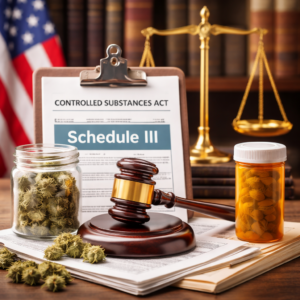
Effective today (March 31, 2026) the Texas Department of State Health Services smokable hemp regulations are in effect. Hemp flower, pre-rolled joints, live rosin, live resin: off compliant store shelves. The rules adopt a “total THC” calculation that includes THCA, and since most smokable hemp products contain THCA well above 0.3%, they no longer meet the legal threshold to be sold in Texas.
This is a story about chemistry, regulatory overreach, and the very real likelihood that innocent Texans are going to be arrested for conduct that is not a crime. Let me explain why each of those things is true.

"Deandra Grant Law – Criminal & DWI Defense handled my case with diligence and professionalism. Deandra Grant's reputation is stellar and now I know why. She has a team of individuals who provide quality service."
- N. Coulter
"Deandra Grant Law – Criminal & DWI Defense fights hard for their clients and is always willing to go above and beyond. They are the best firm for DWI cases in DFW and beyond. Definitely hire them to represent you in any pending cases."
- P. Williams
"Deandra Grant made a tough situation so much better. She listened to my concerns and helped me so much with my case. I would recommend her to anyone needing legal services."
- M. Haley
First: The Chemistry You Need to Understand
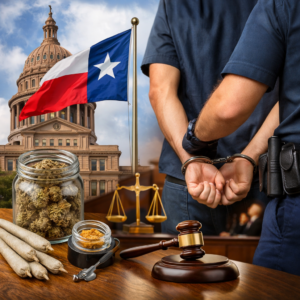
Texas legalized hemp in 2019 by defining it as cannabis containing less than 0.3% Delta-9 THC. Delta-9 THC is the primary psychoactive compound in cannabis which means it is what causes intoxication. THCA is a different compound: tetrahydrocannabinolic acid. In its natural, unheated state, THCA is not intoxicating. It does not bind to cannabinoid receptors the way Delta-9 does. Consuming raw THCA will not get you high.
When THCA is heated (through smoking, vaporization, or cooking) it undergoes decarboxylation and converts to Delta-9 THC at approximately an 88% rate. That conversion is what produces intoxication. Smokable hemp products with high THCA content are, in chemical reality, a Delta-9 THC delivery mechanism when smoked.
The hemp industry exploited this distinction deliberately. By cultivating plants with very high THCA and very low Delta-9, manufacturers produced a product that was chemically “legal hemp” under the Delta-9-only measurement standard while delivering a Delta-9 THC high when used as intended. The DSHS regulations close that gap by measuring total THC (Delta-9 plus THCA) and applying the 0.3% cap to the combined figure.
This is scientifically defensible. You cannot seriously argue that a product designed to convert to Delta-9 at 88% efficiency upon use is not a Delta-9 THC product. But the method by which Texas arrived at this rule (through administrative regulation rather than legislation) is legally significant in ways that matter for anyone charged under these new standards.
The Legislature Tried and Failed. The Governor Did It by Executive Order Instead.
In 2025, the Texas Legislature passed SB 3, a bill that would have banned virtually all hemp-derived THC products in Texas. The Senate passed it 30-1. The House passed it 86-53. Governor Abbott vetoed it on June 22, 2025, citing concerns about unconstitutional takings from businesses that had invested legally, conflict with federal law, and the example of Arkansas, where a similar ban was struck down in federal court.
Then Abbott called two special sessions. Neither produced hemp legislation. Then he issued Executive Order GA-56 on September 10, 2025, directing DSHS to develop new regulations. DSHS published proposed rules in December, held a public hearing in January, received over 1,400 comments, and adopted the final rules on March 2, 2026 with an effective date of March 31.
What the Legislature was constitutionally authorized to do through the legislative process, the Governor directed an agency to accomplish through administrative rulemaking. The industry’s legal argument (that DSHS cannot do through regulation what the Legislature declined to do through statute) has factual support in the SB 3 veto history. Whether that argument prevails in court remains to be seen. Litigation has already been filed or threatened in multiple jurisdictions. The hemp industry has seen regulatory bans enjoined in other states, including a partial injunction in New Jersey.
The point for criminal defense purposes is this: a regulatory framework that is itself legally contested is not a stable foundation for criminal prosecution.
What Is and Is Not a Crime Starting Today
This is the most important thing I can tell a Texas resident reading this post, and it is the thing the news coverage is getting wrong by omission.
Possession of smokable hemp products is not a criminal offense after March 31. The regulations impose obligations on licensed retailers and manufacturers. A consumer who purchased hemp flower legally last week and still has it is not committing a crime by possessing it. The regulatory violation falls on the business that sells noncompliant products, not the person who bought them before the rules took effect.
Selling noncompliant smokable hemp products is a regulatory violation, not automatically a criminal charge. A licensed hemp retailer who continues selling products above the 0.3% total THC threshold faces license revocation and civil fines up to $10,000 per day of violation. That is not the same as being charged with delivery of a controlled substance. The criminal exposure for sellers depends on the specific conduct and how prosecutors choose to charge it.
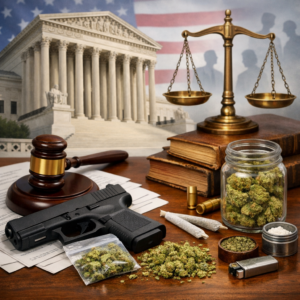
The fundamental criminal law question has not changed: marijuana remains Schedule I. Unregulated cannabis (ex. street marijuana, dispensary products from illegal sources) is still prosecuted under Texas Penal Code §481.121 and the Texas Controlled Substances Act. Nothing in the DSHS regulations changes the existing marijuana possession statutes.
The Wrongful Arrest Risk Is Real and It Starts Today
Here is where I am most concerned as a defense attorney: smokable hemp flower and marijuana are visually indistinguishable. They smell the same. They are consumed the same way. A Texas peace officer who observes someone smoking what appears to be a marijuana cigarette cannot determine from that observation alone whether the product is legally purchased hemp, noncompliant hemp, or street marijuana.
Before today, a person smoking THCA hemp flower purchased from a licensed Texas retailer was in possession of a legal product. After today, that same person may be viewed by law enforcement as possessing something that looks indistinguishable from marijuana and that, under the new total THC standard, would have been noncompliant for sale.
Andrea Steel, a Houston attorney who represents hemp businesses, has already said she expects law enforcement agencies will incorrectly arrest people caught smoking hemp products. I agree with that prediction. And here is the criminal defense reality: an arrest based on an officer’s reasonable suspicion that smokable cannabis is marijuana is not automatically an unlawful arrest just because the substance turns out to be legal hemp. The Fourth Amendment requires reasonable suspicion for a stop and probable cause for an arrest. The officer’s belief that the substance was marijuana, even if mistaken, may satisfy those standards depending on the totality of the circumstances.
This means we are likely to see a wave of hemp-related arrests in the coming months where the defense argument is not “my client didn’t possess cannabis” but “my client possessed legal hemp, not marijuana, and the State cannot prove otherwise.” That argument requires laboratory testing that can distinguish between THCA and Delta-9 THC and quantify each accurately. The immunoassay screens used in field drug tests cannot make that distinction. A positive field test for THC does not establish that the substance was marijuana rather than legal hemp.
Case Results
The Federal Dimension
The Texas smokable hemp ban does not exist in isolation. On November 12, 2025, President Trump signed H.R. 5371, a government funding bill that contained a provision (Section 781) that fundamentally rewrote the federal definition of hemp. The old federal standard measured Delta-9 THC only. The new federal standard adopts a total THC calculation (the same approach DSHS has now taken in Texas) and caps finished hemp products at 0.4 milligrams of total THC per container. That federal provision takes effect on November 12, 2026, giving the industry a one-year compliance window.
The convergence of the Texas regulatory approach with the new federal standard significantly complicates the industry’s constitutional and preemption arguments. If federal law is moving in the same direction as DSHS, the argument that DSHS exceeded its authority by adopting a total THC standard faces a headwind.
What This Means If You Are Charged
If you are arrested in connection with hemp or cannabis in Texas in the coming months, the first questions your attorney should be asking are: What was the substance? How was it tested? What does the laboratory analysis show. Specifically, what were the Delta-9 THC and THCA concentrations, measured separately, by a validated methodology? A field test positive is not an answer to any of those questions.
The THCA-to-Delta-9 conversion chemistry that drove the hemp industry’s growth is now the same chemistry that will be at the center of the legal disputes arising from this ban. As a forensic lawyer-scientist with a Master’s Degree in Pharmaceutical Science and a Graduate Certificate in Forensic Toxicology, the analytical chemistry involved in distinguishing hemp from marijuana (and in evaluating whether a laboratory result accurately reflects the pre-combustion composition of a sample) is something I am specifically positioned to evaluate.
If you or someone you know is facing a marijuana or hemp-related charge in North or Central Texas, call Deandra Grant Law at (214) 225-7117.
Deandra M. Grant is the Managing Partner of Deandra Grant Law, a criminal defense and DWI firm with offices in Dallas, Fort Worth, Allen, Denton, Waco, and Rockwall. She holds the ACS-CHAL Forensic Lawyer-Scientist designation, is a trained SFST instructor, and has been recognized as a Texas Super Lawyer continuously since 2011.
Firm Accolades

Better Business Bureaus

D Magazine