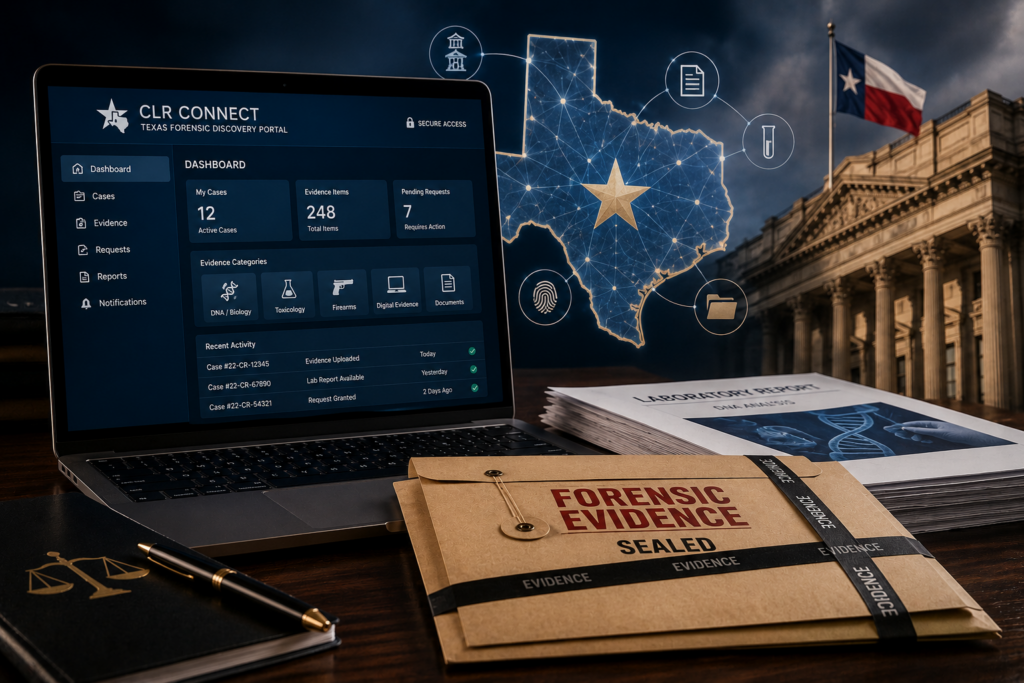
In August 2026, if the rollout stays on schedule, the way crime-laboratory records reach Texas criminal defendants will change. Not because the underlying law of discovery is changing (the Michael Morton Act and the rest of Article 39.14 of the Texas Code of Criminal Procedure remain what they were) but because the Texas Department of Public Safety is launching a single statewide portal through which every accredited Texas crime laboratory will be required to deliver its records to both prosecutors and defense counsel on equal terms. The portal is called Texas Crime Lab Records Connect, abbreviated Texas CLR Connect and pronounced (per DPS) Texas “Clear” Connect.
This post explains what the portal does, what the patchwork it replaces actually looks like in practice, what the relevant statutes and administrative rules say, and what defense practitioners should be watching as the August launch approaches. The short version: this is a quiet but consequential change to how forensic evidence reaches the defense, and the details of implementation are going to matter more than the headline.
The Lab-Discovery Patchwork We Have Now
Texas does not currently have one rule for how crime-laboratory records get from the lab to the defense in a criminal case. It has dozens. Each county, in some cases each court, in many cases each laboratory, has its own practice.
In Harris County and several surrounding jurisdictions, a standing discovery order makes a defined set of crime-laboratory discovery available to the defense as a matter of course when a case is filed. The defense lawyer does not have to take extra steps to obtain lab discovery.
In most of the rest of the state, the practice is different. Lab records reach the defense through one of three mechanisms: a Michael Morton Act discovery request under Article 39.14, made to the prosecutor; a subpoena duces tecum served on the laboratory directly; or, in some cases, by Order of the judge. Each mechanism has friction. Each mechanism produces different content, on different timelines, with different completeness, depending on which lab, which prosecutor, and which defense lawyer is involved.
The practical effect, for a Texas criminal defendant whose case turns on a forensic lab result, is that the substantive value of “discovery” in their case depends in part on geography. A request for lab discovery on a DWI blood test analyzed at the DPS Garland lab and prosecuted in Houston goes through one workflow; the same blood test discovery for a DWI prosecuted in Dallas goes through another. Neither workflow is necessarily wrong; they are different. CLR Connect is built on the premise that they should be the same.
The Statute and the Rules: SB 991 and 37 TAC §§ 28.211–28.215
CLR Connect runs on legal authority. In the 88th Legislative Session (2023), the Texas Legislature passed Senate Bill 991 (codified at Texas Government Code §§ 411.161–164) which tasked DPS with establishing and maintaining “a central computerized portal” to facilitate criminal discovery of crime-laboratory records. The bill became law that session, with implementation entrusted to DPS as the operating agency.
The implementing administrative rules are codified at Title 37, Texas Administrative Code, Chapter 28, Subchapter N, §§ 28.211–28.215. DPS proposed the rules in the April 25, 2025, issue of the Texas Register; the rules were adopted in the June 27, 2025, issue and took effect July 3, 2025. The launch of the operational portal itself is targeted for August 2026 on a phased rollout DPS has indicated will take six to eight weeks to complete across the participating laboratories.
The central statutory principle the rules implement is the one most worth pausing on. The rules expressly establish a portal “that makes crime laboratory records equally available to prosecutors and defense counsel.” That is not standard discovery-statute language. The traditional structure of Article 39.14 places the disclosure duty on the prosecutor, with the defense’s access running through the prosecutor as intermediary. CLR Connect cuts out the intermediary for the specific category of crime-laboratory records. The lab uploads its records to the portal, and prosecutors and defense counsel access them on the same terms.
That structural shift is small in some ways and important in others. It is not a new substantive discovery right. The underlying discoverable categories under Article 39.14 are what they are. It is, however, a new procedural channel for the records to reach the defense without going through the prosecutor first. For categories of evidence that have historically been at risk of being lost in the prosecutor-to-defense relay, that channel matters.
There is a structural qualifier to the “equally available” principle that defense practitioners should understand from the start. Per the prosecution-office role documentation DPS has published in advance of launch, every prosecution-side user role (Prosecution Admin and Prosecutor) has authority to assign or remove defense counsel from a case in the portal and to approve or deny defense access requests. Once the defense lawyer of record on a case is assigned, that lawyer appears to have full case-level access to the records the laboratory has uploaded. But the gate to that assignment is prosecution-controlled. “Equally available” therefore needs to be read carefully: equally available within the case once defense counsel is on it, not freely available to the defense bar as a class. Whether that gate functions as a routine administrative formality or as a meaningful chokepoint will be one of the first-year questions worth watching.
Another issue is that what the labs upload may not be the full lab discovery the defense wants. Once the portal launches we’ll see what is actually made available. There may be (and likely will be) push back from the Defense on what is left out of the portal.
What CLR Connect Will Actually Do
Per the DPS rules and the Department’s public materials, the portal is designed to:
- Provide a secure, centralized, and digital means for delivering laboratory records that are subject to discovery in criminal cases.
- Standardize the format and the workflow of those deliveries, so that the same kind of record is delivered the same way from any participating Texas crime lab.
- Operate within the framework of Article 39.14 of the Texas Code of Criminal Procedure (the Michael Morton Act), and within the federal constitutional baseline set by Brady v. Maryland.
- Make the records available, on equal terms, to attorneys for the State and attorneys for the defense.
The scope of mandatory participation is broad. Under the rules, every crime laboratory (as defined by Article 38.35 of the Code of Criminal Procedure) within the State of Texas that conducts forensic analysis for use in a Texas criminal case is required to participate. That includes the DPS state crime laboratories, the major municipal and county laboratories (Houston Forensic Science Center, the Tarrant County Medical Examiner’s Crime Laboratory, the Dallas County Southwestern Institute of Forensic Sciences, and the Bexar County Criminal Investigation Laboratory, NMS, and Armstrong Labs, among others), and the private accredited laboratories used in particular case categories.
There is an important qualification on the scope of mandatory participation that the public-facing materials make clear but that the press coverage has largely missed. Participation is tied to the Texas Forensic Science Commission’s accreditation framework. Only forensic disciplines the Commission has determined require accreditation are within the mandate; disciplines the Commission has not designated as requiring accreditation are not. A laboratory running a mix of accredited and non-accredited disciplines is required to put its accredited-discipline work through CLR Connect; participation in the portal for the laboratory’s non-accredited work is optional. For the defense bar, that line matters. Not every kind of forensic analysis a Texas prosecutor might rely on will move through CLR Connect at launch. Disciplines that fall outside the Commission’s accreditation requirements will continue to be reached, if at all, through the older Article 39.14 and subpoena-based pathways.
Out-of-state laboratories are subject to a narrow exemption: they can apply for a two-year exemption if they are physically located outside of Texas and conduct fewer than 300 Texas cases annually. The exemption is not automatic; it requires application on a DPS form and must be renewed every two years. The reason for the exemption category, judging from DPS’s public commentary during the rulemaking, is that an out-of-state laboratory with a small Texas caseload should not be forced to bear the technical costs of portal participation for what is, for that lab, a marginal practice area. Smaller in-state laboratories are not similarly exempted; they have to participate even if they are small.
DPS’s small-business impact analysis during the rulemaking estimated that there are roughly 40 accredited forensic laboratories operating in Texas, five to ten of which qualify as small businesses. Setup costs per laboratory were estimated at $3,000 to $50,000 in the first year, with recurring annual costs of $1,000 to $21,000. Those numbers are, on the universe of forensic-lab budgets, modest. They are not zero, and they are part of why the lead time between SB 991 in 2023 and the August 2026 launch is three years rather than three months.
What Problems CLR Connect Is Trying to Solve
The Department’s stated goals (efficiency, transparency, compliance with Brady and the Michael Morton Act) are accurate but high-level. The more concrete problems the portal is trying to solve are familiar to any Texas criminal defense practitioner.
- The relay problem. Lab records that exist at the laboratory and that are discoverable under Article 39.14 do not, in current practice, always reach the defense in any given case. They may not reach the prosecutor either. The Texas Court of Criminal Appeals’ 2024 decision in State v. Heath, 696 S.W.3d 677, made clear that “the State” under Article 39.14 includes law enforcement and (by extension) the laboratories doing forensic work for the prosecution, and that records sitting in those files are in the State’s possession whether the prosecutor has seen them or not. CLR Connect is, in part, a structural response to the problem Heath was naming: a way for the lab to put the records on the portal directly, rather than relying on a chain of prosecutor-side intake that has historically lost records along the way.
- The format and standardization problem. Lab records produced in response to a discovery request currently arrive in inconsistent formats: some on paper, some as scanned PDFs, some as native instrument outputs, some as proprietary lab management system extracts. A defense expert reviewing the same kind of forensic test from two different labs is often comparing apples to a slightly different kind of apple. A standardized portal that delivers records in a defined format addresses that.
- The latency problem. In current practice, a subpoena duces tecum to a Texas crime laboratory takes weeks, sometimes months, to be honored. That timeline can run up against trial settings, plea deadlines, and motion deadlines that move on a faster clock. A statewide portal designed for routine, fast delivery on a predictable timetable shrinks that latency.
- The unequal-access problem. The current system makes the prosecutor a structurally privileged user of lab records. Prosecutors talk to lab personnel routinely; defense lawyers, with rare exceptions, do not. CLR Connect, by making records “equally available” as a matter of design, does not equalize access to lab personnel (that is a different problem) but it does begin to equalize access to lab records as a class.
What the Defense Bar Should Be Watching
The headline of CLR Connect is good for defense practice. The implementation will determine how much of that promise is realized. A handful of questions are worth tracking as the launch approaches:
- What counts as a “record”? The scope of records the portal is required to deliver is the threshold question for almost every issue that follows. Does “record” mean the final lab report only, or does it include bench notes, instrument outputs, chromatograms, chain-of-custody documentation, validation studies, calibration records, proficiency-testing results, and the analyst’s technical review? The defense bar should be paying close attention to how the rules and DPS’s implementation define this term in practice.
- What about quality incidents and corrective actions? Every accredited Texas crime laboratory has, in its files, some history of quality-management issues, non-conforming work, and corrective-action documentation. Some of that material is discoverable under Article 39.14 and required disclosure under Brady; some of it raises harder questions. Whether CLR Connect provides a workflow for delivering this category of record (or expects the defense to seek it separately) is going to be a significant practical issue.
- How does CLR Connect interact with the Michael Morton Act’s broader disclosure framework? Article 39.14 is not limited to lab records. CLR Connect is. The risk a defense lawyer should be aware of is the temptation (from the prosecution side) to treat the existence of the portal as a sufficient response to a broader Article 39.14 request. The portal is a tool. It is not a substitute for the Michael Morton Act’s general obligations, and the defense should not let it be treated as one.
- How does defense access actually work in practice? The published prosecution-office role documentation describes a portal architecture in which every prosecution-side user role (Prosecution Admin and Prosecutor) has authority to approve or deny defense access requests and to assign or remove defense counsel from cases. There is no parallel defense-side administrative role. How quickly access requests are processed in real-world cases, whether denials occur and on what grounds, what happens if a defense lawyer is removed from a case under the portal’s permission rules, and whether any pattern of denial develops that requires litigation or rulemaking attention are all open questions as of this publication date. Patterns in how the gate operates will, in practice, shape how “equally available” translates from the rule into the case file.
- What about pre-CLR-Connect cases? Cases pending on the August 2026 launch date, and cases pending appeal involving forensic records that should have been disclosed under the prior patchwork, are not going to be automatically swept into the new portal. The defense lawyer in those cases should be thinking now about whether a pending case’s lab-records production needs to be supplemented after launch.
- What about lab personnel records, accreditation issues, and analyst-specific issues? Crime-laboratory records, as a category, can include records about the laboratory and records about the people working in it. An analyst’s training file, proficiency-testing history, prior disciplinary or quality-incident involvement, and accreditation status are all material a defense lawyer may legitimately need. Whether CLR Connect provides a route to that material is a question the practical implementation will answer.
- What about federal cases? CLR Connect is a state system, built on state legal authority, governing state criminal cases. Federal criminal prosecutions in Texas, including those handled by U.S. Attorney’s Offices in the Northern, Eastern, Southern, and Western Districts, continue to run on the federal discovery framework. A federal defendant whose case involves forensic analysis by a federal laboratory or by a Texas laboratory used in a federal prosecution will need to address discovery through federal procedural channels.
Why This Matters for Texas Defendants
A defendant whose case turns on a forensic lab result (a DWI blood alcohol or drug screen, a DUID toxicology panel, a controlled-substance identification, a DNA analysis, an arson chemistry workup, a firearm-toolmark comparison, a digital-forensic exam) has a constitutional and statutory entitlement to the records underlying that result. The Michael Morton Act says so. The Brady line of cases says so. The new portal does not change any of that.
What the portal does is reduce the number of points at which the system can lose the records between the laboratory and the defense. It does that by giving the laboratory a direct delivery channel to defense counsel, on the same terms as the prosecutor, governed by uniform administrative rules across the state. For a defense practice that has spent years explaining to clients why the lab records in their case were delayed, incomplete, or different from the records in the case next door, that is a substantive shift.
It is also not the end of the work. Records on a portal still have to be reviewed. Reviewing them still requires someone on the defense side who knows what the instrument outputs mean, what the calibration history is supposed to look like, what the validation study covered and did not cover, and what the relevant scientific consensus says about the method being used. A well-designed discovery portal makes the records available. It does not make them comprehensible. That part is the defense lawyer’s job, and that part is what makes the difference between knowing the State has produced “something” and knowing what the State has produced means.
The Takeaway
Texas CLR Connect is, on its face, a piece of administrative infrastructure. Pieces of administrative infrastructure rarely make headlines. This one is worth a defense practitioner’s attention because, in the area of practice where it operates (i.e. forensic-evidence discovery in criminal cases) administrative infrastructure is the difference between a defendant getting the records that determine the outcome of their case and not getting them.
The August 2026 launch (phased over six to eight weeks per DPS’s published schedule) is the milestone. The implementation rolling out across the state’s roughly 40 accredited forensic laboratories will continue for months and years afterward. The defense bar that pays attention to the rollout, asks the right questions about scope and content, and treats the portal as a tool to use (not a substitute for the broader Article 39.14 framework) will be in a position to use the new system on behalf of their clients in the way the Legislature appears to have intended.
Deandra Grant holds a Master of Science in Pharmaceutical Science, a Graduate Certificate in Forensic Toxicology, and the ACS-CHAL Forensic Lawyer-Scientist designation — the first attorney in Texas to earn it. The firm handles DWI, DUID, and other criminal cases throughout North and Central Texas in which forensic-laboratory evidence and lab-records discovery are central. To discuss a pending case, call (214) 225-7117.