
Home »


Do You Need Legal Help?

"Deandra Grant Law fights hard for their clients and is always willing to go above and beyond. They are the best firm for DWI cases in DFW and beyond. Definitely hire them to represent you in any pending cases."
- P. Williams
"Deandra Grant made a tough situation so much better. She listened to my concerns and helped me so much with my case. I would recommend her to anyone needing legal services."
- M. Haley
"Deandra Grant Law handled my case with diligence and professionalism. Deandra Grant's reputation is stellar and now I know why. She has a team of individuals who provide quality service."
- N. Coulter
New! AI Legal Avatar — Get 24/7 Answers on Texas DWI Law, Penalties, and Defenses
Our AI Legal Avatar provides instant, plain-language answers to your questions about Texas DWI laws—like penalties, license suspension, and defense strategies—anytime, day or night. While it's a helpful starting point, it doesn't replace the clarity and advocacy of our experienced DWI attorneys.
As Seen On






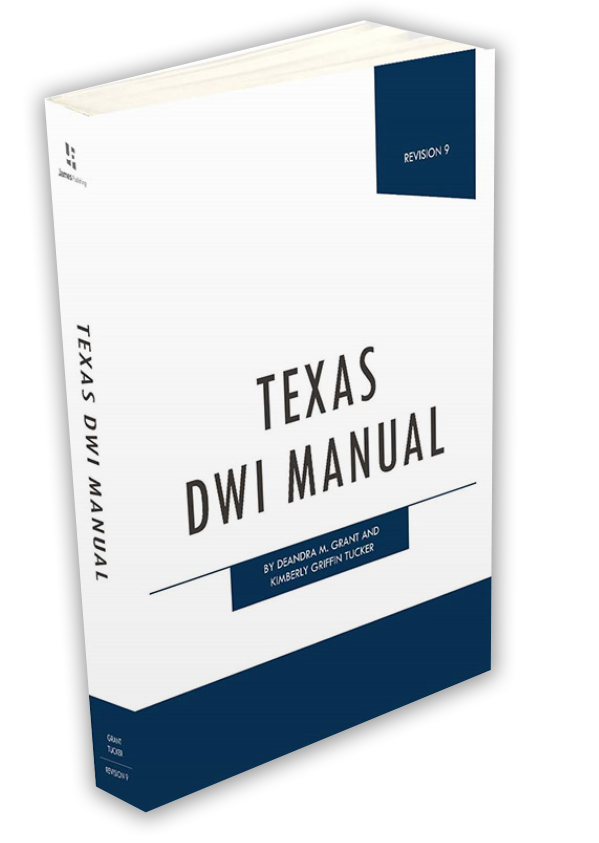
Texas DWI Manual
By Attorney Deandra Grant
Fighting DWI charges can present many challenges, not only for the defense, but prosecutors as well. This is why it is important to be armed with the necessary knowledge so you understand the DWI process.
Attorney Deandra M. Grant is the co-author of the Texas DWI Manual, offering legal advice to both clients and fellow attorneys.
Learn MoreTexas Intoxication Manslaughter Lawyers
Navigating Intoxication Manslaughter Charges in Texas: Your Path to Defense
Intoxication manslaughter is one of the most technically demanding charges in Texas criminal defense. An accident happens. Someone dies. A blood draw shows a BAC above 0.08. The prosecution does not have to prove you intended to cause harm. They do not have to prove you were driving recklessly. They only have to prove you were intoxicated and that your intoxication caused the death. Everything else (the other driver’s conduct, the road conditions, the quality of the blood evidence) is defense territory.
Managing Partner Deandra Grant brings more than 30 years of DWI defense experience, a Master’s Degree in Pharmaceutical Science, and the ACS-CHAL Forensic Lawyer-Scientist designation to every intoxication manslaughter case. These are not credential footnotes. They are the scientific foundation from which blood evidence is evaluated, crash reconstruction is challenged, and causation is contested.
Deandra Grant Law – Criminal & DWI Defense Helps Residents Across Texas with DWI Defense – Including: Allen , Arlington, Belton, Cleburne, Collin County, Dallas, Denton, Fairview, Fort Worth, Frisco, Gainesville, Granbury, Hood County, Johnson County, Lewisville, Little Elm, McKinney, Park Cities, Parker County, Plano, Princeton, Richardson, Rockwall, Rowlett, Royse City, Southlake, Sunnyvale, The Colony, Waco, and Weatherford.
What the Statute Requires: §49.08
Texas Penal Code §49.08 defines intoxication manslaughter as operating a motor vehicle while intoxicated and by reason of that intoxication causing the death of another person by accident or mistake. Every element must be proven beyond a reasonable doubt: operation, public place, intoxication, and causation.
Intoxication. Under §49.01, intoxication means either a BAC of 0.08 or above at the time of driving, or the loss of normal use of mental or physical faculties by reason of alcohol, a drug, or a controlled substance. This is a two-prong definition: the prosecution may proceed under either or both prongs. A driver can be charged with intoxication manslaughter even if the blood result is below 0.08, if the loss-of-normal-use prong is supported by officer observations and other evidence.
Causation — the central battleground. The prosecution must prove that the defendant’s intoxication (not merely their presence at the scene or their operation of a vehicle) caused the death. A driver with a 0.09 BAC who is rear-ended at a green light by a driver who ran a red light is present, is operating a vehicle, and is arguably intoxicated, but the cause of the collision and the death was the other driver’s traffic violation, not the first driver’s BAC. Concurrent causation, third-party fault, and independent crash reconstruction are all tools the defense uses to contest the causation element.
No recklessness required. Unlike traditional manslaughter under §19.04, intoxication manslaughter does not require proof of recklessness. A driver who was intoxicated and caused a fatal accident through ordinary negligence can be convicted. This strict-liability-adjacent structure is what makes the causation analysis so critical.
Related Videos
Certified in the science and testing of DWI enforcement
Biggest Mistakes of a DWI Charge
Lawyer Scientist Certification
DWI with a child in the car
Choosing a DWI attorney
Choosing quality over cost with a DWI attorney
Cost of a DWI attorney
DWI on your criminal record
DWI probable cause
DWI with prior convictions
Emotional state of a DWI client
How long does a DWI conviction stay on my record?
How long will a DWI case take?
Out-of-state DWI Arrest
Police didn’t have probable cause
Relieving stress of a DWI client
What happens in Texas if you get into an accident and you’re charged with a DWI if you killed somebody?
Charged with a DWI while sitting in your car
Can I defend myself against a DWI charge?
Court process for a DWI charge
DWI license suspension
DWI with injury penalties
DWI written case evaluations
Ignition Interlock Device
Losing your job from a DWI
Losing your license from a DWI
Penalties from a DWI conviction
Plea bargaining a DWI charge
Will pleading guilty reduce a DWI charge?
Refusing to answer police questions during a DUI arrest
Refusing field sobriety tests
Why you should choose a DWI attorney with lawyer scientist certification
Penalties and the Enhancement for Protected Victims
Intoxication manslaughter is a second-degree felony carrying 2 to 20 years in state prison and a fine up to $10,000. If the deceased was a peace officer, firefighter, judge, or emergency medical services employee performing official duties, the charge is enhanced to a first-degree felony carrying 5 to 99 years or life.
Effective September 1, 2023, Texas added a mandatory financial consequence under Texas Code of Criminal Procedure Article 42.0375 — known as Bentley’s Law. When a defendant is convicted of intoxication manslaughter and the deceased was the parent of a minor child, the court must order monthly child support restitution for that child until they turn 18 or graduate high school. Payments are deferred during incarceration but are not waived. They begin within one year of release and include any arrearage accumulated during imprisonment. The age and number of the victim’s minor children is a factor that belongs in any honest assessment of a plea decision.
Related Blogs
How the Defense Is Built
Independent Crash Reconstruction
The state’s investigators produce a crash reconstruction report. The defense retains an independent expert to evaluate the methodology, measurements, physical evidence, and conclusions. Skid mark analysis, point of impact determination, vehicle speed calculation, and fault attribution all involve technical judgment that can be challenged when the underlying data does not support the conclusions.
Third-Party Fault
Evidence that another driver violated a traffic law, was distracted, or created the dangerous condition that led to the collision is directly relevant to causation. This evidence must be developed and preserved early. Witness memories fade and surveillance footage is overwritten.
Event Data Recorder Evidence
Modern vehicles capture pre-crash vehicle speed, brake application, throttle position, steering angle, and seatbelt status in the seconds before a collision. This data is often more reliable than eyewitness accounts or post-hoc reconstruction and can establish exactly what the defendant’s vehicle was doing when the crash occurred. It must be preserved immediately after arrest.
The Blood Evidence
Blood draws in intoxication manslaughter cases are warrant-authorized and analyzed by forensic toxicology laboratories: SWIFS or DPS in Dallas County, TCME or the Fort Worth Crime Lab in Tarrant County, DPS labs elsewhere. Evaluating whether a blood result accurately reflects the defendant’s BAC at the time of driving (rather than hours later at the time of the draw) requires pharmacokinetic analysis and retrograde extrapolation methodology. Learn more about blood test defense in DWI cases.
The Constitutional Foundation
Under Texas Code of Criminal Procedure Article 38.23, evidence obtained through a constitutionally defective warrant is suppressible. Texas has no good faith exception. The validity of the blood draw warrant (whether the affidavit accurately stated the facts and whether those facts established probable cause) is one of the first questions in every intoxication manslaughter defense.
Frequently Asked Questions: Navigating Intoxication Manslaughter Charges in Texas
Facing Intoxication Manslaughter charges in Texas can lead to numerous questions and concerns. To provide you with a better understanding of your situation, we’ve compiled answers to common questions individuals in your position might have. Here’s what you need to know:
What is Intoxication Manslaughter in Texas?
Intoxication Manslaughter occurs when a person causes the death of another while operating a vehicle under the influence of alcohol or drugs. This offense is taken seriously to prevent tragedies resulting from impaired driving.
What Penalties Can I Face if Convicted of Intoxication Manslaughter?
Conviction for Intoxication Manslaughter in Texas can lead to severe consequences. These include significant prison time, substantial fines, driver’s license suspension, and a permanent criminal record.
What Factors Can Impact My Case?
Various factors can affect the outcome of an Intoxication Manslaughter case, such as the circumstances of the incident, prior criminal history, blood alcohol concentration (BAC) level, and more. An experienced attorney can assess these factors to build a strong defense strategy.
Should I Speak to the Police Without a Lawyer Present?
It’s generally advisable to exercise your right to remain silent and consult with an attorney before speaking to the police. Anything you say can be used against you, so having legal representation can help protect your rights.
Can I Get My Charges Dismissed?
Every case is unique, and the possibility of having charges dismissed depends on the evidence, legal strategies, and negotiations involved. An experienced Intoxication Manslaughter Lawyer can assess your case to determine the right course of action.
How Can an Attorney Help with My Defense?
An experienced attorney can analyze the evidence, identify potential defenses, and build a strong case on your behalf. They can also negotiate with prosecutors, explore plea options, and represent you in court if necessary.
Can I Afford Legal Representation?
Deandra Grant Law – Criminal & DWI Defense offers free consultations to individuals facing Intoxication Manslaughter charges. This consultation provides you with the opportunity to discuss your case, learn about your rights, and understand your legal options.
What's the Timeline for Resolving My Case?
The timeline for resolving an Intoxication Manslaughter case can vary based on factors such as case complexity, court availability, negotiations, and trial proceedings. An attorney can provide you with an estimate based on your specific circumstances.
How Can Deandra Grant Law – Criminal & DWI Defense Assist Me?
Deandra Grant Law – Criminal & DWI Defense’s team of skilled Intoxication Manslaughter Lawyers is here to provide you with personalized legal guidance, comprehensive defense strategies, and unwavering support throughout the legal process.
The Grand Jury and the Timeline
Intoxication manslaughter is a felony. The prosecution must obtain a grand jury indictment before the case can proceed to trial. A well-prepared defense packet submitted before grand jury presentment may influence whether an indictment issues and what charge is presented. The investigation that will determine the defense (crash reconstruction, blood evidence, witness accounts) is happening right now. Acting immediately is not optional.
Speak With Deandra Grant Law
Intoxication manslaughter cases require simultaneous defense on multiple fronts: the constitutional validity of the blood draw, the forensic accuracy of the BAC result, the scientific foundation of the crash reconstruction, and the legal sufficiency of the causation theory. Deandra Grant Law has offices in Dallas, Fort Worth, Allen, Denton, Waco, and Rockwall. We have appeared in North and Central Texas courts for more than 30 years, across more than 500 trials to verdict.
Call (214) 225-7117 for a confidential consultation. The investigation is happening now. Don’t wait.
Client Reviews

“Deandra Grant Law – Criminal & DWI Defense handled my case with diligence and professionalism. Deandra Grant’s reputation is stellar and now I know why. She has a team of individuals who provide quality service.”
N. Coulter


(214) 225-7117
Experienced DWI Defense