By Deandra Grant & Griffin Grant
Welcome to The Defense File where we examine the criminal cases of public figures through the lens of Texas criminal law. Each entry looks at what happened in court, what the defense argued, and what a defendant would have faced (and how they might have been defended) if the same facts had occurred in Texas.
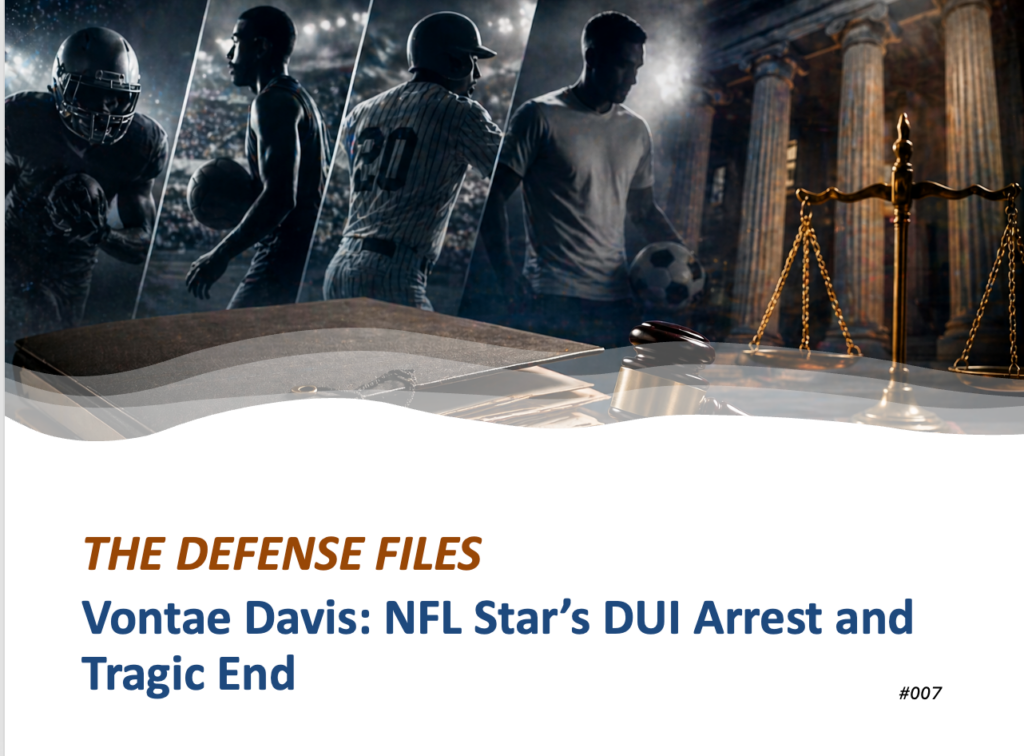
This entry examines the 2023 DUI case involving former NFL cornerback Vontae Davis. Davis passed away in April 2024 at age 35. This analysis is written with respect for his memory and focuses solely on the legal issues his case raises that are directly relevant to anyone in Texas facing a DWI case involving an accident and an injured third party.
The Incident
On February 4, 2023, at approximately 7:50 a.m., Florida Highway Patrol responded to a crash on Florida’s Turnpike near mile marker 45 in Broward County. Vontae Davis’s Tesla had struck a disabled pickup truck that was stopped on the shoulder. The impact caused the pickup truck to strike a man standing nearby who had stopped to assist with the disabled vehicle. That person, along with his son who was present, sustained injuries and was hospitalized. The civil lawsuit that followed alleged significant injuries and emotional distress and sought $1 million in damages.
When officers arrived, they found Davis asleep on the highway shoulder, with his vehicle heavily damaged. Officers noted slurred speech, bloodshot eyes, and instability. Davis leaned on a roadway barrier to remain standing. He told officers he had consumed two mixed drinks at a club earlier that evening and reported that he could not recall the crash itself. Body camera footage of the arrest captured an officer telling Davis directly: “You almost killed somebody.”
Davis was charged with DUI and five related counts, including reckless driving. His bond was set at $500.
What Happened in Court
Davis initially pleaded not guilty. On October 23, 2023, he accepted a plea deal. He pleaded no contest to a lesser charge of reckless driving and the DUI and remaining charges were dropped. On November 1, 2023, he was sentenced to 12 months of probation, fines, payment of the victims’ medical bills, and 50 hours of community service. No jail time was imposed beyond his initial arrest. The civil lawsuit filed by the injured father and son remained pending.
The Texas Analysis
In Texas, the same facts (a driver who is intoxicated, crashes into another vehicle, and causes bodily injury to a person at the scene) do not produce a DUI charge. They produce an intoxication assault charge which is a third-degree felony carrying 2 to 10 years in TDCJ. Florida’s resolution path (DUI reduced to reckless driving, 12 months probation) would be a difficult outcome to obtain unless the causation of the accident or the BAC were called into question.
Intoxication Assault: Texas Penal Code §49.07
Texas Penal Code §49.07 provides that a person commits intoxication assault if the person, by accident or mistake, while operating a motor vehicle in a public place while intoxicated, causes serious bodily injury to another. “Serious bodily injury” is defined under §1.07(a)(46) as injury that creates a substantial risk of death, causes permanent disfigurement, or causes protracted loss or impairment of a bodily organ or member.
Intoxication assault is a third-degree felony carrying 2 to 10 years in the Texas Department of Criminal Justice and a fine up to $10,000. Unlike Florida’s DUI (which was a misdemeanor) intoxication assault in Texas is a felony from the moment it is charged. It cannot be resolved as a misdemeanor reckless driving offense without the felony charge being dismissed or reduced.
The Davis facts map onto §49.07 directly: He was operating a motor vehicle. He was possibly intoxicated according to the officer’s observations, his own admission to consuming alcohol, and his inability to recall the crash. His vehicle struck a disabled truck, which in turn struck a person who was hospitalized with injuries. Whether those injuries constitute “serious bodily injury” under the Texas definition (creating a substantial risk of death, permanent disfigurement, or protracted loss of function) would be the key factual question. The $1 million civil lawsuit suggests the injuries were significant. A hospitalization alone does not establish serious bodily injury, but serious injuries sustained in a high-speed turnpike crash often do.
The “Operating” Element: Found Asleep After the Crash
One defense argument the Florida case may have touched on (and that would arise in any Texas version of this case) is the “operating” element of the DWI/intoxication assault charge. Davis was found asleep on the shoulder after the crash, not actively driving. Could the defense argue he was not “operating” the vehicle at the time officers arrived?
Texas law does not define operating. The operating element does not require the defendant to be actively driving at the moment of contact with law enforcement. Evidence that the defendant recently operated the vehicle (including a crash, the vehicle’s position on the roadway, the defendant’s proximity to the vehicle, and physical evidence of operation) may be sufficient. The crash itself and Davis’ admission that he had been driving can be evidence of recent operation.
The defense argument in a Texas case would more likely focus on the temporal gap between the last documented drink and the time of driving, and whether the blood or breath test (if administered) accurately reflected his BAC at the time of operation rather than at the time of the test. Retrograde extrapolation arguments are available when there is a significant gap between the crash and the chemical test.
The Admission: “Two Mixed Drinks”
Davis told officers he had consumed two mixed drinks at a club earlier that evening. In Texas, this statement would be admissible as an admission against interest. It does not establish a specific BAC level, and two mixed drinks would not necessarily produce a BAC above 0.08% for a person of Davis’s size (he was a professional athlete). But the statement, combined with the officer’s observations of slurred speech, instability, and an inability to stand without support, builds toward the “loss of normal use of mental or physical faculties” prong of Texas’s intoxication definition, which does not require a specific BAC result.
In Texas, this admission creates a two-track prosecution. The State can pursue the per se intoxication theory (BAC of 0.08% or greater) if chemical testing confirms it, and the impairment theory (loss of normal use of faculties) based on the officer’s observations and the circumstances of the crash. Both tracks are available simultaneously, and the prosecution does not have to elect between them.
How Would the Defense Approach This in Texas?
- Contest the serious bodily injury element. The difference between bodily injury and serious bodily injury under Texas law is the difference between an intoxication assault charge and misdemeanor DWI. The defense would obtain complete medical records for the victim, retain a medical expert to evaluate the nature and extent of the injuries, and challenge whether they meet the “substantial risk of death,” permanent disfigurement, or “protracted loss or impairment” standard. In a case where injuries are serious but fully recoverable, the serious bodily injury element is genuinely litigable.
- Chemical test challenge. If blood was drawn (whether at the scene, during transport, or at the hospital) the defense examines the complete laboratory file, chain of custody, and methodology. Davis was found asleep and was transported for medical care, creating the possibility that any blood draw was conducted in a hospital setting under the legal-blood vs. hospital-blood framework discussed elsewhere in our DWI resources. Hospital enzymatic testing is not forensic methodology and is subject to the serum-to-whole-blood conversion challenge.
- Retrograde extrapolation. If Davis consumed alcohol at a club and the crash occurred hours later, the BAC at the time of the test may not accurately reflect the BAC at the time of driving. The defense would examine the timing of alcohol consumption, the absorption and elimination curve, and whether the test result (if above 0.08%) actually reflects the BAC at the time the crash occurred or a later measurement after continued elimination.
- Negotiate the intoxication assault charge aggressively. A third-degree felony intoxication assault conviction in Texas is a permanent felony record with all the consequences that entails. In a case where the victim’s injuries are fully documented and the civil case is pending, the defense team and the civil attorney would coordinate strategy to ensure that statements made in the criminal proceeding do not prejudice the civil defense, and vice versa. In some cases, resolution of the civil matter may affect the prosecution’s willingness to negotiate the criminal charge.
- Article 38.23 — the stop and initial contact. Davis was found by responding officers. There was no traffic stop in the traditional sense. The initial contact was with a crash scene. The legality of any search of the vehicle, including any items tested or recovered, is examined under Article 38.23.
The Civil and Criminal Double Track
One aspect of the Davis case that distinguishes accident-based DWI cases from standard traffic stops is the parallel civil lawsuit. The injured father and son filed a $1 million civil lawsuit against Davis. This creates what practitioners call the double track: simultaneous criminal and civil proceedings arising from the same incident.
In Texas intoxication assault cases involving civil litigation, the defense must be managed on both tracks simultaneously. Statements Davis might make in the criminal proceeding can be used in the civil case. Discovery conducted in the civil case (depositions, expert witness reports, medical records) may become relevant to the criminal defense. The sequencing of the two proceedings and the management of what is said in each is a strategic issue that requires coordination between criminal defense counsel and any civil defense attorney involved.
What This Case Illustrates
The Davis case is a clear example of how the same facts produce fundamentally different legal outcomes depending on jurisdiction. Florida’s DUI framework treated the crash as a misdemeanor aggravated by reckless driving, and the resolution reflected that. Texas’ intoxication offense framework specifically addresses DWI crashes that seriously injure other people as a distinct category of felony offense (intoxication assault) that carries felony consequences regardless of whether the defendant had any prior criminal history.
For anyone in Texas who has been in a DWI-related accident involving serious injuries to another person: the charge is not a DWI. It is intoxication assault. The defense strategy, the negotiation framework, and the likely range of outcomes are all different from a standard DWI case, and the stakes are correspondingly higher.
Related Reading on Deandra Grant Law
- Intoxication Assault Defense in Texas — Elements of the charge, the serious bodily injury threshold, and how accident reconstruction evidence is challenged.
- DWI Defense in Texas — The per se and impairment definitions of intoxication, chemical test challenges, and retrograde extrapolation.
- “Legal Blood” vs. “Hospital Blood” — Why hospital enzymatic blood testing differs from forensic GC-FID analysis and why the distinction matters in accident cases.
Sources
- ESPN — Vontae Davis DUI arrest and case resolution: espn.com
- South Florida Sun Sentinel — Davis crash details and court proceedings: sun-sentinel.com
- TMZ Sports — Vernon Davis statement on Vontae’s arrest: tmz.com
- Broward County Circuit Court records — State of Florida v. Vontae Davis (2023)
- Texas Penal Code §49.07 — Intoxication Assault: statutes.capitol.texas.gov
- Texas Penal Code §1.07(a)(46) — Serious Bodily Injury Definition: statutes.capitol.texas.gov
- The Defense File is an educational series. All Texas analysis is hypothetical and does not constitute legal advice about any specific case.
If you are facing intoxication assault charges in Texas following a crash that injured another person, call (214) 225-7117 for a free, confidential consultation. Intoxication assault is a third-degree felony and not a DWI. The defense analysis, the negotiation strategy, and the stakes are all different. Or schedule online at texasdwisite.com.