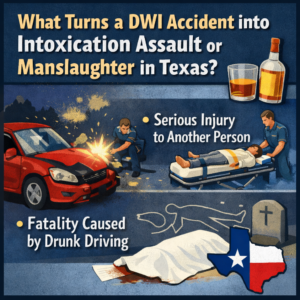
A DWI arrest is a Class B misdemeanor. The moment someone is seriously injured in the same accident, it becomes a third-degree felony. The moment someone dies, it becomes a second-degree felony. That escalation (from misdemeanor to felony, from probation-eligible to mandatory minimum) happens because of two words in the statute: serious bodily injury, and one more: death.
But the existence of a crash, injuries, and a positive BAC reading does not automatically satisfy the felony charges. There is a fourth statutory element in both intoxication assault and intoxication manslaughter that prosecutors often treat as automatic but that the defense must examine rigorously: causation. Whether the defendant’s intoxication (and not some other factor) caused the injury or death is the most important and most frequently contested question in these cases.
Intoxication Assault: Texas Penal Code §49.07
Intoxication assault is charged when a person causes serious bodily injury to another person by accident or mistake while operating a motor vehicle in a public place while intoxicated. It is a third-degree felony carrying 2 to 10 years in prison and a fine up to $10,000.
Serious bodily injury is a defined term under Texas Penal Code §1.07(a)(46). It means injury that creates a substantial risk of death, causes permanent disfigurement, or causes protracted loss or impairment of the function of any bodily member or organ. This is a materially higher threshold than “bodily injury,” which is the standard for simple assault and requires only physical pain or any impairment. A broken arm with full recovery is bodily injury. A spinal injury resulting in permanent impairment is serious bodily injury. The distinction determines whether the case is a misdemeanor or a felony, and the defense should independently evaluate whether the injuries actually meet the statutory definition.
Enhancement to second-degree felony. Intoxication assault is elevated to a second-degree felony (carrying 2 to 20 years) when the victim is a peace officer, firefighter, emergency medical services personnel, or a judge, and the person knew or should have known the victim’s status. This elevation more than doubles the maximum punishment range and significantly affects the plea landscape.
Civil liability runs parallel. Unlike most criminal offenses, intoxication assault cases almost always generate simultaneous civil litigation. Statements made in the criminal case can affect the civil case and vice versa. Defense strategy must account for both proceedings from the outset.
Intoxication Manslaughter: Texas Penal Code §49.08
Intoxication manslaughter is charged when a person causes the death of another by accident or mistake while operating a motor vehicle in a public place while intoxicated. It is a second-degree felony carrying 2 to 20 years in prison and a fine up to $10,000.
Mandatory minimum confinement. Unlike some second-degree felonies where deferred adjudication or straight probation is available, intoxication manslaughter carries a mandatory minimum period of confinement as a condition of community supervision. A defendant who receives probation must still serve a period of jail time as a condition.
Bentley’s Law. Texas Code of Criminal Procedure Article 42.0375 requires a court to order a defendant convicted of intoxication manslaughter to pay monthly restitution to the minor children of the victim. If the person who died was a parent of minor children, the defendant is ordered to pay child support-level restitution for each child until the child turns 18 or graduates from high school — whichever is later. This restitution obligation runs from the date of conviction and continues through any period of incarceration and supervision. A defendant released after serving their sentence still carries the monthly obligation for years or decades depending on the ages of the victim’s children. Bentley’s Law is a significant long-term consequence that must be part of any plea discussion.
Enhancement to first-degree felony. Intoxication manslaughter can be enhanced to a first-degree felony (5 to 99 years or life) when the victim was a peace officer, firefighter, or emergency medical services personnel acting in the course of their duties.
The Element That Determines Both Charges: Causation
Both §49.07 and §49.08 require the prosecution to prove that the defendant caused the serious bodily injury or death
Texas criminal law requires both actual causation (but-for causation, meaning the injury or death would not have occurred but for the defendant’s conduct) and proximate causation, meaning the result was a foreseeable consequence of the conduct. When other factors contributed independently to the collision or the injury, the causation element may not be fully satisfied.
Common causation disputes in intoxication assault and manslaughter cases include:
Another driver’s actions. If the other driver ran a red light, crossed the center line, or made a sudden lane change that a sober driver could not have avoided, the argument is that the intoxication was not the but-for cause of the collision.
Road design or maintenance failures. Defective signage, absent guardrails, inadequate lighting, or pavement conditions that contributed to the crash may support an independent causation argument.
Vehicle mechanical failure. A tire failure, brake failure, or steering defect that caused or contributed to the loss of control is an independent causation factor that the defense should investigate.
Victim’s own conduct. In intoxication assault cases, whether the victim’s actions contributed to the collision or to the severity of their injuries is relevant to causation and to the damages analysis in the parallel civil case.
The Forensic Evidence That Drives These Cases
Blood Alcohol Evidence and Retrograde Extrapolation
The prosecution must establish the defendant’s intoxication at the time of the crash, not at the time of the blood draw, which may occur hours later. Retrograde extrapolation (calculating backward from a measured BAC to estimate the BAC at an earlier time) uses the Widmark formula and requires assumptions about the defendant’s elimination rate, which varies across the population from approximately 0.010 to 0.025 g/dL per hour. Different assumed rates produce materially different estimated BAC values at the time of driving.
In cases where the measured BAC is near the 0.08% threshold and the blood draw was delayed, the uncertainty in the retrograde calculation may be wide enough to raise genuine doubt about whether the defendant was legally intoxicated at the time of the crash.
Accident Reconstruction
Law enforcement deploys a crash reconstruction specialist in virtually every intoxication assault and manslaughter case. The reconstructionist analyzes physical evidence (skid marks, yaw marks, gouge marks, vehicle crush patterns, debris fields) to develop opinions about speed, direction, point of impact, and the sequence of events. These opinions are not infallible: they depend on the accuracy of scene measurements, the integrity of physical evidence, and the methodology applied. The defense is entitled to retain its own independent reconstruction expert and to challenge the methodology and conclusions of the state’s expert.
When the reconstruction evidence supports alternative causation theories (when the physical evidence is consistent with both the prosecution’s theory and a defense theory that attributes the collision to a non-intoxication factor) that ambiguity belongs to the defendant under the reasonable doubt standard.
Event Data Recorder Evidence
Most modern vehicles contain an Event Data Recorder (EDR) that captures pre-crash data including speed, throttle position, brake application, steering input, and seatbelt status in the seconds before impact. EDR data can corroborate or contradict the reconstruction analysis and may provide the most objective available evidence of the defendant’s actions immediately before the crash. The defense should obtain and independently analyze EDR data in every serious DWI accident case where it is available.
Serious Bodily Injury: Independent Medical Evaluation
In intoxication assault cases, the prosecution’s characterization of the injury as “serious bodily injury” must be supported by evidence. The defense should obtain independent medical records and, where appropriate, consult with a medical expert to evaluate whether the injuries actually satisfy the statutory definition (substantial risk of death, permanent disfigurement, or protracted loss or impairment of a bodily member or organ). An injury that does not meet this threshold may support reduction to a misdemeanor DWI with accident rather than a felony intoxication assault.
Medical Examiner Evidence in Manslaughter Cases
In intoxication manslaughter cases, the cause and manner of death are established by autopsy findings. The medical examiner’s report may also reveal pre-existing conditions, contributing causes, or questions about the adequacy of medical treatment following the crash. Where the victim survived for a period after the collision and there are questions about the medical response, the intervening-cause doctrine (whether a superseding cause broke the causal chain between the defendant’s conduct and the death) may become relevant.
When the Charge May Be Reduced or Defeated
Intoxication assault and manslaughter cases present the strongest defense arguments when:
Causation is genuinely disputed. The collision involved multiple contributing factors that provide a reasonable basis for arguing that the defendant’s intoxication was not the but-for cause of the injury or death.
The BAC is near the threshold. Retrograde extrapolation uncertainty and partition ratio variability create genuine scientific doubt about whether the defendant was legally intoxicated at the time of the crash.
The injury definition is contestable. In intoxication assault cases, whether the victim’s injuries actually satisfy the statutory definition of serious bodily injury is a fact question that the defense must evaluate independently.
The blood evidence has problems. In vitro fermentation, improper storage, documentation gaps, or analyst qualification issues may affect the reliability of the BAC result.
The reconstruction is vulnerable. The state’s reconstruction opinion rests on assumptions that can be challenged, or the physical evidence supports an alternative theory more consistent with the defense’s causation argument.
Intoxication assault and intoxication manslaughter are the most serious DWI charges in Texas, and they are the charges where the forensic science most directly determines the outcome. Deandra Grant Law handles these cases across North and Central Texas. Managing Partner Deandra Grant holds a Master’s Degree in Pharmaceutical Science, a Graduate Certificate in Forensic Toxicology, and the ACS-CHAL Forensic Lawyer-Scientist designation. She is a trained SFST instructor who administers and grades both the ACS-CHAL Forensic Lawyer-Scientist and DUIDLA Board Certification exams. Call (214) 225-7117 for a confidential consultation.