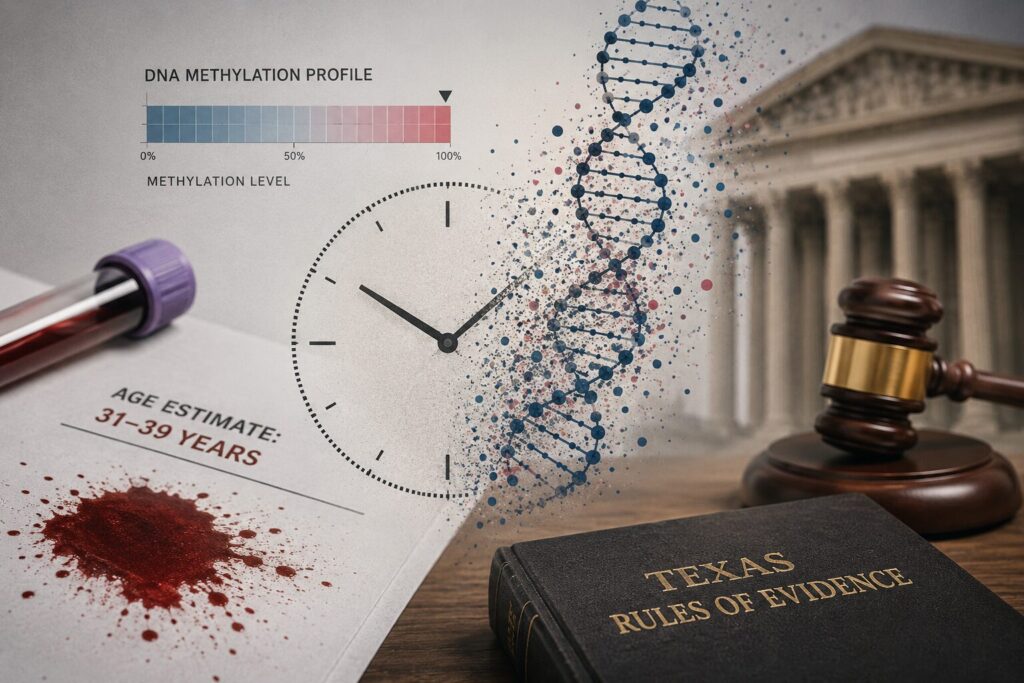
Not long ago, a bloodstain at a crime scene could tell investigators one useful thing: whose it was, but only if the DNA profile matched someone already in a database. A newer generation of testing claims to tell them something the database never could. DNA methylation “clocks” estimate a person’s age from a spot of blood, a bit of saliva, or even a fragment of bone, often to within a few years. The science is real, and it is improving quickly. The law that decides whether a jury ever hears it is not moving nearly as fast. For a Texas defense lawyer, the question is not whether this technology is impressive. It is whether it can get past Kelly.
What a Methylation “Clock” Actually Measures
Start with the biology. Epigenetics refers to chemical tags your body adds to DNA that change how genes behave without changing the genetic code itself. The most studied of these tags is methylation which is a methyl group attached at specific spots on the genome called CpG sites. As we age, certain CpG sites gain or lose methylation in a strikingly predictable pattern. Measure the methylation level at a handful of well-characterized age markers (the gene ELOVL2 is the workhorse, alongside others like C1orf132, KLF14, FHL2, and TRIM59) feed those readings into a statistical model, and the model returns an estimated age. For clean blood samples, the best models often land within about three to four years of a person’s true chronological age.
Here is the distinction that matters most in a courtroom: this is not identification. A methylation clock does not tell you who left a sample. It produces a biological estimate, a probable age range. Its natural home, at least for now, is the investigative stage by narrowing a pool of potential suspects when crime-scene DNA does not match anyone in a database. Forensic researchers have said as much directly, describing age estimation from methylation as a tool to guide investigation, “not in the courtroom.” But that line is starting to blur. A method built to point police in a direction is now being eyed as proof to put in front of a jury, and those are very different reliability bars. That shift is precisely what should put defense lawyers on alert.
The Texas Connection
This is not distant, someone-else’s-state science. Some of the foundational forensic data is being generated in Texas. A published study developing methylation-based age estimation from human bone drew part of its reference material from donated remains at the Forensic Anthropology Center at Texas State University (the FACTS facility in San Marcos) which is one of the country’s handful of “body farms.” In other words, some of the groundwork for putting an age on skeletal remains is being validated on Texas soil. When the technique reaches a Texas courtroom, our judges will be gatekeeping a method partly grown in their own backyard. That is also the kind of frontier DNA science I went to Boise State to study hands-on in Dr. Greg Hampikian’s “DNA for Lawyers” workshop because the defense bar cannot cross-examine what it does not understand.
Why “The DNA Says He Was About 45” Is So Dangerous
Jurors treat the word “DNA” as a synonym for certainty. But a methylation age estimate is a probabilistic prediction wrapped in an error window, and it is only as trustworthy as the model behind it. Its accuracy depends on several things that rarely hold true for real evidence. Tissue matters because a clock built on blood does not read the same way on bone, teeth, or a degraded stain. The training population matters because a model built mostly on one demographic can drift when applied to someone outside it. Sample quality matters because low-template, mixed, or degraded crime-scene DNA is a far cry from a clean research draw. And the person’s own biology matters: studies have shown that disease can push the clock off, with early-onset Alzheimer’s making the methylation “age” run ahead of the true one, and smoking, alcohol, and environmental exposure all leave their own marks. A figure that honestly means “somewhere in this range, assuming this person resembles our training set and has none of the conditions we did not screen for” can arrive in front of a jury wearing the white coat of “DNA.” That gap between what the number says and what a jury hears is the whole ballgame.
The Gatekeeper Is Kelly, Not Daubert
In Texas criminal court, novel scientific evidence does not go straight to the jury. It has to clear a reliability gate first, and in Texas that gate is the Kelly standard — not the federal Daubert test. (In federal court, including the federal DWI cases we have written about elsewhere, the analog is Daubert and Federal Rule of Evidence 702; in Texas state court, it is Kelly.) Under Kelly v. State, 824 S.W.2d 568 (Tex. Crim. App. 1992), and Texas Rule of Evidence 702, the party offering the evidence (here, the State) must show by clear and convincing evidence that it is reliable. Reliability breaks into three questions:
- The underlying scientific theory is valid. For methylation clocks, this is the least contested prong. That DNA methylation changes with age is well established and heavily published.
- The technique applying the theory is valid. This is the battleground. Is a particular age-prediction assay actually validated for forensic samples (ex. degraded, low-template, mixed, non-blood) or only for pristine research blood? What is its documented error rate? Was the model trained on a population that resembles the defendant?
- The technique was properly applied on this occasion. Even a valid method can be botched. Chain of custody, the condition of the sample, whether the analyst used a validated assay and an appropriate reference model, and the analyst’s own qualifications all come into play.
To weigh those questions, Texas courts look to the Kelly reliability factors: how widely the technique is accepted in the relevant scientific community, the existence of peer-reviewed literature, the technique’s potential rate of error, whether independent experts can test and evaluate it, and how much the result depends on subjective interpretation. Run a methylation age clock through that grid and the pressure points are obvious. The error rate and the representativeness of the training data are exactly where a Kelly challenge lives. The point for the defense is simple but easy to forget: a methylation age estimate does not get in just because it is “DNA.” The State has to walk it through all three prongs at a gatekeeping hearing before a jury hears a word.
A Privacy Problem Ordinary DNA Profiles Do Not Have
There is a second reason to slow down. A standard forensic DNA profile (the set of STR markers used to identify people) is often described as revealing little beyond identity. Methylation is different in kind. The very same testing that estimates age can also expose lifestyle and health information: smoking and drinking history, and patterns associated with disease. Collecting, storing, and mining that data raises Fourth Amendment and privacy questions that an identification-only profile never did. This is where innovation is plainly outrunning settled law. Texas courts and the Legislature have not squarely addressed what the State may retain and analyze from a methylation sample once it has one, and that silence is itself a live issue for the defense to raise.
What This Means for the Defense
The fight over novel forensics is won or lost before the jury is ever seated. If the State intends to tell jurors that “the DNA indicates the person who left this blood was in their mid-forties,” the defense’s move is a pretrial motion and a Kelly gatekeeping hearing, where the burden sits on the State to prove reliability by clear and convincing evidence. In that hearing, insist on the specifics:
- The validation studies for the specific assay, run on forensic-type samples and not just clean research blood.
- The documented error rate, stated as a real range, not a single confident number.
- The makeup of the training population, and whether it resembles the defendant.
- Proof the sample was not too degraded, mixed, or limited for a reliable read.
- The analyst’s qualifications and whether a validated, appropriate reference model was used.
Many of these methods were designed to generate investigative leads, not courtroom conclusions. That gap between “good enough to point the police” and “reliable enough to convince a jury beyond a reasonable doubt” is the heart of the challenge, and it is a gap the State should be made to close on the record.
The Bottom Line
DNA methylation clocks are a genuine advance, and they will keep getting better. But “better” is not the same as “admissible.” In Texas, novel science gets into evidence through the gate, not around it, and the gate is Kelly. The defense’s job is to make the State prove the method is reliable before a jury ever hears the number because once a jury hears “DNA,” a shaky estimate is very hard to unhear.
Facing Novel Forensic Evidence in a Texas Case?New forensic methods reach the courtroom faster than the law that governs them. Whether it is a DNA age estimate, a probabilistic-genotyping result, or a breath or blood test, the reliability fight belongs at the gate before a jury hears a number. Deandra Grant Law brings genuine forensic training to that fight, challenging the science on its own terms. Call (214) 225-7117 • texasdwisite.com |
Sources & Further Reading
- Castagnola, Medina-Paz & Zapico, “Uncovering Forensic Evidence: A Path to Age Estimation through DNA Methylation,” Int’l J. of Molecular Sciences (2024). nlm.nih.gov
- “Forensic DNA methylation profiling from evidence material for investigative leads” (review) — notes methylation age and lifestyle inference is meant to guide investigation, not serve as courtroom proof. nlm.nih.gov
- “DNA methylation-based forensic age estimation in human bone” — reference dataset drawn in part from donated remains at the Forensic Anthropology Center at Texas State (FACTS), San Marcos. org
- Study finding disease can skew methylation age estimates — the age markers ELOVL2 and C1orf132 predicted age accurately in several groups, but accuracy dropped in early-onset Alzheimer’s. nlm.nih.gov
- Kelly v. State, 824 S.W.2d 568 (Tex. Crim. App. 1992); R. Evid. 702 — the Texas reliability standard for novel scientific evidence.
- Related, from our blog: how the Kelly standard differs from the federal Daubert/Rule 702 test in federal DWI cases. com