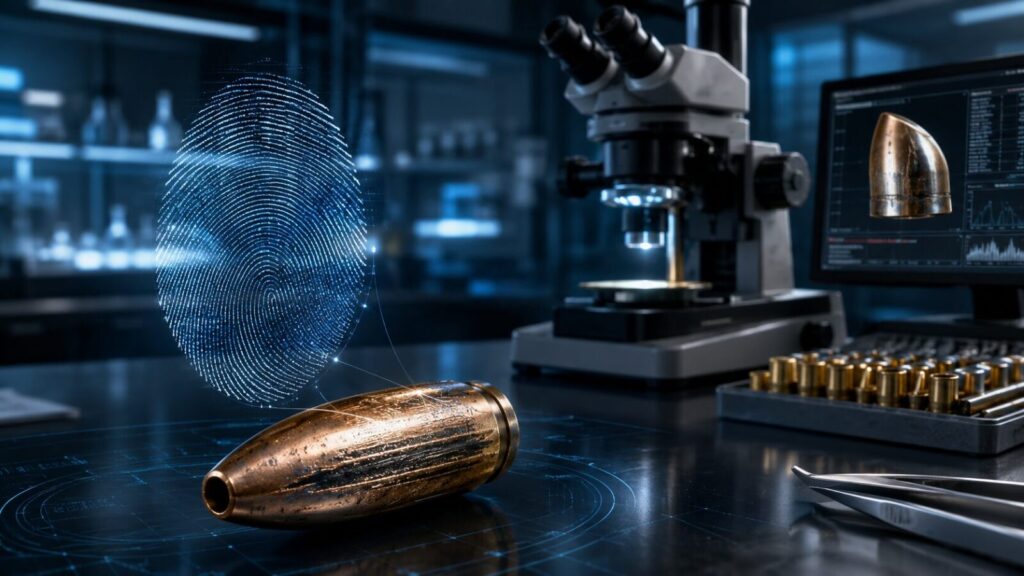
In April 2025, two Irish researchers (Dr. Eithne Dempsey and her former PhD student Dr. Colm McKeever, in the Department of Chemistry at Maynooth University in Ireland) published research describing an electrochemical method for recovering fingerprints from fired brass cartridge casings. The work drew broad international press attention in the fall of 2025, when the university issued a press release and major scientific outlets picked up the story. Dr. Dempsey called the recovery of prints from fired ammunition casings “the Holy Grail in forensic investigation,” and described the new method as the first that has shown it can be done on a usable scale, including on casings up to 16 months old.
If the technique is validated, adopted by accredited forensic laboratories, and proven reliable in casework, it has the potential to change what evidence is recoverable from shooting scenes in the United States. A casing that the police would previously have collected and bagged for ballistic comparison alone could, in the future, also be examined for fingerprint evidence. The investigative question would shift from “which gun fired this round” to also “who loaded this round into the gun.”
That is the news. This post is about what comes after the news. New forensic techniques do not move from a laboratory bench in Ireland to a Texas courtroom in a straight line. They move through a long process of independent replication, peer review, validation studies, accreditation, casework experience, and, ultimately, an admissibility test in front of a judge. Some emerging techniques clear those hurdles and become reliable tools for investigators and for the defense. Some do not. The criminal-defense lawyer’s job, when a new technique starts showing up in case files, is to know how to tell the difference.
What the Maynooth Researchers Actually Did
In plain English, the Maynooth method works like this. A brass cartridge casing recovered from a crime scene is placed in a small electrochemical cell containing a solution of chemicals. A low voltage is applied across the cell. The chemicals in the solution are attracted to the surface of the casing and deposit in the tiny gaps between fingerprint ridges, using the burnt residue left on the casing after firing as a kind of stencil. The result is a high-contrast image of the latent fingerprint that had previously been invisible. The image appears within seconds.
In Dr. McKeever’s words, “With this method, we have turned the ammunition casing into an electrode, allowing us to drive chemical reactions at the surface of the casing.” The method uses non-toxic polymer materials and minimal energy. The team’s peer-reviewed paper, “Electrodeposition of redox materials with potential for enhanced visualisation of latent finger-marks on brass substrates and ammunition casings,” was published on April 19, 2025, in Forensic Chemistry, Vol. 44 (2025) (DOI: 10.1016/j.forc.2025.100663). The technique has been tested on samples that were aged up to 16 months after firing, with reported success.
The published work names a specific chemistry. The optimal co-monomer mixture the team identified was 3,4-ethylenedioxythiophene (EDOT) combined with thionine acetate (abbreviated EDOT-Th) deposited under a low constant potential of 0.1 V (versus an Ag|AgCl reference electrode) for 120 seconds. The paper characterizes that protocol as a “low energy, rapid” approach, which is accurate by the operational standards of similar electrochemical visualization research published in the same line of work.
That broader line of work has been active for several years. An earlier paper by Costa et al., published in 2020 in the journal Nano Select, reported electrochemical visualization of finger-marks on brass cartridge cases using PEDOT (a polymerized form of EDOT) deposited via a chronocoulometric method, with successful results on sebaceous marks aged up to 30 days and eccrine marks aged up to 15 days. The Maynooth contribution extends that prior work in three directions: a more effective chemistry (the EDOT-Th co-monomer mixture), substantially longer aging tolerance (up to 16 months for sebaceous marks), and demonstrated survival of the visualization technique through brief high-temperature exposure simulating the heat of firing. The published advance is therefore best understood as an incremental refinement of an existing research line, not as an out-of-nowhere capability.
More important, for purposes of where this technique sits on the road to courtroom use, is the way the authors themselves describe what they have done. The paper expressly designates the work as “a Phase 1 pilot study of a new approach” under the validation framework of the International Fingerprint Research Group (IFRG). It is proof-of-principle work at the earliest stage of that framework, not validation work and not operational casework. The aging study used eight donors. The thermal-degradation study used four samples per condition. The authors explicitly identify Phase 2 (“optimization and comparison” against established operational techniques) and Phase 3 (operational casework deployment) as next steps not undertaken in the present paper. That self-characterization, from the original research team, is the cleanest articulation of where this technique sits in the long process between published proof-of-concept and admissibility before a jury.
Four things are worth noting up front about the scope of the result.
- It is brass-specific. The technique was developed and tested on brass casings. Whether it works on steel, aluminum, nickel-plated, or coated casings (all of which are in routine use in modern ammunition) is not established by the published work.
- It is laboratory work, not yet field casework. The samples were prepared and tested under controlled conditions. Real-world crime-scene casings are exposed to weather, contamination, multiple handlers, prior contact with other surfaces, and storage conditions that are not present in a chemistry lab. The transition from a successful proof of concept in Ireland to validated casework in U.S. accredited forensic laboratories is a substantial set of steps.
- Sebaceous prints survived heat; eccrine prints did not. In the paper’s heat-degradation testing, only sebaceous (oil-rich) finger-marks could be visualized after high-temperature exposure. Eccrine (water-rich) sweat marks were destroyed by the heat. Real-world finger-marks on a fired casing are typically a mix of both, and many depositions are more eccrine than sebaceous. The implication is that some real-world casings will have recoverable prints by this method, and some will not, and the difference will not always be predictable from inspection of the casing alone.
- On curved surfaces, electrode alignment mattered. The paper reports that on the ammunition-casing samples, regions of successful visualization “were closely linked to parallel alignment with the Pt gauze counter electrode,” with partial visualizations otherwise. In casework terms, the practical limit may be that only the portion of a print aligned correctly with the analytical setup is visualized cleanly. A defense lawyer evaluating an expert’s results from this technique would want to know whether the full print or only a portion was visualized, and on what basis any unvisualized portion is being characterized.
This is not, in other words, a technique that is going to appear in a Dallas County trial next month. It is a technique that is at the front end of the process that determines whether it ever appears in an American trial at all.
Why This Matters and Why It Cuts Both Ways
Forensic technology that is genuinely new draws a particular kind of attention in criminal defense circles, because new techniques are not, on their face, prosecution tools or defense tools. They are evidence tools. Their usefulness in any given case depends on whose theory of the case the evidence ends up supporting.
If the Maynooth method becomes a validated, accepted forensic technique used in American criminal casework, it could matter in a defense case in any of the following ways:
- A casing recovered at a shooting scene shows a defendant’s fingerprint. The State has new evidence connecting the defendant to the ammunition, which under current practice would not exist.
- Exculpatory by absence. A casing recovered at a shooting scene shows fingerprints, but not the defendant’s prints. The State’s theory that the defendant loaded the firearm has to contend with affirmative physical evidence that someone else did.
- Exculpatory by alternate suspect. A casing recovered at a shooting scene shows the fingerprint of a person other than the defendant. The defense has a concrete alternate-suspect lead that does not depend on speculation.
- Limiting the chain. A defendant who handled ammunition in a lawful context (loading a magazine for a hunting trip, for example, or selling cartridges through a lawful retail transaction) may have prints on a casing that ends up at a scene through a chain of custody that has nothing to do with them. The defense’s ability to explain that chain, and to insist the State prove who actually fired the weapon as distinct from who once touched the ammunition, becomes a material part of the case.
For decades, the casing at a shooting scene has been the State’s evidence by default (ballistic comparison to the firearm, recovered shell-ejection pattern, presence or absence of unfired rounds). Adding fingerprint evidence to that recoverable set is a structural change in what the casing can be used to prove. Defense lawyers who are paying attention to the rollout of this kind of technique will be in a position to use it offensively, not just defensively, when their cases warrant it.
The Admissibility Test: Why a Jury Doesn’t Automatically Hear About “New” Science
There is a procedural framework, applicable in every Texas criminal trial, that controls whether a new forensic technique can be the basis of expert testimony in front of a jury. It is not a high bar in absolute terms. It is also not nothing. The framework is best known by its leading Texas case, Kelly v. State.
In Kelly v. State, 824 S.W.2d 568 (Tex. Crim. App. 1992), the Texas Court of Criminal Appeals held that, under Rule 702 of the Texas Rules of Evidence, the proponent of novel scientific testimony has to establish three things by clear and convincing evidence: that the underlying scientific theory is valid; that the technique applying the theory is valid; and that the technique was properly applied on the occasion in question. The Court identified seven non-exclusive factors a trial judge should consider in making the validity determination:
- The extent to which the underlying scientific theory and technique are accepted as valid by the relevant scientific community
- The qualifications of the expert testifying
- The existence of literature supporting or rejecting the underlying theory and technique
- The potential rate of error of the technique
- The availability of other experts to test and evaluate the technique
- The clarity with which the underlying theory and technique can be explained to the court
- The experience and skill of the person who applied the technique on the occasion in question
The Kelly factors overlap meaningfully with the federal Daubert factors articulated in Daubert v. Merrell Dow Pharmaceuticals, 509 U.S. 579 (1993): whether the theory has been tested, whether it has been subjected to peer review and publication, the known or potential error rate, and the degree of acceptance in the relevant scientific community. Texas state courts apply Kelly. Federal courts in Texas apply Daubert. The lawyer’s job is the same in either forum: hold the State’s expert to the framework the rule actually requires.
For a technique like the Maynooth electrochemical method, the early-adoption questions a defense lawyer should be asking are roughly the same as the Kelly factors themselves.
- Has the technique been independently replicated by laboratories other than the original research group?
- Has it been subjected to blind validation studies on samples representative of casework conditions, not just laboratory conditions?
- Is it published in peer-reviewed forensic science journals, and what has the response been?
- Has the relevant scientific community (in this instance, the analytical chemistry and forensic science communities) expressed an opinion on its readiness for casework?
- What is the documented error rate, including the false-positive and false-negative rates?
- Are accredited laboratories using it under properly validated standard operating procedures?
- Is the examiner who applied it in the case at hand competent in the technique under their laboratory’s accreditation?
For the Maynooth electrochemical method specifically, the published paper itself offers concrete answers to several of those questions. It has been published in a peer-reviewed forensic-chemistry journal. The authors themselves designate the work as a Phase 1 pilot study under IFRG guidelines, with Phase 2 (optimization and comparison against operational techniques) and Phase 3 (operational casework validation) explicitly identified as next steps not undertaken in the published work. Sample sizes are pilot-scale and disclosed in the paper. Identified failure modes (eccrine prints destroyed by heat, female finger-marks more difficult to visualize than male, partial-only visualizations on curved surfaces dependent on counter-electrode alignment) are characterized by the authors in the paper itself. Independent replication outside the original research group is, as of the date of this post, not established in the published literature. The technique has not been deployed in accredited forensic laboratories operating under validated standard operating procedures. None of that is hostile to the work. It is the work, accurately described from the published record.
None of those questions is hostile to forensic progress. They are the questions the rule of evidence asks. A technique that holds up under those questions is one that should be in the courtroom. A technique that does not is one that the rule of evidence is designed to keep out.
The History Is a Warning
The reason the admissibility framework exists is that the history of forensic science includes more than a few “Holy Grail” techniques that turned out, on rigorous later examination, to have been less reliable than the proponents believed. Some of them produced wrongful convictions. The defense bar that pays attention to that history is the defense bar that asks the hard questions about new techniques at the front end, before, not after, those techniques are load-bearing in real cases.
- Bite mark comparison. Treated for decades as a reliable forensic identification discipline. Subjected to scientific scrutiny in the 2009 National Academy of Sciences report and the 2016 President’s Council of Advisors on Science and Technology (PCAST) report, both of which concluded that the discipline had not been validated to support individual identification. Multiple bite-mark-based convictions, including in Texas, have been overturned.
- Microscopic hair comparison. Long used in federal and state prosecutions. The FBI’s own internal review, made public in 2015, acknowledged that examiners in its laboratory had overstated the value of microscopic hair comparison in numerous cases over decades. Exonerations followed. (But see new developments in that in our recent blog post Solving a Cold Case with Analysis of 45 Year-Old Hair.)
- Comparative bullet lead analysis (CBLA). Used by the FBI for decades to link bullet lead at crime scenes to bullets in a suspect’s possession. The FBI abandoned the technique in 2005 after the National Academy of Sciences concluded that the underlying premises were unsound.
- Firearm and toolmark identification. The traditional claim that a particular bullet or casing can be “matched” to a specific firearm to the exclusion of all others has been subjected to substantial scrutiny in the 2016 PCAST report and elsewhere. Some courts now limit the conclusions toolmark examiners are permitted to offer at trial. The underlying discipline remains in use, but the way it is presented to juries has been narrowed in many courts as a result of validation concerns.
- Arson investigation indicators. A subject covered in detail in this firm’s prior post on Article 11.073 and the Cameron Todd Willingham case. A whole generation of arson investigations turned on indicators (alligator char, pour patterns, multiple points of origin) that subsequent fire science research established are not reliable diagnostic signs of arson.
Each of those disciplines, at the moment it entered American courtrooms, was treated by its proponents as a Holy Grail, or close to it. Each was used in real cases against real defendants. Each, when subjected to the kind of validation that the Kelly framework asks for, was found to be substantially weaker than its proponents had represented. The defense bar that did not push back on those techniques at the front end is the defense bar that, in many cases, helped produce wrongful convictions that took decades to undo.
There is no current reason to think that the Maynooth electrochemical method will follow that pattern. The published work is careful, the underlying chemistry is well-understood, and the researchers themselves have explicitly acknowledged that the technique “faces rigorous testing and validation before it could potentially be adopted by law enforcement agencies worldwide.” That kind of statement from the original research team is a good sign, not a bad one. It is the position the science is supposed to start in. The job of the defense bar, and of the rule of evidence, is to make sure the technique is held to that standard when it eventually arrives at the courtroom door.
The Texas Backstop: Article 11.073
Texas has one tool that is worth mentioning in this context, because no other state has done quite the same thing in quite the same way.
Article 11.073 of the Texas Code of Criminal Procedure (the so-called “junk science writ,” enacted in 2013 and amended in 2015) authorizes a Texas court to grant habeas relief based on a change in scientific evidence. If a Texas criminal conviction is obtained on the strength of a forensic technique that is later shown to be unreliable, or contradicted by subsequent scientific developments, Article 11.073 provides the procedural mechanism to reopen the conviction. Several states have followed Texas’s lead in some form, but Texas remains the leading jurisdiction in the country. The firm has covered the statute in greater detail in a separate post on arson convictions and the Willingham case.
The relevance to emerging forensic techniques is structural. If a new technique is admitted in Texas criminal courtrooms, used in casework, and then later shown not to support the conclusions experts have been drawing from it, Article 11.073 is the procedural door for the defendants convicted in the meantime. That backstop does not relieve the defense bar of the obligation to push back at the front end, before a problematic technique becomes the basis of a conviction. But it does mean that, in Texas, the consequences of an admissibility ruling that turns out to be wrong are not necessarily permanent.
What This Means in Practice
Three practical observations for Texas defendants, families, and lawyers paying attention to the rollout of new forensic techniques generally, and to the Maynooth method specifically.
- New techniques deserve scrutiny in the courtroom, not deference. A new forensic method that has not been independently replicated, validated through blind studies on casework-representative samples, peer-reviewed, and operationally deployed in accredited laboratories with documented error rates is not, at that stage, ready for the witness stand. The Kelly framework exists to test that readiness. A defense lawyer in a case involving a novel forensic claim should be expecting to litigate admissibility as a threshold issue, not accepting it as a given.
- The defense uses of a new technique can be as important as the prosecution uses. If casing-based fingerprint recovery becomes a routine forensic capability, the absence of a defendant’s prints on casings linked to a shooting becomes potentially material evidence. The presence of someone else’s prints becomes potentially material evidence. A defense lawyer who knows the technique exists, and knows the State has access to it, is in a position to ask the right questions about why it was or was not used in a given case.
- The Texas Forensic Science Commission is the right place to watch. Emerging forensic techniques in Texas are evaluated, in part, through the Texas Forensic Science Commission’s accreditation framework. A new method that ends up routinely used in Texas casework will, at some point, intersect with the Commission’s authority. Following the Commission’s published reports and case-specific inquiries is one way for both lawyers and informed clients to track the state of the science as it actually develops in this jurisdiction.
A Final Thought
Forensic science is a real discipline. It produces real evidence. Some of that evidence has helped solve crimes that would otherwise have gone unsolved, and some of it has helped exonerate people who would otherwise have remained convicted. Neither of those things is in dispute.
What is in dispute, in any given case involving an emerging technique, is whether the science has reached the point at which the conclusions a witness is asked to draw from it are supported by what the science actually shows. That dispute is what the rule of evidence is for. It is also what makes the difference between an emerging forensic technology that earns its place in the courtroom and one that does not. The Maynooth fingerprint method may turn out to be the former. It may turn out to be the latter. The authors’ own published characterization is that the present work is Phase 1 of the IFRG validation framework, with Phase 2 (optimization and comparison) and Phase 3 (operational casework deployment) explicitly named as next steps not undertaken in this paper. That framework, set by the researchers themselves, is the right one for the defense bar to use too. The next few years, in Irish laboratories, in U.S. validation studies, in peer-reviewed publications, and eventually in Texas courtrooms, will tell.
Until then, the Holy Grail framing is the researchers’ own. The validation work is everyone else’s.
Deandra Grant holds a Master of Science in Pharmaceutical Science, a Graduate Certificate in Forensic Toxicology, and the ACS-CHAL Forensic Lawyer-Scientist designation. The firm handles criminal cases throughout North and Central Texas in which forensic evidence is central, including matters in which the admissibility of expert scientific testimony is at issue. To discuss a pending case, call (214) 225-7117.