By Deandra Grant, J.D., M.S., ACS-CHAL Forensic Lawyer-Scientist
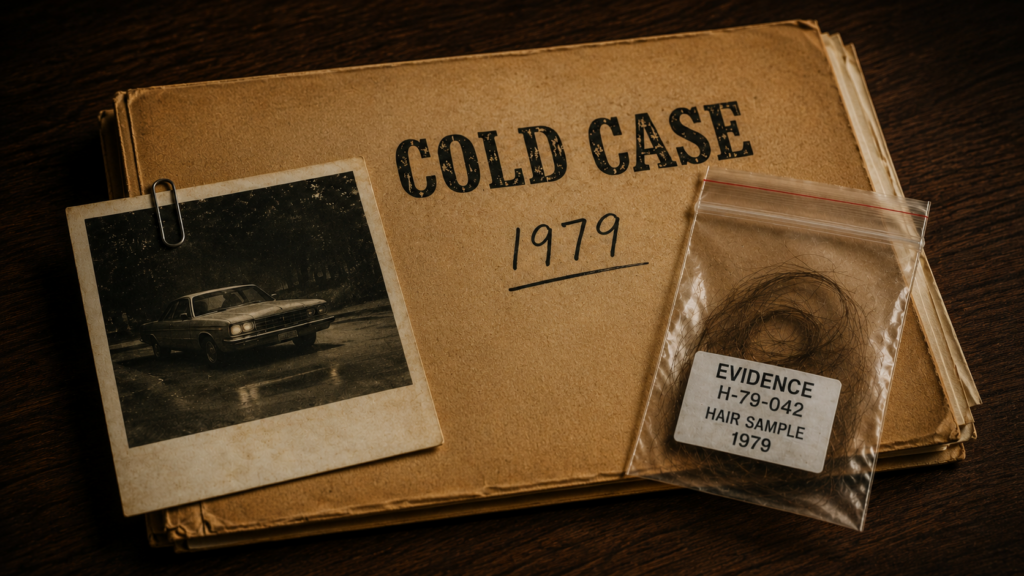
In January 2026, Columbus, Ohio detectives announced a name in one of the city’s oldest unsolved homicides. On November 12, 1980, 23-year-old Lynn Vest and her 2½-year-old nephew, Jeremy Pickens, left home to run errands and never returned. They were found the next morning in the trunk of Vest’s new Mustang. Lynn had been strangled and Jeremy suffocated. Her wedding ring, a credit card, and some cash were gone. For 45 years, the crime-scene DNA, including DNA that was collected as part of sexual assault examination, matched no one in any law-enforcement database.
What finally produced a name, according to investigators, was “two rootless hairs” and a genealogist who traced them through a family tree. Police identified the suspect as Charles William Elliott, a career criminal who died in an Ohio prison in 2000 on unrelated charges. He was never arrested for these killings and will never stand trial; the identification came a quarter-century after his death. The tool that got investigators there was forensic investigative genetic genealogy (FIGG). For a defense-minded forensic practice this case is a near-perfect teaching example of both the power and the unsettled questions of the method.
Two things make it worth a closer look. First, the science: pulling a usable nuclear DNA profile from a rootless hair shaft was, until very recently, considered close to impossible. Second, the method: FIGG is rewriting how cold cases are solved while raising Fourth Amendment and genetic-privacy questions that courts are only beginning to answer.
How Forensic Genetic Genealogy Actually Works
It helps to separate FIGG from the DNA testing most people picture. Traditional forensic DNA typing reads about 20 short tandem repeat (STR) markers and compares the result against CODIS which is the law-enforcement database. That works only if the contributor (or a close relative who has been arrested or convicted) is already in the system. In the Vest–Pickens case, no one was. That is the dead end FIGG is built to get around.
FIGG takes a different kind of profile. Instead of 20 STR markers, the lab develops a dense single nucleotide polymorphism (SNP) profile (often hundreds of thousands of markers) using a SNP microarray or whole-genome sequencing, the same general technology behind consumer ancestry kits. That profile is uploaded to genealogy databases that permit law-enforcement matching, principally GEDmatch and FamilyTreeDNA, where users have affirmatively opted in. The database returns not a single suspect but a list of relatives, ranked by how much DNA they share. Genealogists then build family trees outward from those matches, combine the genetic data with obituaries, marriage records, and census data, and triangulate toward a single candidate.
| The point defense lawyers cannot afford to miss
FIGG generates an investigative lead and nothing more. It does not, by itself, identify anyone to a scientific certainty, and it is not what a jury ultimately hears. Once genealogy points to a candidate, investigators obtain a fresh reference sample from that person (often covertly, from a discarded cup or cigarette, or by warrant) and a crime lab runs a direct comparison against the crime-scene profile. That confirmatory test (not the family tree) is the evidence offered at trial. Knowing where the genealogy ends and the testable science begins is the whole game. |
The Hair Twist: Junk Science, Quietly Redeemed
The “rootless hairs” detail is easy to skim past, but it is the scientific heart of the story. A hair shaft pulled with its follicle carries nuclear DNA. A shed hair (a rootless shaft) historically yielded only mitochondrial DNA, which is inherited down the maternal line and shared by everyone in that lineage. Mitochondrial DNA can exclude, but it cannot individualize, and it is useless for the kind of SNP profile FIGG requires.
That has begun to change. Library-preparation techniques borrowed from ancient-DNA research (the same field that sequences thousand-year-old skeletal remains) can now recover enough degraded nuclear DNA from a rootless shaft to build a SNP profile dense enough for genealogical searching. A category of evidence that sat inert in evidence lockers for decades is suddenly back in play.
There is an irony here that a defense audience will appreciate. Microscopic hair comparison (an examiner peering through a scope and declaring two hairs a “match”) was one of forensic science’s most notorious failures. In 2015, the FBI and the Department of Justice acknowledged, in a review conducted with the Innocence Project and the National Association of Criminal Defense Lawyers, that bureau examiners had given scientifically flawed or overstated testimony in the overwhelming majority of the pre-2000 trials reviewed. Hair “matching” helped send innocent people to prison and, in some cases, to death row. Now hair is being rehabilitated, not as a visual “matching” discipline, but as a genuine source of DNA. The lesson is not that hair evidence is now beyond question. It is that every forensic technique deserves scrutiny on its own validation record, and a method’s newness is a reason for more questions, not fewer.
Where the Privacy Questions Bite
FIGG’s constitutional friction comes from a simple fact: the person identified usually never put their DNA in any database. Charles Elliott did not upload his genome. A relative did — someone curious about their ancestry who clicked “I agree” and, in doing so, made every cousin, living or dead, genetically visible to anyone permitted to search. The question courts are wrestling with is whether the Fourth Amendment has anything to say about that.
The Supreme Court’s decision in Carpenter v. United States (2018) signaled that the old “third-party doctrine” (the idea that information voluntarily shared with a company loses Fourth Amendment protection) does not translate cleanly to the digital age. Genetic data is about as sensitive as third-party data gets, and it implicates people who made no choice to share anything. But Carpenter was expressly narrow, and lower courts have so far been reluctant to extend it to consumer DNA databases.
The GEDmatch saga shows how unsettled the ground is. After the database was used to identify the Golden State Killer in 2018, GEDmatch shifted to an opt-in model for law-enforcement searches in 2019. Within months, a Florida detective obtained a warrant to search the entire database including users who had opted out. The episode put every genealogy user on notice that a privacy setting may not survive a signed warrant.
The regulatory response has been patchy. The Department of Justice’s Interim Policy on FIGG, effective November 1, 2019, limits federal use to violent crimes and the identification of human remains, requires that CODIS be tried first, mandates the confirmatory direct comparison, and restricts surreptitious sampling. However, this is internal guidance, not binding law, and it does not reach state and local agencies. A handful of states have legislated: Maryland’s 2021 statute, the most comprehensive in the country, requires judicial authorization and confines FIGG to serious crimes; Montana requires a warrant for government use of a consumer database absent the user’s waiver. Most states (Texas among them) have no FIGG-specific statute at all, leaving the practice governed by general Fourth Amendment principles and lab policy.
What It Means for the Texas Defense Bar
Here is the hard truth for the defense: a frontal Fourth Amendment attack on FIGG usually fails, and it fails on standing. Courts have generally held that a defendant has no reasonable expectation of privacy in DNA he abandoned at a crime scene (the logic of California v. Greenwood (1988), the curbside-trash case) and no standing to complain about a relative’s voluntary upload to a database. You generally cannot suppress a search of someone else’s genetic data. So, the more productive fight is rarely suppression; it is reliability and discovery.
Prosecutors like to frame FIGG as “just an investigative tool,” and that framing does real work: it is used to keep the genealogy workup out of discovery and away from reliability scrutiny under Kelly v. State, 824 S.W.2d 568 (Tex. Crim. App. 1992), the Texas standard governing scientific evidence under Rule 702. Push back on the framing. The Michael Morton Act, Texas Code of Criminal Procedure Article 39.14, gives the defense broad discovery rights, and the complete file is fair game including the crime-scene SNP profile, the list of database matches, the genealogist’s tree and working notes, the bioinformatics, and, critically, the bench notes and validation records for the confirmatory lab comparison. That confirmatory test is the link Kelly reaches (valid underlying theory, valid technique, and proper application on this occasion) so scrutinize the lab, the analyst, and the sample, not just the genealogy.
A few Texas-specific wrinkles are worth knowing. The Texas Forensic Science Commission’s accreditation regime (Code of Criminal Procedure Articles 38.01 and 38.35) governs “forensic analysis”. Genealogical research itself sits in a gap but the underlying DNA testing does not. You need to know exactly where the accreditation line falls in a given case. And in any decades-old matter, the ordinary defenses gain force: chain of custody on samples stored for 45 years, contamination and degradation risk in low-template DNA, and whether the covert reference sample was lawfully obtained. The science may be new, but the cross-examination fundamentals are not.
| A short checklist for defense counsel facing FIGG-derived evidence
• Demand the complete FIGG workup in discovery (the SNP profile, match lists, family-tree notes, and bioinformatics) not just the final lab report. • Identify the confirmatory direct-comparison test and challenge it under Kelly; that is where the testable science lives. • Probe chain of custody, contamination, and low-template risk on aged or degraded samples. • Ask exactly how the reference sample was obtained (abandoned, by warrant, or by consent) and whether the collection was lawful. • Watch for overstatement: FIGG produces a lead, not a “match.” Hold the State to that distinction in front of the jury. |
Forensic genetic genealogy is going to keep solving cases that deserve solving: the Vest–Pickens family waited 45 years for a name. But “it solved a terrible crime” and “it was done within constitutional limits and proven by reliable science” are two different statements, and it is the defense bar’s job to insist on both. The technology is impressive. That is exactly why it earns scrutiny, not deference.
At Deandra Grant Law, our defense is built on the science. We read the bench notes, we know where forensic methods are validated and where they are not, and we hold the State to its burden, especially when the evidence arrives wrapped in the language of cutting-edge technology. If you or someone you love is facing charges involving DNA or other forensic evidence, call us at (214) 225-7117 or visit deandragrantlaw.com.
Deandra Grant, J.D., M.S., ACS-CHAL Forensic Lawyer-Scientist, is the Managing Partner of Deandra Grant Law. She holds a Master’s in Pharmaceutical Science and a graduate certificate in Forensic Toxicology, completed the “DNA for Lawyers” workshop with Dr. Greg Hampikian at Boise State University, and is the author of 17 books, including the Texas DWI Manual (13th ed.).