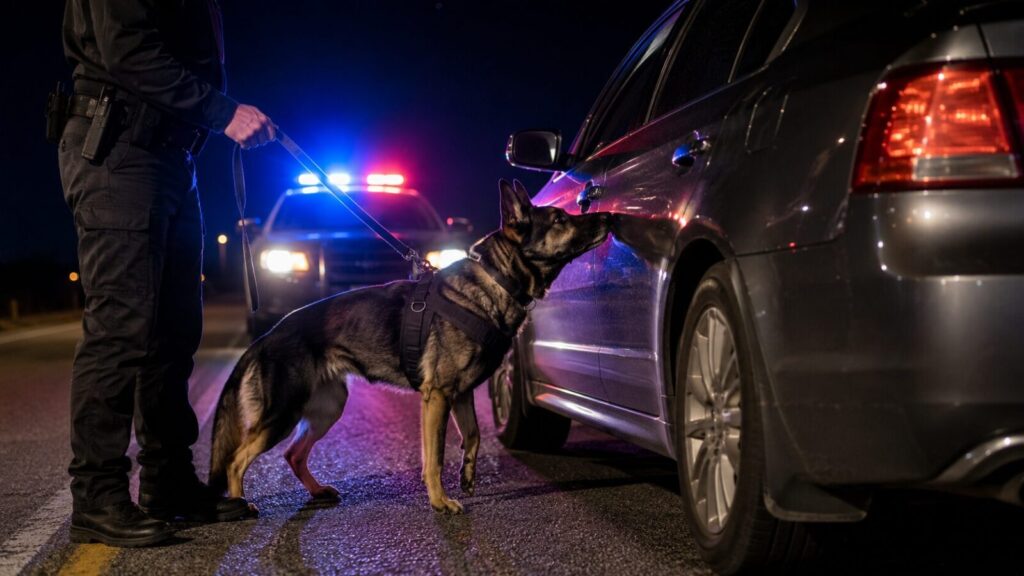
A patrol car pulls in behind you on I-35. The stop is for a lane change. While one trooper writes the warning, a second walks a dog around your car, and the dog sits. Within seconds the officers are pulling your seats apart, because in the eyes of the law that quiet sit just became probable cause, the legal key that opens your vehicle without a warrant. No one saw contraband. No one smelled it. A dog changed its posture, a handler read that posture as an alert, and that was enough.
That is the strange power of the drug-detection dog. In American courtrooms a K-9 alert has long been treated as something close to scientific proof, a living instrument that reveals hidden contraband the way a thermometer reveals a fever. But a dog is not a thermometer. It is a trained animal that wants, above all, to please the person holding the leash, and its alert is a behavior a human being has to interpret. Pull on that thread and much of what makes a dog sniff feel like proof begins to unravel. Here is how these dogs actually work, why an alert is an investigative lead rather than a verdict, what the Fourth Amendment does and does not allow, and why the legalization of hemp has thrown the whole question into fresh doubt, including in Texas.
How a Drug Dog Actually Works
A detection dog is trained to recognize a set of target odors, traditionally the volatile chemicals given off by marijuana, cocaine, methamphetamine, heroin, and their derivatives, and to perform a specific trained behavior when it detects one. That behavior is the final response, and it comes in two flavors: an aggressive alert, meaning scratching, pawing, or biting at the source, or, more commonly today, a passive alert, meaning sitting, lying down, or freezing. The dog does not speak. It changes its body, and a handler decides whether that change counts as an alert.
That last point is the whole ballgame, and it is where the trouble starts. The dog’s nose is genuinely extraordinary, with hundreds of millions of scent receptors against a human’s few million. But the courtroom evidence is not the odor. It is the handler’s interpretation of the dog’s behavior, filtered through training records the defense rarely sees. A dog can alert to a faint residual odor from drugs that left the car days or weeks ago. It can alert because it was walked around the vehicle three times instead of once. And, as the research below shows, it can alert because it sensed, from a tightened leash, a change in the handler’s breathing, or a pause at a particular door, exactly where the handler expected it to.
Why an Alert Is a Lead, Not Proof
Popular culture sells the drug dog as nearly infallible. The data tell a different story. When the Chicago Tribune reviewed three years of suburban traffic-stop data, it found that dog alerts turned up drugs or paraphernalia only about 44% of the time, barely better than a coin flip. Tellingly, the success rate fell to roughly 27% when the driver was Hispanic. A tool that is right less than half the time is not measuring contraband. It is measuring something else.
What that something else is became clear in a landmark 2011 study published in Animal Cognition. Researchers at UC Davis ran eighteen certified handler-dog teams through rooms that held no drugs at all, but told the handlers that markers flagged hidden targets. Every single team produced false alerts, and the dogs alerted most often precisely where their handlers had been led to expect drugs. The dogs were not finding narcotics. They were reading their handlers. That is the Clever Hans effect, named for the horse that seemed to do arithmetic but was really responding to its owner’s unconscious cues, and it is the central reliability problem with canine detection.
The rest of the record is no more reassuring. A 2006 Australian study found unverified-alert rates ranging from 44% to 93% across seventeen police dogs. An amicus brief filed in the Supreme Court’s own Harris case collected studies showing individual certified dogs with accuracy anywhere from 7% to 56%. Add the well-documented pulls of residual odor and confirmation bias, and the plain fact that there is no single, mandatory national certification standard, since certification varies from vendor to vendor and agency to agency, and you have a tool that is useful for generating leads and dangerous when treated as proof.
Where the Law Bites: The Fourth Amendment Framework
For all those weaknesses, the Supreme Court has given the drug dog a remarkably privileged place in Fourth Amendment law. Four decisions set the boundaries.
First, the sniff usually is not a search at all. In United States v. Place (1983), and again in Illinois v. Caballes (2005), the Court reasoned that a dog sniff is unique, on the theory that it reveals only the presence or absence of contraband, in which no one has a legitimate privacy interest. On that reasoning, walking a dog around a car during a lawful traffic stop does not, by itself, trigger the Fourth Amendment. Justices Souter and Ginsburg dissented in Caballes, pointing precisely to the dogs’ documented fallibility.
Second, once the dog alerts, that alert can supply probable cause. In Florida v. Harris (2013), a unanimous Court rejected any rigid checklist for proving a dog reliable and held that a dog’s satisfactory performance in a bona fide training or certification program can be enough. But the Court also held, and this matters, that the defense must get a fair chance to contest that reliability, meaning cross-examine the handler, question the training and testing, and put on its own evidence. Harris is not a rubber stamp. It is an invitation to fight, if you have the records.
Third, the home is different. In Florida v. Jardines (2013), the Court held that bringing a drug dog onto the front porch of a house to sniff for narcotics is a Fourth Amendment search, full stop. The porch is part of the home’s protected curtilage, and police cannot take the dog there without a warrant. The car window may be fair game. The doorstep is not.
Fourth, timing is everything. In Rodriguez v. United States (2015), the Court held that police may not prolong an otherwise-completed traffic stop, even by a few minutes, to walk a drug dog around the car, unless they have independent reasonable suspicion. The mission of a traffic stop is the traffic violation. Once that work is done, or reasonably should be, the driver must be free to go, and a sniff that adds time to the stop is a seizure that needs its own justification.
The Hemp Problem: A Dog That Cannot Tell Legal from Illegal
Then the ground shifted. When the 2018 federal Farm Bill and, in Texas, the 2019 Texas Hemp Farming Act, House Bill 1325, legalized hemp, defined as cannabis containing no more than 0.3% delta-9 THC, they created a substance that is chemically, and to a dog’s nose, identical to marijuana, yet perfectly legal. The problem is obvious once you see it. The traditional drug dog was trained to alert to marijuana, and no dog on earth can tell 0.3% THC from 0.4%. A marijuana-trained dog now signals a legal substance and an illegal one with exactly the same sit.
That has forced courts across the country to ask whether an alert from such a dog can still mean anything, and they have split. Some say no. Colorado’s high court, in People v. McKnight (2019), held that because a marijuana-trained dog alerts to conduct that is now legal there, deploying it is itself a search that requires prior probable cause. A Florida appellate court reached a similar conclusion in early 2025, holding that an undifferentiated alert, one that cannot separate legal hemp or medical marijuana from illegal drugs, cannot by itself justify a warrantless car search. Others go the other way. The Tennessee Supreme Court, in State v. Green (2024), held that a dog’s alert can still contribute to probable cause under the totality of the circumstances, even though the dog cannot distinguish hemp from marijuana. The national law is genuinely unsettled.
How This Plays Out in Texas
Texas has so far landed on the government-friendly side of that split, but the last word has not been written, and the defense argument is very much alive. Since 2019, a steady line of Texas courts of appeals decisions, including Gonzales and Isaac, has held that the odor of marijuana alone still supplies probable cause to search a vehicle, notwithstanding hemp legalization. The reasoning: probable cause requires only a fair probability, not certainty; marijuana remains illegal in Texas; and an officer’s reasonable, even if mistaken, belief that a substance is marijuana is permitted. A marijuana-trained dog’s alert stands on the same footing as an officer’s nose, so under this line a K-9 alert will generally still support probable cause in Texas today.
But note three things. First, those cases are intermediate appellate decisions, and most of them are about human officers smelling marijuana. The Texas Court of Criminal Appeals, the state’s highest criminal court, has not squarely and finally resolved whether a marijuana-trained dog’s alert, standing alone, survives hemp legalization, and courts elsewhere have shown the argument can win. Second, generally supports is not always. The alert is one factor in a totality analysis, and its weight can be attacked. Third, Texas gives defendants unusually strong tools to do that attacking.
On discovery, the Michael Morton Act (Article 39.14 of the Code of Criminal Procedure) is one of the broadest criminal-discovery statutes in the country, and the State includes law enforcement. On a timely request, it reaches the dog’s training and certification records, the handler’s logs, and, crucially, this dog’s field-performance history: how often it has alerted, and how often those alerts found nothing. That is exactly the material Harris says you are entitled to use, and exactly what turns an abstract the dog is certified into a concrete reliability fight.
On suppression, Texas backs the Fourth Amendment with Article 38.23, its statutory exclusionary rule, which is broader than the federal version and carries only a narrow good-faith exception tied to warrants. A search built on a prolonged stop under Rodriguez, a home-curtilage sniff under Jardines, or a demonstrably unreliable dog is precisely the kind of search Article 38.23 is designed to remedy.
If a Drug Dog Touched Your Case
This is general education, not advice about any specific case. But if a K-9 alert is anywhere in the State’s theory, these are the questions worth pressing:
- Demand the dog’s records. Under the Morton Act, ask for training and certification files, the handler’s logs, and this specific dog’s field-alert history, including how often its alerts turned up nothing.
- Attack the timeline. Did the sniff add any time to the stop after the trooper had, or should have, finished the traffic business? Under Rodriguez, even a few extra minutes without independent suspicion can sink the search.
- Ask where the dog was. A sniff at a car window is one thing. A sniff at the door or porch of a home is a Jardines search that needed a warrant.
- Was it a marijuana dog? If the K-9 was trained to alert to marijuana, its alert cannot distinguish legal hemp from illegal cannabis. That is the live post-hemp argument that has already won in other states and is worth preserving in Texas.
- Probe for handler cueing. How many times was the dog walked around the car? Where did the handler pause? What did the handler know or suspect before the sniff? The UC Davis study makes those fair and pointed questions.
- Get the video. Dash-cam and body-cam footage often shows the sniff in real time: the number of passes, the handler’s positioning, and whether the alert is as clear as the report claims.
The Bottom Line
A drug dog is a genuinely remarkable nose attached to a trained animal that wants, above all, to please its handler, and its alert is a human interpretation of a dog’s behavior, not a chemical readout. Used honestly, it is a fine way to generate a lead. Treated as proof, it carries error rates no laboratory would tolerate, and, since hemp became legal, it now alerts to substances that are perfectly lawful to possess. The lesson of this series holds once more. The label on the evidence, the dog alerted, is only as good as the method, the handler, and the honesty behind it, and you are entitled to see all three.
Deandra Grant is a forensic lawyer-scientist who holds an M.S. in Pharmaceutical Science and a Graduate Certificate in Forensic Toxicology. She’s spent three decades challenging the science behind the State’s evidence. This post is part of the Deandra Grant Law forensic science series.
Further Reading
- Illinois v. Caballes, 543 U.S. 405 (2005); Florida v. Harris, 568 U.S. 237 (2013); Florida v. Jardines, 569 U.S. 1 (2013); Rodriguez v. United States, 575 U.S. 348 (2015). The governing Supreme Court dog-sniff cases, along with United States v. Place, 462 U.S. 696 (1983).
- Lisa Lit, Julie Schweitzer, and Anita Oberbauer, “Handler beliefs affect scent detection dog outcomes,” Animal Cognition (2011). The UC Davis handler-cueing study.
- The Chicago Tribune’s 2011 analysis of suburban traffic stops (44% overall, 27% for Hispanic drivers), summarized by NPR.
- “State Legalization of Marijuana Is Changing Search and Seizure Jurisprudence,” State Court Report. On the national hemp and dog split, including Colorado’s McKnight and Tennessee’s Green.
- UNC School of Government, “The Effect of Legal Hemp on Drug Dog Sniffs”. How courts are handling the sniff-plus problem.
- On the Texas odor-of-marijuana line after hemp: State v. Gonzales and Isaac v. State (Tex. App. 2023), summarized by the Texas District & County Attorneys Association.
- Code Crim. Proc. Art. 39.14 (Michael Morton Act) and Art. 38.23 (Texas exclusionary rule); Texas Hemp Farming Act, HB 1325 (2019).
This post is an informational synthesis for educational purposes and is not legal advice. Case citations should be independently verified against the official record before use in any filing.