Say the words “fingerprint match” to a jury and you have already half-won the argument. Decades of television have taught all of us that a fingerprint is unique, permanent, and machine-certain, and that a “match” is a fact rather than an opinion. Not surprisingly, it turned heads in June 2026 when the New Jersey Supreme Court did something rare: it unanimously ordered a full hearing on whether latent fingerprint identification is even reliable enough to put in front of a jury at all.
That is a striking thing for a state’s highest court to say about a technique that has been sending people to prison for more than a century. And while the decision is not binding in Texas, the questions behind it are very much live here. So let me do two things: explain, in plain English, why a fingerprint “match” is a human judgment call rather than an infallible readout, and then walk through exactly how a Texas court is supposed to test forensic testimony like this before a jury ever hears it.
What the New Jersey Court Actually Did
The case is State v. Lee decided June 29, 2026. Mr. Lee was convicted of two counts of burglary, and the only evidence tying him to the crimes was a latent fingerprint comparison. His public defenders challenged that evidence, pointing to two landmark scientific reviews: the National Academy of Sciences’ 2009 report on the state of forensic science and the 2016 report of the President’s Council of Advisors on Science and Technology (PCAST). Both flagged the subjectivity and measurable error rates in fingerprint analysis. The State’s answer was essentially tradition: more than a hundred years of courts accepting fingerprint evidence.
The trial court admitted the evidence without holding any pretrial reliability hearing. The Appellate Division reversed, and the New Jersey Supreme Court, in a unanimous opinion by Chief Justice Stuart Rabner, agreed that the judge should have acted as a gatekeeper and actually examined the science. It ordered a full plenary hearing and appointed a Special Adjudicator (retired Appellate Division Chief Judge Carmen Messano) to decide three things: whether fingerprint evidence meets the state’s current reliability standard; if it does, whether guardrails should limit how it is presented; and if so, what those guardrails and revised jury instructions should be.
New Jersey used to admit expert evidence under the old Frye “general acceptance” test, but in 2023 it moved to a reliability-focused framework built on the federal Daubert factors. Under that shift, the court said, evidence that had been waved through for generations has to be re-examined once the underlying science is called into question. In other words, a technique does not get grandfathered in just because courts have trusted it for a hundred years. That single idea is the heart of the decision, and it is exactly where the Texas conversation begins.
Wait, Isn’t a Fingerprint Match Basically Certain?
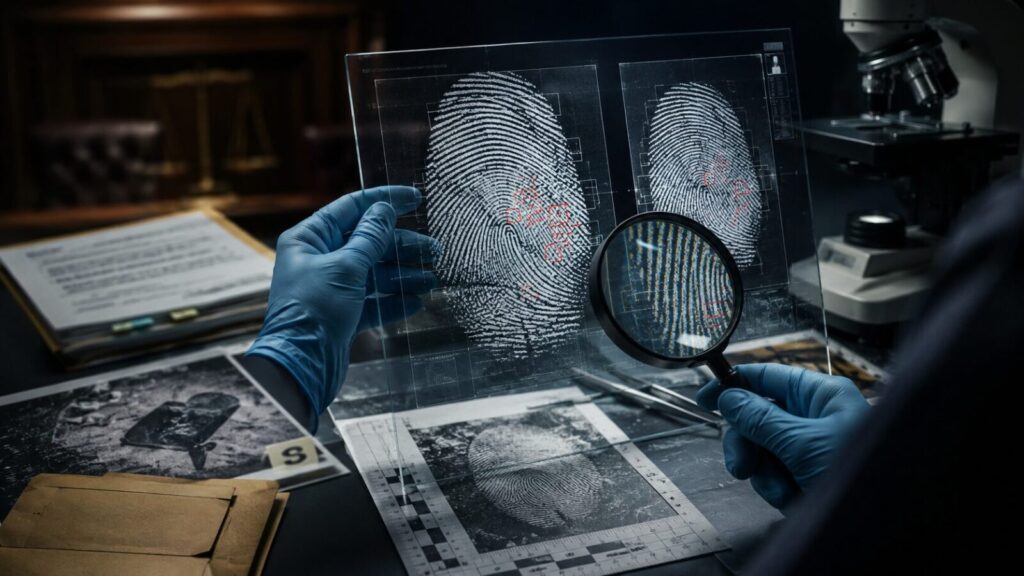
Here is the part that surprises most people. There is no computer that looks at two prints and announces “match.” A latent print, the smudged partial mark lifted from a crime scene, is compared to a known print by a human examiner, using a method called ACE-V: Analysis, Comparison, Evaluation, and Verification. The examiner studies the ridges, looks for features that correspond, and then forms a judgment that there are “enough” similarities to call it an identification.
The trouble is in the word “enough.” In the United States there is no fixed, objective number of matching points required to declare an identification, and no statistical model behind the examiner’s ultimate call. It is a trained, experienced, good-faith opinion. But it is an opinion. And the “V” at the end, verification, is often done by a second examiner who already knows the first examiner reached an identification, which is not exactly an independent check.
So how often are examiners wrong? For a hundred-year-old technique, the honest answer is that we barely have the data. When PCAST reviewed the field in 2016, it found only two properly designed “black box” studies testing accuracy. The large FBI/Noblis study reported a false-positive rate around 0.1%, roughly one erroneous identification in a thousand, while a Miami-Dade study found closer to 3%. PCAST noted that, accounting for statistical uncertainty, the false-positive rate could run as high as 1 in 306 in the first study and 1 in 18 in the second. Reasonable people argue about which figure best reflects real casework, but every honest version of the number is a measurable, non-trivial error rate.
Now compare that to what jurors believe. When researchers asked, jurors estimated the error rate for fingerprint comparison at about one in 5.5 million. That gap, between a technique that errs somewhere in the range of one in a thousand or worse and a jury that hears “match” as one in millions, is the whole ballgame. Layer on the unproven assumptions the field rests on (that every fingerprint is truly unique and never changes) and the well-documented pull of confirmation bias, and you can see why a state supreme court finally said: prove it.
This Is Bigger Than Fingerprints
Fingerprints are not the outlier here. They are the most respected member of a whole family of “feature-comparison” disciplines that share the same DNA: bite marks, firearms and toolmarks, hair, and handwriting. Each rests on a trained examiner eyeballing two samples and declaring a match, and each drew pointed criticism in the 2009 NAS and 2016 PCAST reports for subjectivity, thin validation, and error rates juries are rarely told about. Regular readers of this series will recognize the theme from our pieces on DNA mixture software and courtroom algorithms: a confident veneer of certainty sitting on top of a much messier human (or machine) judgment. The New Jersey ruling is one more court pulling back that veneer.
How Texas Judges Forensic Evidence and Why It Cuts in the Defense’s Favor
In Texas our reliability gatekeeping runs through two Court of Criminal Appeals decisions: Kelly v. State, 824 S.W.2d 568 (Tex. Crim. App. 1992), for hard science, and Nenno v. State, 970 S.W.2d 549 (Tex. Crim. App. 1998), for experience-based fields. Kelly asks whether the underlying theory is valid, whether the technique applying it is valid, and whether it was properly applied in this case. Nenno asks whether the field is a legitimate one, whether the testimony is within its scope, and whether the expert properly relied on the field’s principles. Courts still debate where subjective pattern-matching like fingerprint comparison best fits, but under either test the destination is the same: reliability.
And here is what many people do not realize. For the defense, Texas law is in some ways friendlier than the federal standard the New Jersey court just adopted. Two features stand out. First, the reliability hearing in Texas is mandatory when properly requested, and the party offering the scientific evidence must prove its admissibility by clear and convincing evidence, a higher burden than the “more likely than not” standard used in federal court. As the Court of Criminal Appeals has put it, getting scientific evidence admitted is already harder in Texas than in the federal system.
Second, Texas has real oversight machinery that most states lack. The Texas Forensic Science Commission investigates forensic complaints and has itself examined latent-print casework and the very error-rate studies discussed above. Texas licenses forensic analysts, and Article 38.35 of the Code of Criminal Procedure ties the admissibility of forensic analysis to laboratory accreditation. Texas courts have also been explicit that a discipline is not grandfathered in simply because it has been admitted before. That is the same principle now driving the New Jersey hearing. Prior acceptance is not a substitute for present reliability.
What This Means If You’re Facing Forensic Evidence in Texas
None of this makes fingerprint evidence worthless, and none of it is a substitute for advice about a specific case. But it does reframe what a careful defense looks like when the State’s case leans on a “match.” The levers, in plain terms:
- Insist on the gatekeeper hearing. Make the State prove reliability under Kelly and Nenno before the jury hears the word “match,” by clear and convincing evidence, not by pointing to a century of habit.
- Expose the subjectivity. Get the examiner to explain, on the record, that ACE-V produces a judgment, that there is no fixed-point standard, and how the “identification” threshold was actually decided in this case.
- Put the error rates in front of the factfinder. The measured false-positive rates, and the fact that jurors wildly overestimate the technique’s certainty, are fair game and directly relevant to weight.
- Probe the verification. Was the second examiner blind to the first examiner’s conclusion, or not? Was documentation preserved so the comparison can be independently re-checked by a defense expert?
- Watch for bias in the workflow. What did the examiner know about the suspect before reaching a conclusion? Context can shape a subjective judgment more than anyone likes to admit.
The Bottom Line
A fingerprint “match” is a trained human being’s opinion that two marks share enough features to call them the same. That is a valuable opinion, often a correct one, but not the machine-certain fact that popular culture sells. The New Jersey Supreme Court’s decision in State v. Lee simply insists that courts test that opinion against the actual science instead of a century of assumption. Texas already gives defendants strong tools to demand exactly that: a mandatory hearing, a heightened burden on the State, and a forensic-oversight system built to ask hard questions. The lesson of the series holds here as everywhere. The label on forensic evidence is only as good as the method, the examiner, and the proof behind it, and you are entitled to see all three.
Deandra Grant is a ACS-CHAL Forensic Lawyer-Scientist who holds an M.S. in Pharmaceutical Science and a Graduate Certificate in Forensic Toxicology, and she has spent three decades challenging the science behind the State’s evidence. This post is part of the Deandra Grant Law forensic science series.
Further Reading
- Morgan Lewis, “NJ Supreme Court Issues Landmark Decision on Reliability of Fingerprint Evidence.” com
- PCAST (2016), “Forensic Science in Criminal Courts: Ensuring Scientific Validity of Feature-Comparison Methods.” archives.gov
- National Academy of Sciences (2009), “Strengthening Forensic Science in the United States.” gov
- NIJ, “The History and Legacy of the Latent Fingerprint Black Box Study.” ojp.gov
- Texas Forensic Science Commission. gov/fsc/
- UCLA Law Review, “The Reliable Application of Fingerprint Evidence.” org
- TDCAA, “Forensic Sciences Under Scrutiny” (Kelly/Nenno and no grandfathering). com
This post is an informational synthesis for educational purposes and is not legal advice. Case citations, including State v. Lee, A-6 Sept. Term 2025 (090662), 2026 WL 1857378 (N.J. June 29, 2026), should be independently verified against the official record before use in any filing.