
Home »


Do You Need Legal Help?

"Deandra Grant Law fights hard for their clients and is always willing to go above and beyond. They are the best firm for DWI cases in DFW and beyond. Definitely hire them to represent you in any pending cases."
- P. Williams
"Deandra Grant made a tough situation so much better. She listened to my concerns and helped me so much with my case. I would recommend her to anyone needing legal services."
- M. Haley
"Deandra Grant Law handled my case with diligence and professionalism. Deandra Grant's reputation is stellar and now I know why. She has a team of individuals who provide quality service."
- N. Coulter
As Seen On







Download Our Free Texas Criminal Guide
Learn what you should and shouldn't be doing to help your criminal defense case.
Dallas Theft Defense Attorneys
Theft charges in Dallas County are prosecuted by the Dallas County District Attorney’s Office and heard in the Criminal District Courts at the Frank Crowley Courts Building, 133 N. Riverfront Blvd, Dallas, TX 75207. The charge level and penalty range are determined almost entirely by the value of the property alleged to have been stolen. Texas significantly updated those value thresholds in 2016, raising them across the board. Many penalty descriptions published online still reflect the pre-2016 numbers, which are wrong.
Deandra Grant Law has defended theft charges in Dallas County for more than 30 years. The analysis in every theft case begins with the value evidence the prosecution will use to establish the charge level, the intent evidence on which the prosecution will rely, and the Article 38.23 question of whether the evidence was lawfully obtained.
Deandra Grant Law – Criminal & DWI Defense Helps Residents across Texas with Criminal Defense Matters – Including: Allen , Arlington, Belton, Cleburne, Collin County, Dallas, Denton, Fairview, Fort Worth, Frisco, Gainesville, Granbury, Hood County, Johnson County, Lewisville, Little Elm, McKinney, Park Cities, Parker County, Plano, Princeton, Richardson, Rockwall, Rowlett, Royse City, Southlake, Sunnyvale, The Colony, Waco, and Weatherford.
Texas Theft Penalty Structure — Current Law (Post-HB 1396, Effective January 1, 2016)
Texas Penal Code §31.03 defines theft and establishes the value-based penalty ladder. The following thresholds have been in effect since January 1, 2016:
- Less than $100: Class C misdemeanor — fine only, up to $500. No jail time.
- $100 to less than $750: Class B misdemeanor — up to 180 days in county jail, fine up to $2,000.
- $750 to less than $2,500: Class A misdemeanor — up to 1 year in county jail, fine up to $4,000.
- $2,500 to less than $30,000: State jail felony — 180 days to 2 years in state jail, fine up to $10,000.
- $30,000 to less than $150,000: Third-degree felony — 2 to 10 years in TDCJ, fine up to $10,000.
- $150,000 to less than $300,000: Second-degree felony — 2 to 20 years in TDCJ, fine up to $10,000.
- $300,000 or more: First-degree felony — 5 to 99 years or life in TDCJ, fine up to $10,000.
Enhancements that can elevate the charge level regardless of value: Theft from a person 65 years of age or older is enhanced one penalty level. Theft by a public servant from assets under their custody or possession is also enhanced. Prior theft convictions can be aggregated with the current charge to reach a higher value threshold.
Defense Strategies in Dallas County Theft Cases
The Intent Element
Theft requires proof that the defendant intended to deprive the owner of the property. Mistake (ex. genuinely forgetting to pay, accidentally walking out with merchandise, or misunderstanding the terms of a transaction) negates the intent element. A defendant who had a good-faith belief that they had a right to the property may have a claim of right defense. These are legitimate legal arguments, not admissions of wrongdoing.
The Value Evidence
The prosecution must prove the value of the property meets the threshold for the charged offense beyond a reasonable doubt. “Value” under Texas law is the fair market value at the time and place of the offense and not necessarily the retail price. For damaged or used goods, the replacement value may be lower than what the prosecution claims. The value calculation is a factual issue subject to challenge.
Consent and Authorization
Appropriation is not unlawful if the owner consented or if the defendant reasonably believed the owner consented. In employee theft cases involving ambiguous authorization, the consent defense is frequently raised.
Article 38.23 — Suppression of Unlawfully Obtained Evidence
Texas’s exclusionary rule carries no good faith exception. In theft cases involving warrantless searches of vehicles, bags, or persons, evidence obtained through an unlawful search is suppressible. Without the physical evidence of the allegedly stolen property, the prosecution frequently cannot prove its case.
Digital Evidence Challenges
Dallas County theft cases increasingly involve digital evidence: surveillance footage, transaction records, access logs, and communications. The authenticity, completeness, and chain of custody of digital evidence are all subject to challenge. Surveillance footage that has been compressed, excerpted, or provided without full context may present a misleading picture of the defendant’s conduct. Douglas Huff’s digital forensics training covers authentication, chain of custody, and technical evaluation of this evidence at the data level.
Related Blogs
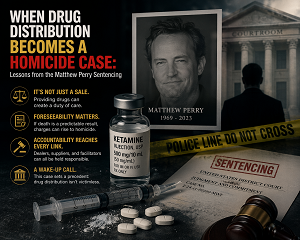
When Drug Distribution Becomes a Homicide Case: Lessons from the Matthew Perry Sentencing
On April 8, 2026, U.S. District Judge Sherilyn Peace Garnett sentenced Jasveen Sangha (the Los [...]

Criminal Justice Reform in 2026: What It Means for Texas Defendants
National headlines about criminal justice reform in 2026 tell a story of accelerating bipartisan progress [...]

How Do Police Track Your Online Activity And Can That Evidence Be Challenged?
Law enforcement agencies have increasingly sophisticated tools for monitoring and documenting internet activity. They can [...]

What to Do if You’re Falsely Accused of Sexual Assault in Texas
Few things are more terrifying than being accused of something you did not do and [...]

How Killing a Cop Went from Murder to Manslaughter
A New York jury recently acquitted Guy Rivera of first-degree murder in the 2024 shooting [...]

When Restraining a Student Becomes a Criminal Charge: What Texas Teachers Need to Know About Injury to a Child
A veteran teacher with twenty-something years in the classroom, no disciplinary history, no prior criminal [...]

When Protest Becomes Terrorism: What the Prairieland Verdict Means for Texas Defendants
On March 13, 2026, a federal jury in Fort Worth returned guilty verdicts against nine [...]
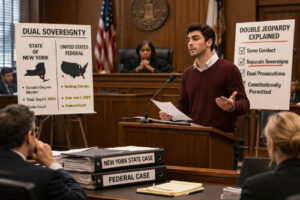
Why Being Charged Twice Isn’t Double Jeopardy: Luigi Mangione and Parallel State and Federal Prosecutions
At a February 2026 hearing, Luigi Mangione stood up in a Manhattan courtroom and told [...]
Deferred Adjudication: Available for Theft
Deferred adjudication community supervision is available for most theft offenses. A defendant who successfully completes the conditions of deferred adjudication (typically a supervision period, fines, and restitution) receives a dismissal rather than a final conviction. The charge then becomes eligible for non-disclosure (sealing) in most circumstances. For first-time defendants, deferred adjudication is often the most important tool in minimizing the long-term consequences of a theft charge.
Why Deandra Grant Law for Dallas Theft Defense
- 30+ years in Dallas County courts. 500+ trials to verdict. The Frank Crowley Courts Building and the Dallas County DA’s office are familiar ground.
- Article 38.23 — no good faith exception. Every theft case begins with the lawfulness of the search or seizure that produced the evidence.
- Digital forensics training — Douglas Huff. Surveillance footage, digital transaction records, and access logs evaluated at the technical level.
- 17 published law books. Including A First Offender’s Guide to Texas Criminal Courts
- Texas Super Lawyer since 2011. AV® Preeminent rated by Martindale-Hubbell®.
If you are facing theft charges in Dallas County, call (214) 225-7117 for a free, confidential consultation. Or schedule online at texasdwisite.com.
Frequently Asked Questions About Theft Charges in Dallas, TX
If you have been recently arrested for theft in Dallas, TX, you likely have many questions about your situation and what to expect. At Deandra Grant Law – Criminal & DWI Defense, we understand the concerns you may have, and we are here to provide answers and guidance. Below are some frequently asked questions about theft charges, along with answers from our experienced Dallas Theft Defense Attorneys:
What should I do if I've been arrested for theft?
If you’ve been arrested for theft, the first and most crucial step is to remain calm and exercise your right to remain silent. Avoid making any statements to the police until you have legal representation. Contact an experienced Theft Defense Attorney at Deandra Grant Law – Criminal & DWI Defense as soon as possible to discuss your case and protect your rights.
What are the potential consequences of a theft conviction in Dallas, TX?
The penalties for theft convictions can vary depending on the value of the stolen property and other factors. In Dallas, TX, theft charges can range from a Class C misdemeanor for low-value thefts to a felony for more serious offenses. Convictions may result in fines, probation, restitution, community service, and even jail or prison time.
Can I be charged with theft if it was a misunderstanding?
Yes, misunderstandings and mistakes can lead to theft charges. In some cases, individuals may unintentionally take property they believe belongs to them or mistakenly forget to pay for items. An experienced Theft Defense Attorney can help investigate the circumstances surrounding your arrest and present evidence to support your innocence.
Will I have a criminal record if I am convicted of theft?
Yes, a theft conviction will result in a criminal record, which can have long-lasting consequences on your personal and professional life. A criminal record can affect employment opportunities, housing applications, and other aspects of your future.
How can a Theft Defense Attorney help me with my case?
A skilled Theft Defense Attorney can provide valuable legal representation throughout the legal process. They can review the evidence against you, build a strong defense strategy, negotiate with prosecutors, and represent you in court. Their goal is to seek a positive outcome for your case, whether through reduced charges, alternative sentencing options, or a complete dismissal.
What should I do if I believe I am wrongly accused of theft?
If you believe you are wrongly accused of theft, it is essential to gather any evidence that supports your innocence and consult with a Theft Defense Attorney immediately. They can investigate the details of your case, interview witnesses, and present a compelling defense on your behalf.
Client Reviews

“Deandra Grant Law – Criminal & DWI Defense handled my case with diligence and professionalism. Deandra Grant’s reputation is stellar and now I know why. She has a team of individuals who provide quality service.”
N. Coulter


(214) 225-7117
Experienced DWI Defense